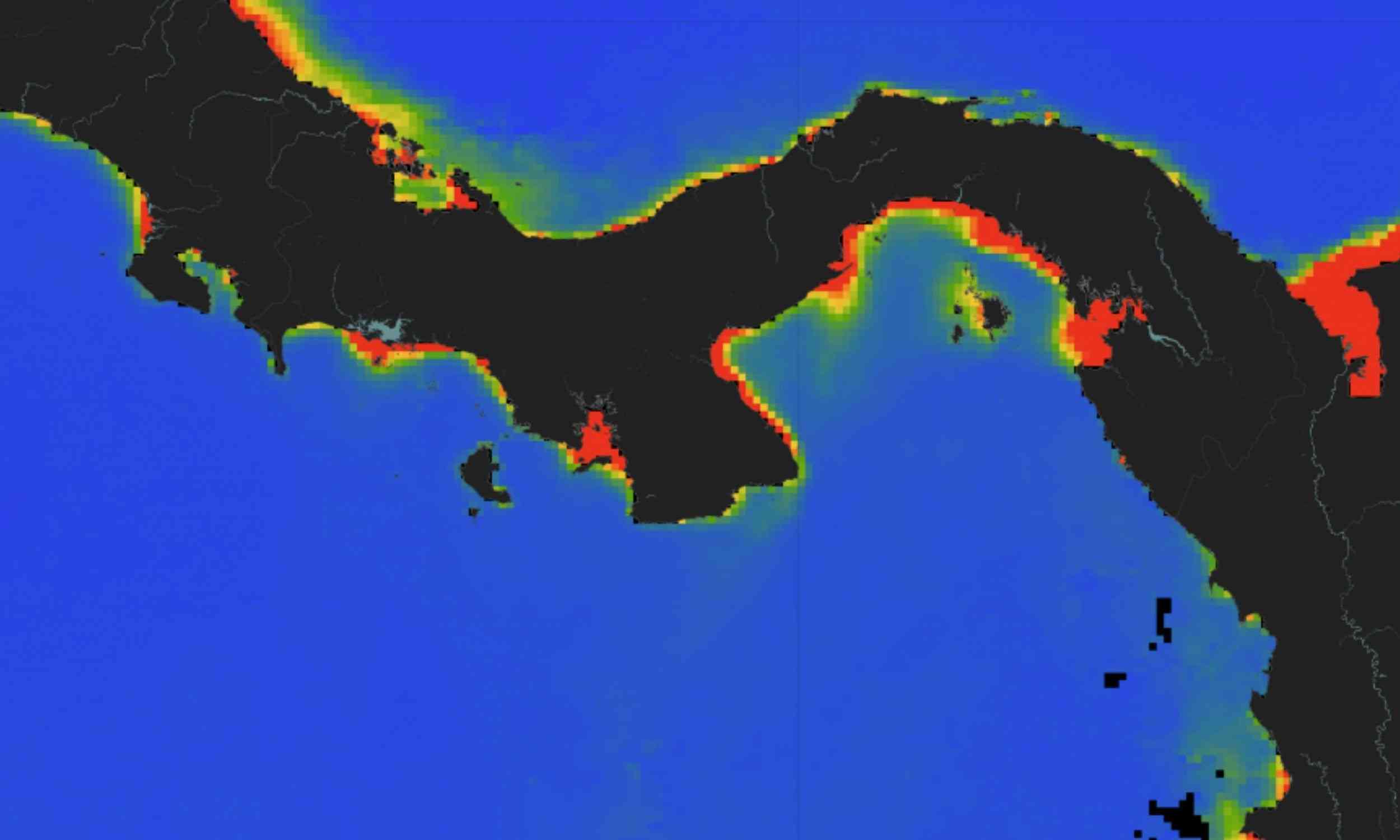
The Gulf of Panama’s seasonal oceanic “breath” failed to appear in 2025 for the first time in over four decades, breaking a vital natural cycle that cools coastal waters and fuels marine life along Panama’s Pacific coast.
Researchers led by Aaron O’Dea at the Smithsonian Tropical Research Institute (STRI) documented this unprecedented disruption to a long-standing “upwelling” pattern, where deep, cold, nutrient-rich water usually rises annually to cool waters and support marine food webs during the dry season.
What Just Happened?
Normally by January 20 each year, strong northerly winds push warm surface water offshore, allowing colder and nutrient-rich water to surge upward. In 2025, that critical cooling surge did not arrive until March 4, a delay of more than six weeks. Plus, the cooler water lasted only around 12 days—far shorter than the typical two-month span—and never reached the usual temperatures associated with the cycle.
The result was a layering of warm water rather than the typical upwelling of cold water. Scientists confirmed this through water column temperature profiles collected via the S/Y Eugen Seibold, a research sailing vessel that monitors ocean conditions.
Why It Matters Now
Fisheries, coral reefs, and coastal communities in Panama now face immediate ecological and economic risks. Upwelling supports phytoplankton blooms that fuel the entire marine food chain, from tiny plankton to commercial fish. This seasonal boost also tempers heat stress on coral reefs, which rely on this annual cooling to survive extreme warm conditions often intensified by El Niño events.
Without the 2025 upwelling, reefs endured prolonged warmer water and greater thermal stress. Although a single disrupted season won’t destroy reefs, repeated failures could accelerate coral bleaching and jeopardize livelihoods dependent on fishing.
What Caused the Failure?
While individual gusts of wind remained near normal, their frequency dropped by an astounding 74% throughout the dry season, and lulls between breezes lasted longer, reducing the cumulative push that drives upwelling. This key change in wind patterns likely underpins the failure to bring deep water to the surface.
This upwelling failure occurred despite a weak La Niña event—the region previously withstood stronger Pacific oscillations without such disruption—highlighting the potential for new, region-specific factors affecting ocean dynamics.
Broader Implications and Next Steps
The Gulf of Panama is one of many tropical upwelling zones that remain poorly monitored, making this data-rich observation from the STRI—including satellite and temperature records dating back to 1985 and 1995—a rare and vital alert for scientists. It raises urgent questions: is this a one-time disturbance or the early sign of a lasting shift?
STRI scientists are now tracking the 2026 upwelling season closely, with early reports showing a return of strong cooling—but vigilance remains crucial. Coastal fishing communities cannot afford to rely on historical patterns when key seasonal conditions might disappear.
“Panama’s 2025 upwelling failure underscores that regional-scale dynamics, rather than blanket global predictions, are essential for understanding these tropical upwelling systems,” said Aaron O’Dea.
Local and Global Significance
Marine ecosystems worldwide depend on predictable upwelling cycles for nutrients and temperature regulation. Changes like the Gulf of Panama’s failure have ripple effects on biodiversity, fisheries yields, and food security. For the United States and Montana readers interested in climate impacts on natural systems and communities, this event highlights how subtle shifts in regional ocean winds can trigger rapid, unexpected ecological changes.
This discovery, published in the Proceedings of the National Academy of Sciences, is both a warning and an urgent call for increased monitoring and forecasting of coastal ocean dynamics amid a changing climate.
Stay tuned to Montana Insider for ongoing updates on this developing story and how global ocean patterns might affect fisheries and ecosystems closer to home.