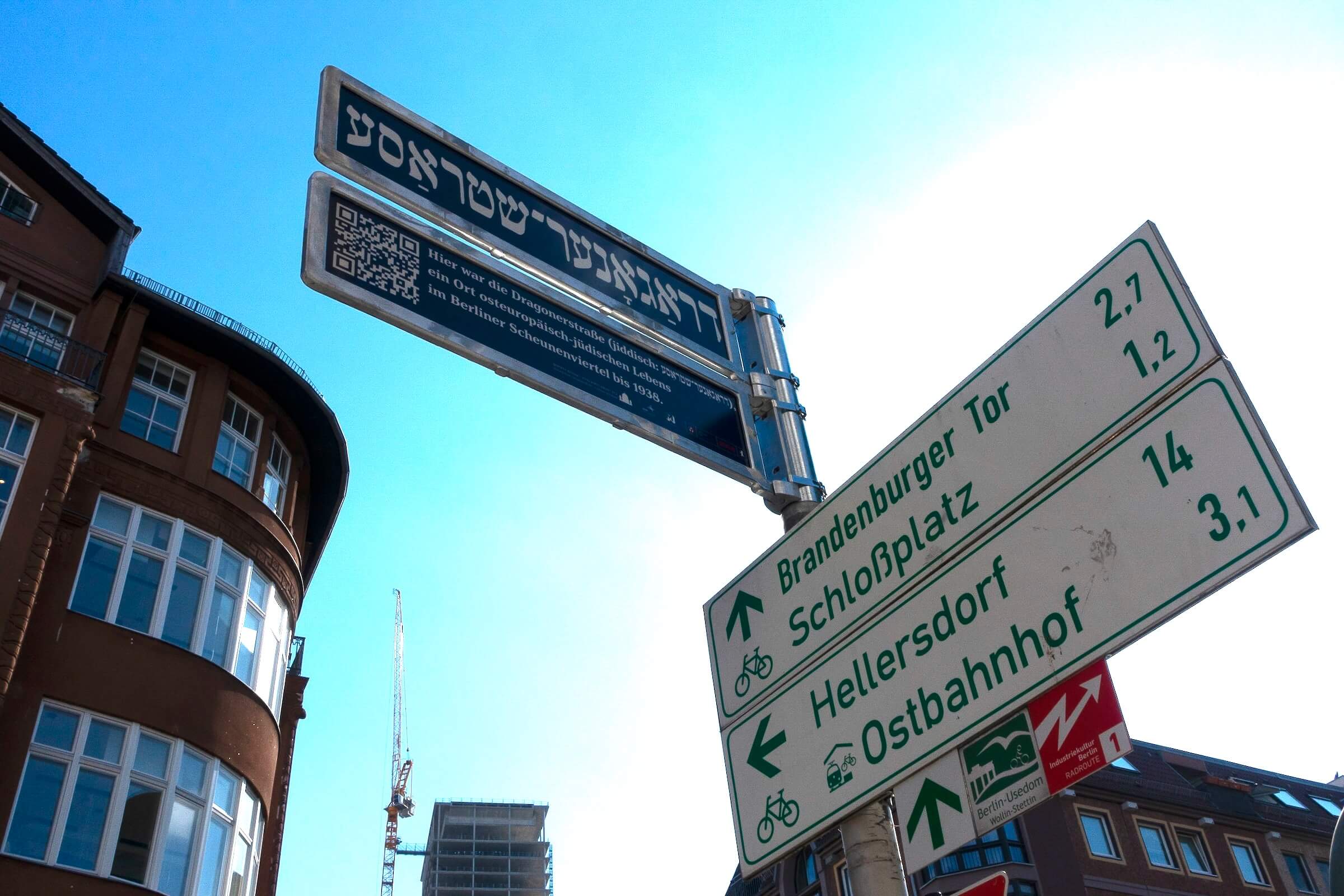
Berlin just took a bold step in reclaiming its Jewish cultural legacy as new official Yiddish street signs were unveiled March 11 in the city’s historic Jewish quarter. The project, years in the making, is igniting urgent debate over whether Yiddish should gain official minority language status in Germany.
The story began in spring 2021 when artist Sebestyén Fiumei secretly mounted an unauthorized street sign in central Berlin’s former Grenadierstrasse, inscribed with its historic name in Yiddish. Until 1938, this street was the heart of Berlin’s Yiddish-speaking Jewish community—predominantly Eastern European immigrants who carried their language across borders.
Fiumei’s act was a defiant reclaiming of a language left nearly erased by the Holocaust, which wiped out 85% of Yiddish speakers. Though the original rogue sign was confiscated almost immediately, it caught the attention of Jewish district official Nathan Friedenberg and historian Jess Earle, who pushed for 10 sanctioned Yiddish street signs to memorialize the city’s working-class Jewish heritage.
However, bureaucratic hurdles almost derailed the initiative. Yiddish is not officially recognized as one of Germany’s minority languages, severely limiting its public use. Authorities even restricted the sign’s design, banning art elements and favoring neutral presentations. Yet, persistence paid off. The new sign unveiled this March includes Fiumei’s authentic Yiddish spelling, paired with explanatory plaques in German and English plus QR codes leading to a local history website titled “Without a trace?”
The moment drew a crowd of around 30 attendees including active Yiddish professionals, though no Yiddish was spoken during the ceremony—highlighting the language’s fragile status. “Yiddish isn’t the focus. It’s only mentioned when completely necessary,” Earle said bluntly.
The unveiling is more than symbolic. It highlights a larger movement to revive Yiddish culture in Berlin. Sasha Lurje, a Latvian-born Yiddish singer now based in Berlin’s Neukölln district, leads a vibrant community that has launched a Yiddish music festival and regular cultural events. These efforts illustrate that Yiddish remains alive in immigrant neighborhoods, embodying a living link to the past.
Comparisons to Germany’s officially protected Sorbian minority languages underscore Yiddish’s marginalization. In Lusatia, just east of Berlin, bilingual signs in Lower and Upper Sorbian are mandated by law, supported by government funding, schools, museums, and language programs—all striving to boost speaker numbers amid centuries of suppression.
Activists like Sorbian language advocate Měto Nowak question why Yiddish lacks similar protections, despite its deep roots in German Ashkenazi culture and presence in eight other European countries as a recognized minority language. Nowak has called for renewed advocacy, fueling a revived campaign by Fiumei and former collaborator Eliana Jacobs to make Yiddish Germany’s eighth official minority language.
“Let’s relaunch the campaign!” Jacobs told Montana Insider. Lurje sees official recognition as realistic and urgently needed to make Yiddish visible and vibrant again on public streets and in daily life.
For Montana readers and US audiences, this struggle parallels ongoing efforts to preserve endangered languages and cultural identities nationwide, from Native American languages to immigrant tongues. The Berlin case makes clear that language preservation isn’t just historic remembrance—it’s a frontline issue for cultural survival and social inclusion.
As the new Yiddish signs stand proudly on Berlin’s streets, they represent both a tribute to countless lives lost and a rallying cry for future generations. Without official status, Yiddish remains vulnerable—but with renewed activism and growing community support, this centuries-old language could soon claim its rightful place in Germany’s cultural landscape.
Stay tuned as this story unfolds and Montana Insider follows the campaign to reshape minority language policy in Europe and beyond.