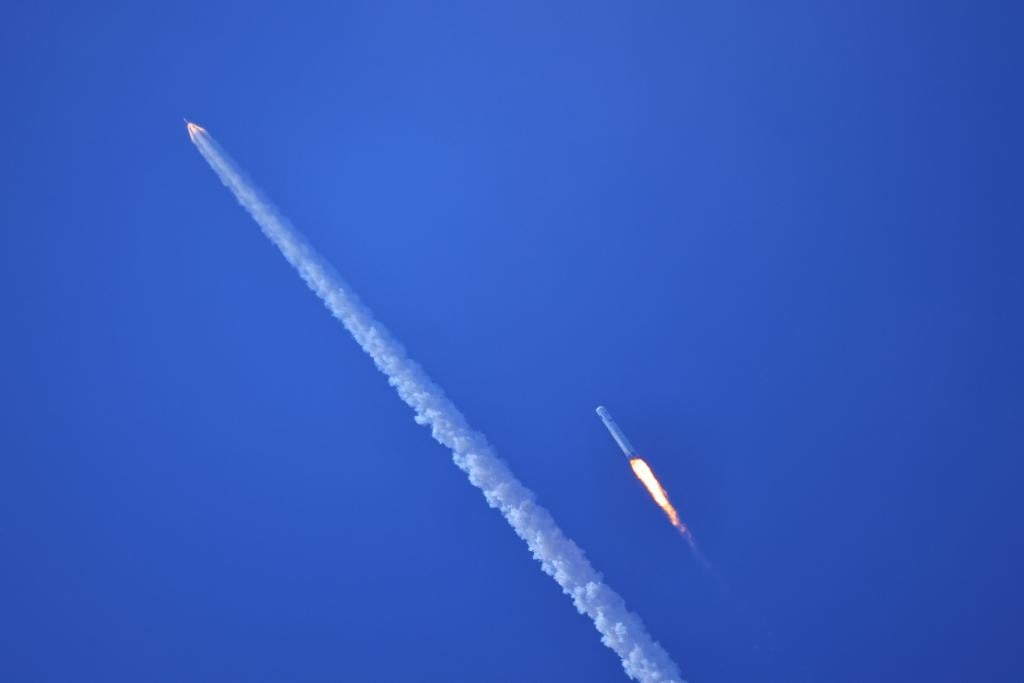
China has made significant strides in its space ambitions with the successful testing of its Long March-10 rocket and the Mengzhou crew capsule. This milestone, achieved on February 11, 2026, at the Wenchang Spacecraft Launch Site in Hainan Province, is a critical step towards China’s goal of landing astronauts on the Moon by 2030. The test combined two key components: a low-altitude demonstration of the Long March-10 rocket and an in-flight abort test of the Mengzhou spacecraft.
The Long March-10 rocket’s first ignition flight involved navigating through maximum dynamic pressure, or Max Q, a crucial phase where aerodynamic stress peaks as the vehicle ascends from the lower to the upper atmosphere. During this phase, the rocket’s performance is rigorously tested, and it successfully completed this challenge. The Mengzhou capsule, which translates to “Dream Vessel,” is designed to carry up to seven taikonauts and demonstrated its safety systems during the abort test, successfully separating from the rocket in a simulated emergency.
Ji Qiming, spokesperson for the China Manned Spaceflight Agency (CMSA), emphasized the importance of this test, stating that the Long March-10 is a next-generation partially reusable launch system designed specifically for crewed lunar missions. The rocket is available in two configurations: one with three stages and two strap-on boosters, and another, designated 10A, featuring two stages without boosters. Both configurations utilize seven liquid oxygen and kerosene engines.
The flight test showcased several key moments, including the rocket’s glide phase after the Mengzhou spacecraft separation. The rocket continued its ascent until reaching its designated altitude and speed, at which point its engines were deactivated. It then transitioned into a glide phase, adjusting its orientation multiple times. At approximately 110 kilometers (68 miles) altitude, the rocket deployed its grid fins in preparation for landing.
Following the glide phase, two engines were reignited for powered deceleration, transitioning into an aerodynamic phase that relied solely on the grid fins. During the final landing phase, three engines were reignited as the rocket maneuvered towards its designated landing site. In a controlled descent, the rocket splashed down in the ocean, where recovery teams were able to retrieve it successfully.
Zhu Pingping of the China Aerospace Science and Technology Corporation (CASC) highlighted that this test brings China closer to its lunar ambitions while also paving the way for future deep space missions, including potential expeditions to Mars.
This achievement is part of China’s broader strategy to establish a prominent position in space exploration. Alongside their lunar ambitions, the country is expanding its Tiangong space station and planning various robotic missions to explore a Near Earth Asteroid and a Main Belt comet, as well as initiatives like the Mars Sample Return missions (Tianwen-2 and Tianwen-3).
As China’s space program continues to advance, the successful testing of the Long March-10 and Mengzhou spacecraft reflects its commitment to becoming a leader in space exploration, positioning itself as a significant competitor to other global space agencies.