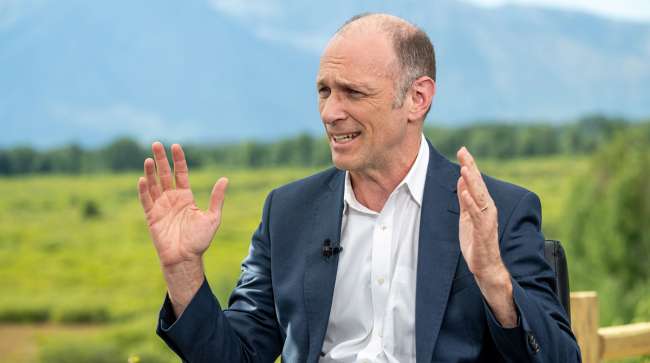
The recent decision by the Supreme Court to invalidate many of former President Donald Trump‘s global tariffs has generated a wave of uncertainty for businesses, according to Austan Goolsbee, President of the Federal Reserve Bank of Chicago. Speaking to reporters on February 23, 2024, Goolsbee highlighted the potential impacts on inflation and hiring dynamics.
“The more unpredictability you have, the more question marks that businesses have about policy,” Goolsbee explained. He noted that this uncertainty could exacerbate the current trend of low hiring and low firing among companies, further complicating the economic landscape. Despite the challenges, he suggested that the ruling might offer some relief in terms of inflation, stating, “That said, it could bring relief to the inflation side.”
The Supreme Court’s ruling has prompted the Biden administration to explore new legal avenues to reimpose tariffs after determining that Trump’s tariffs could not be justified under a 1977 emergency law. Goolsbee, in remarks prepared for a speech at the National Association for Business Economics conference on February 24, emphasized the need to see tangible evidence of inflation cooling before the Federal Reserve considers further interest rate cuts.
“I remain optimistic that there can be more rate cuts this year,” he said. “But that hinges on seeing actual progress on inflation that shows we are on a path back to 2%.”
The Federal Reserve has already cut rates three times in the latter part of 2025, following a significant reduction of one full percentage point in 2024. Rates were held steady in January 2024, and analysts expect a similar decision in March 2024. Economists do not anticipate another quarter-point cut until at least June of this year, with expectations set for only two cuts throughout 2024.
Goolsbee clarified that the Federal Reserve’s decision-making regarding interest rates will not rely solely on the duration of price reductions. Instead, it will depend on multiple economic indicators aligning with the Fed’s inflation target. He mentioned that current interest rates are unlikely to effectively slow demand if inflation remains around 3%.
In a recent report released on February 20, 2024, underlying prices showed an unexpected rise of 3% year-over-year through December, highlighting ongoing inflationary pressures. Goolsbee described the labor market and overall economic growth as “pretty steady” in a subsequent interview with Bloomberg Television.
When asked about the future of Jerome Powell, the current chair of the Federal Reserve, Goolsbee expressed his respect for Powell, stating he would appreciate his continued presence at the Fed as his term ends in May. He also acknowledged Kevin Warsh, whom Trump has suggested as a potential successor for the chair position, as a strong candidate.
As businesses navigate the implications of the Supreme Court’s ruling, Goolsbee’s comments reflect a cautious approach to monetary policy amid fluctuating economic conditions. The interplay between tariff uncertainty and inflation management will remain critical as the Federal Reserve adapts to evolving market dynamics.