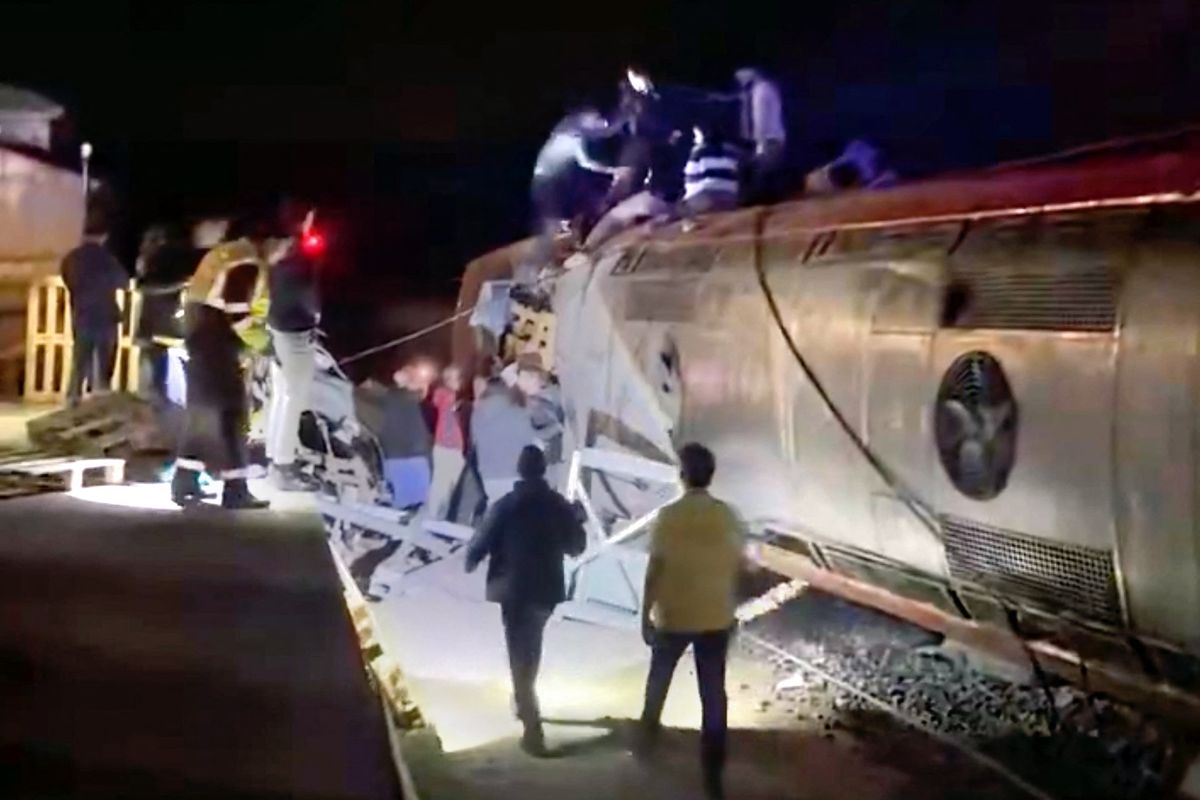
At least 39 people lost their lives in a catastrophic train collision in southern Spain, with rescue operations ongoing. The incident occurred at approximately 19:45 on Sunday, March 24, 2024, near Cordoba. Two high-speed trains collided when the rear of a Malaga-to-Madrid service derailed, crashing into an oncoming train traveling from Madrid to Huelva.
The collision resulted in extensive injuries, with reports indicating that 75 passengers were transported to hospitals, including 15 in serious condition. Most of the injured received treatment at facilities in Cordoba, around 390 kilometres south of the capital. The Spanish Red Cross established a support centre in the nearby town of Adamuz to assist emergency responders and family members searching for information about their loved ones.
Rescue teams, including members of Spain’s civil guard and civil defence, worked tirelessly throughout the night. Eyewitness accounts describe chaotic scenes, as passengers broke windows to escape the wreckage. Salvador Jiménez, a journalist for RTVE who was aboard one of the trains, recounted the moment of impact, stating there was a sensation akin to an earthquake as the train derailed.
The cause of the crash remains uncertain, according to Óscar Puente, Spain’s Transport Minister. He described the incident as “truly strange,” noting that it happened on a flat section of track that had been renovated just months prior. The train involved in the derailment was under four years old and operated by the private company Iryo. The second train, which bore the brunt of the collision, was operated by the public rail service Renfe.
Puente explained that the rear section of the Iryo train derailed and collided with the front of the Renfe service, causing the first two carriages to be knocked off the track and down a slope of approximately four metres (around 13 feet). He confirmed that the most severe damage occurred at the front of the Renfe train. Regarding the investigation, Puente indicated that it could take up to a month to determine the exact circumstances that led to the crash.
Train services between Madrid and various cities in Andalusia were suspended on Monday as authorities began assessing the damage and launching an investigation. Spain boasts the largest high-speed rail network in Europe, catering to trains that travel over 250 kilometres per hour (approximately 155 mph). The network comprises more than 3,100 kilometres (around 1,900 miles) of track and is regarded as both affordable and safe. In 2024 alone, over 25 million passengers utilized Renfe’s high-speed services.
This incident marks the deadliest train crash in Spain this century. The previous tragedy occurred in 2013, when a train derailment in the northwest claimed the lives of 80 people. An investigation into that incident revealed that the train was travelling at 179 kilometres per hour (around 111 mph) on a track with a speed limit of 80 kilometres per hour (approximately 50 mph).
As the nation mourns the loss of life from this latest tragedy, questions surrounding safety measures and operational protocols will likely come to the forefront in the coming weeks. Authorities emphasize the importance of a thorough investigation to prevent future occurrences.