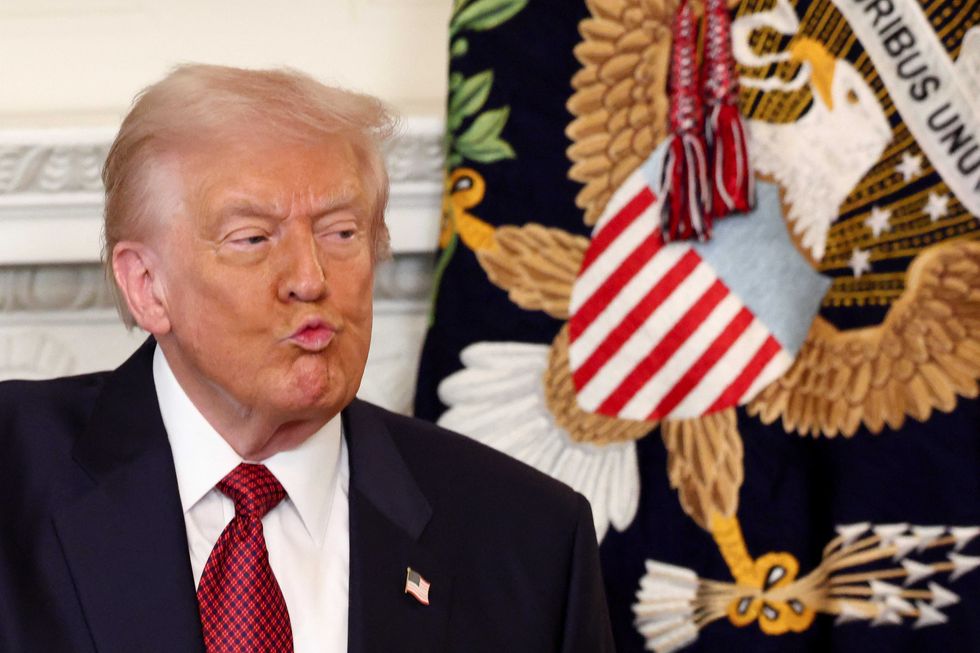
URGENT UPDATE: Political commentator Sabrina Haake warns that Donald Trump’s provocative remarks about Greenland are causing chaos in global politics, particularly empowering Vladimir Putin and threatening NATO unity. In a recent post on her Substack, Haake claims that Trump’s aggressive stance is a dangerous precedent that puts international stability at risk.
Haake stresses that Trump’s threats against Greenland, a semi-autonomous territory of Denmark, are not just isolated comments but rather a signal that could embolden hostile nations. She notes, “Russia is hyperventilating with excitement,” highlighting that Sergey Lavrov, Russia’s Foreign Minister, has described Trump’s actions as fundamentally altering the “rule-based global order” that has long been a cornerstone of Western diplomacy.
In her analysis, Haake points to a disturbing connection between Trump’s rhetoric and the ongoing crisis in Ukraine. She asserts, “Putin knows that Trump’s threats against Greenland have permanently debunked the West’s criticism of Russia’s aggression.” This statement reflects an alarming shift that could have immediate consequences for both Greenland and Ukraine, with potential fallout affecting global peace.
Lavrov remarked that the notion of one NATO member attacking another was once unimaginable, but Trump’s comments have created a climate where such threats are now conceivable. “It was hard to imagine before that such a thing could happen,” he stated, emphasizing the unprecedented danger posed by Trump’s administration.
The implications extend far beyond Greenland. Haake warns that Trump’s behavior jeopardizes decades of alliance-building within NATO, potentially undermining European security. “By threatening Greenland, Trump is issuing a direct threat against Europe and NATO,” she writes, highlighting the historical context of alliances formed to combat fascism in World War II.
Haake’s insights come at a critical moment, as discussions about NATO’s future and its role in global security are more vital than ever. The political ramifications of Trump’s comments could reshape the landscape of international relations, inviting rogue actors to challenge established norms.
This situation is developing rapidly, and experts are urging world leaders to respond decisively to prevent further escalation. The urgency of this matter cannot be overstated; as tensions rise, the safety of nations relies on a unified and strong stance from NATO allies.
As reactions unfold, observers are keenly watching how this crisis evolves. The next steps taken by world leaders could either mitigate the risks or exacerbate the tensions initiated by Trump’s statements. The international community must act swiftly to reaffirm their commitment to sovereignty and cooperative security, or face a reality shaped by instability and aggression.