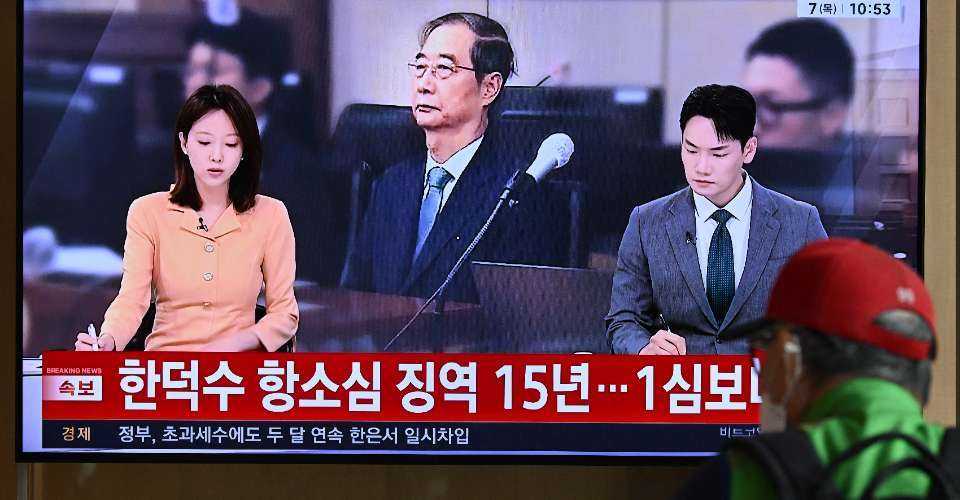
A South Korean appeals court sharply reduced the prison sentence of former Prime Minister Han Duck-soo to 15 years, cutting eight years from his original 23-year term for his role in supporting the brief martial law declaration under former President Yoon Suk Yeol.
The ruling, handed down by the Seoul Appeals Court on May 7, confirms Han’s guilt but lessens his punishment after weighing his long career in public service. The court acknowledged Han’s more than 50 years as a government official and found limited evidence that he actively conspired or systematically led the insurrection linked to martial law.
Martial Law Rocks South Korea and Triggers Trial
In December 2024, Yoon’s martial law order temporarily suspended civilian rule, triggering nationwide chaos that lasted barely six hours before opposition lawmakers swiftly voted to nullify it. Han, 76, was convicted for aiding and abetting this unconstitutional action, which briefly overturned democratic governance.
Despite the reduced sentence, the judge condemned Han for abandoning his official duties during a crucial moment. The court noted Han’s history witnessing unlawful martial law under South Korea’s authoritarian era and criticized him for failing to oppose Yoon’s decrees.
“He had experienced unconstitutional and unlawful martial law measures and insurrectionary situations himself, and was therefore well aware of the extensive damage and chaos such events could cause,” the presiding judge said.
Han’s Role and Reactions
During the short-lived martial law period, Han convened and ran a cabinet meeting to rescind the decree after the parliamentary motion passed. His compliance was a key factor in his conviction. Observers at the Seoul court saw Han listen calmly, wearing a white shirt and dark suit, showing little visible emotion.
The court highlighted that while Han’s involvement was passive rather than conspiratorial, he still sided with the insurrectionists instead of defending democratic processes.
Wider Legal Fallout for Yoon’s Circle
This verdict concludes the appeals cycle for several officials linked to Yoon’s dramatic crackdown. Just last week, Yoon himself saw his sentence for obstructing justice increased from five to seven years. Yoon is already serving a life sentence for leading the insurrection.
Additionally, Yoon’s wife, former First Lady Kim Keon Hee, recently had her corruption sentence raised from 20 months to four years after an appeals court overturned a prior acquittal on bribery and stock manipulation charges unrelated to martial law.
Why It Matters to US Audiences
Though unfolding thousands of miles from Montana, these developments highlight global challenges to democratic governance and the consequences leaders face for undermining rule of law—topics resonant with US readers amid ongoing domestic debates over executive power and civil rights.
Han Duck-soo’s reduced sentence signals judicial recognition of service history but affirms harsh penalties for collusion in democratic breakdowns, emphasizing accountability even for senior statesmen.
What’s Next
Han remains imprisoned following the original verdict. Further appeals are not expected, marking the end of legal proceedings tied to South Korea’s most unstable political crisis in recent years. International observers will watch how this high-profile reckoning shapes South Korea’s future political stability and rule of law.