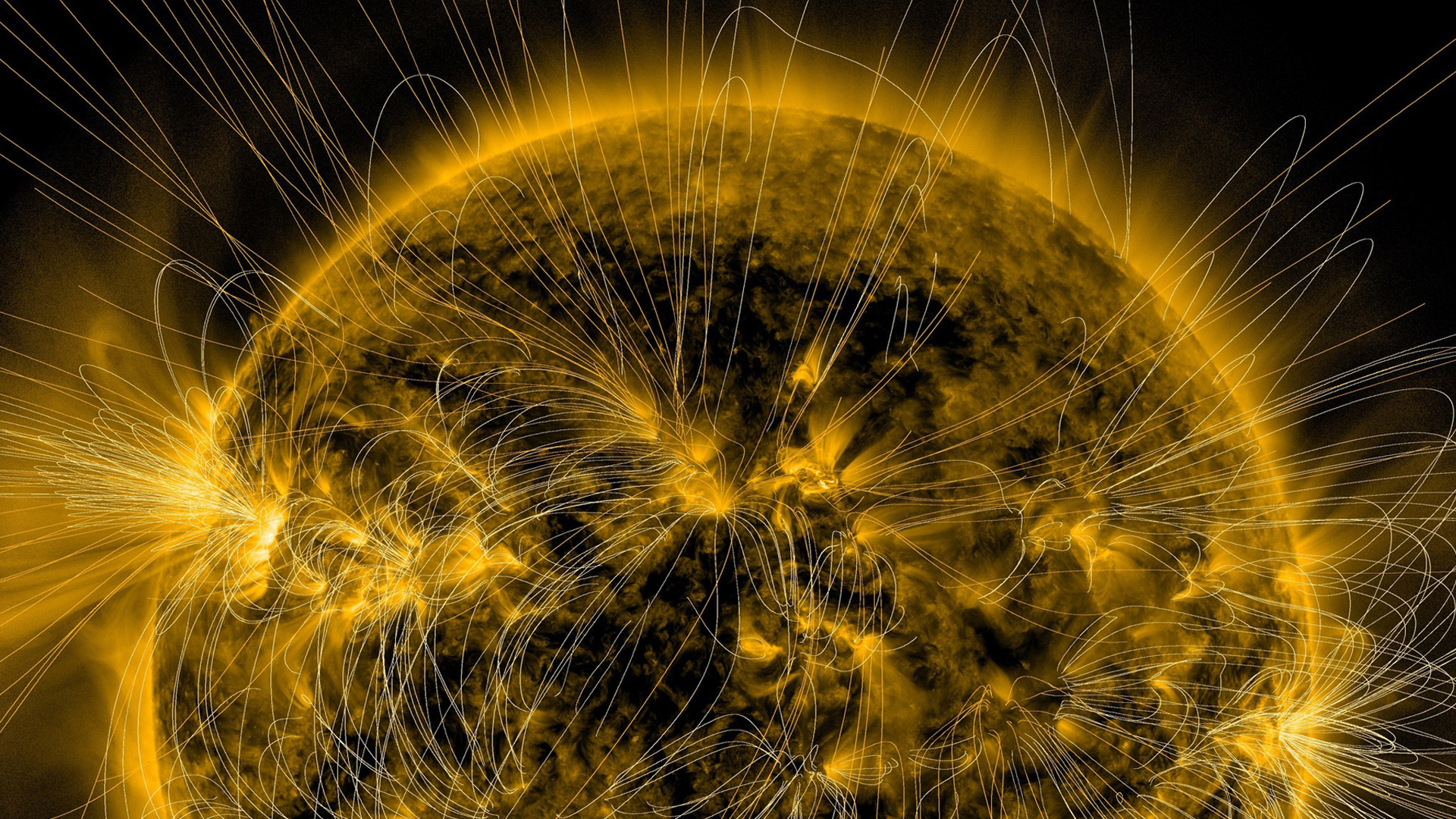
Researchers have successfully mapped the sun’s hidden magnetic interior for the first time, utilizing nearly 30 years of satellite data. This significant advancement in solar science reveals how solar magnetism evolves beneath the sun’s visible surface, providing insights into the forces driving solar activity such as sunspots and solar flares.
Understanding Solar Magnetism
The sun exhibits periodic changes that can disrupt satellite operations and power grids on Earth. These fluctuations are fundamentally driven by magnetic forces generated deep within the sun, a process known as the solar dynamo. Until this recent study, the inner workings of this magnetic field remained largely speculative, as no instruments could directly measure the magnetic fields located below the sun’s surface.
In this groundbreaking study, researchers shifted their approach from traditional modeling methods to a data-driven technique. They gathered daily magnetic field maps from the Solar Dynamics Observatory, covering the period from 1996 to 2025. By analyzing these maps, which depict the appearance and evolution of magnetic fields on the sun’s surface, they created a detailed three-dimensional computer model to simulate the sun’s internal magnetic activity.
A Breakthrough in Solar Predictions
The researchers’ model continuously adjusted itself based on new surface data, allowing them to infer the magnetic structures hidden beneath the sun’s surface. This innovative method enabled them to identify the underlying flows that could generate the observed surface patterns.
To validate their model, scientists tasked it with reconstructing past solar cycles, which are approximately 11 years in duration. The model successfully replicated several cycles observed during the satellite era, accurately capturing the movement of sunspots from higher latitudes to the solar equator, a critical indicator of solar cycle progression. According to the authors, “Our data-driven model successfully reproduces key observational features, such as the surface butterfly diagram, accurate polar field evolution, and axial dipole moment.”
Furthermore, the model demonstrated its predictive capabilities by running simulations without new data input, successfully forecasting significant solar activity features up to three or four years in advance. The researchers noted, “A strong correlation between the simulated toroidal field and sunspot number establishes our 3D magnetogram-driven model as a robust predictive model of the solar cycle.”
This study represents a substantial shift in the way scientists approach solar research. Rather than viewing the sun’s interior as an impenetrable mystery, this new method allows for ongoing monitoring of solar dynamics. Enhanced predictions could potentially safeguard satellites, improve navigation systems, and provide advanced warnings to power grid operators regarding geomagnetic disturbances.
Despite its promise, the model’s effectiveness relies on the continuation of long-term satellite missions. The researchers aim to refine their technique further, not only to predict when solar activity will peak but also to identify where on the sun’s surface active regions are likely to develop.
The findings of this study are published in The Astrophysical Journal Letters, marking a significant milestone in solar science and our understanding of the sun’s complex magnetic behavior.