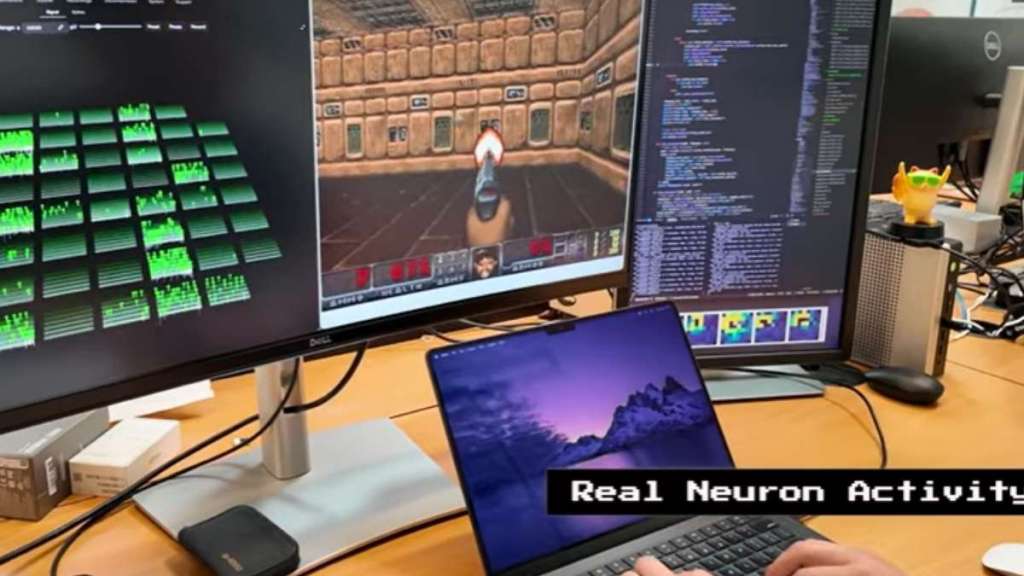
In an innovative experiment, researchers at Cortical Labs have cultivated 800,000 brain cells in a petri dish, successfully enabling them to play the classic video game Doom. This achievement marks a significant advancement in the field of biological computing, merging neuroscience with technology in unprecedented ways. The announcement, shared in a video on social media, has generated a surge of interest and discussion online.
Cortical Labs, an Australian biotech firm, previously demonstrated their capabilities by training brain cells to play Pong in 2021. The leap to Doom represents a considerable challenge due to the game’s complexity. “Pong was much simpler. There was a direct relationship: The ball went up, the paddle went up. It was a direct input-output relationship,” the team explained. In contrast, the team had to interpret the intricate digital environment of Doom into the electrical signals understood by neurons.
Using microelectrode arrays, the researchers were able to stimulate and monitor the brain cells’ electrical activity. “While there’s still a lot of work left to do on this, the exciting thing is we’ve solved the interface problem,” they stated. “We have a way to interact with these cells in real time and train them and shape their behavior to do things even like Doom.”
The video posted by Curiosity on X (formerly Twitter) showcases the brain cells’ gameplay and has captivated viewers worldwide. Comments on the platform reflect a mix of awe and humor, with one user suggesting a competition between the cultured cells and digital signal processors on who could achieve a higher score in Doom. Another user remarked, “Crazy what a ‘clump of cells’ can do,” while a science enthusiast jokingly warned, “That’s the beginning of a Terminator-like plot.”
Despite the groundbreaking nature of this research, Cortical Labs has made it clear that the brain cells are not yet capable of competing with human players. The implications of their work extend beyond gaming, potentially influencing fields such as artificial intelligence, neuroscience, and bioengineering.
As researchers continue to explore the capabilities of biological systems, the intersection of biology and technology promises to yield fascinating developments in the years to come.