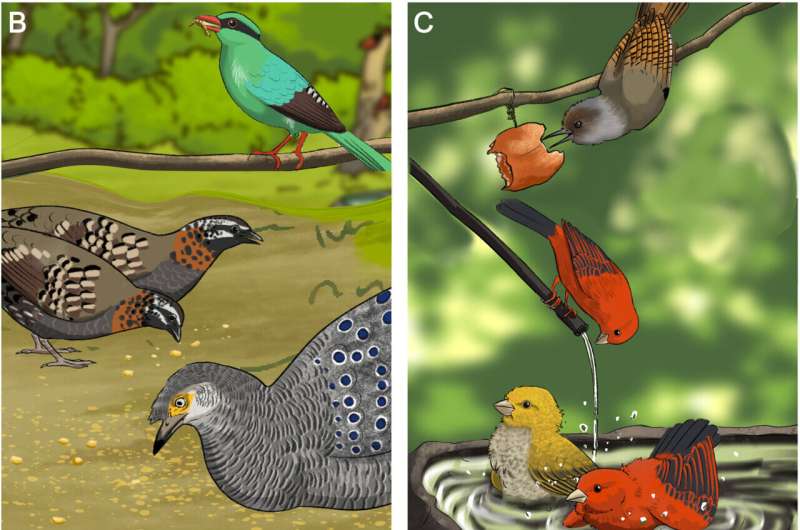
A recent study published in *Avian Research* reveals that the Hide-in-Bird Pond (HIBP) model, a community-driven avitourism initiative in China, is significantly enhancing both biodiversity conservation and rural development. This grassroots approach involves local communities creating artificial ponds and feeding stations to attract bird species for non-invasive observation and photography. The findings underscore the rapid proliferation of this model across the country, offering a sustainable income source while promoting avian diversity.
Researchers from the Kunming Institute of Zoology, part of the Chinese Academy of Sciences, conducted the first national-scale assessment of the HIBP initiative. Their study included semi-structured interviews with 98 operators and comprehensive spatial analysis, identifying 251 HIBP sites across 24 provinces. Notably, approximately 40% of these sites are located in Yunnan Province, which is rich in biodiversity.
Collectively, these sites documented 524 bird species, accounting for around 36% of China’s total avifauna. Among these species are 148 that are either nationally protected or globally threatened. Furthermore, 72% of the HIBP sites are within 5 km of protected areas, and 87% are situated in economically disadvantaged regions. This substantial overlap illustrates the potential of the HIBP model to bridge ecological conservation with socio-economic upliftment.
Balancing Conservation and Economic Growth
The study indicates that the HIBP model could play a crucial role in reconciling ecological conservation efforts with sustainable development. By providing alternative livelihoods for households that traditionally rely on resource extraction, this initiative aims to protect local ecosystems while promoting economic stability. The success of the HIBP model aligns with international biodiversity goals, such as those outlined in the Kunming-Montreal Global Biodiversity Framework, advocating for strategies that foster both conservation and rural revitalization.
Despite its promising outcomes, the study also raises concerns about the lack of standardized management protocols and effective regulatory oversight. The researchers emphasize that without appropriate governance frameworks, the initiative may inadvertently lead to ecological and management issues. They advocate for science-based guidelines, registration systems, and adaptive management to ensure the ecological integrity and long-term sustainability of the HIBP model.
The findings present a compelling case for community-driven ecotourism as a viable strategy for enhancing biodiversity while addressing socio-economic challenges. As the HIBP model continues to expand, it holds the potential to not only support avian conservation efforts but also to empower rural communities across China.
For further details, please refer to the study by Lin He et al, titled “Hide-in-Bird Pond: A new pathway to synergize biodiversity conservation and sustainable development in China,” published in *Avian Research* on January 6, 2026.