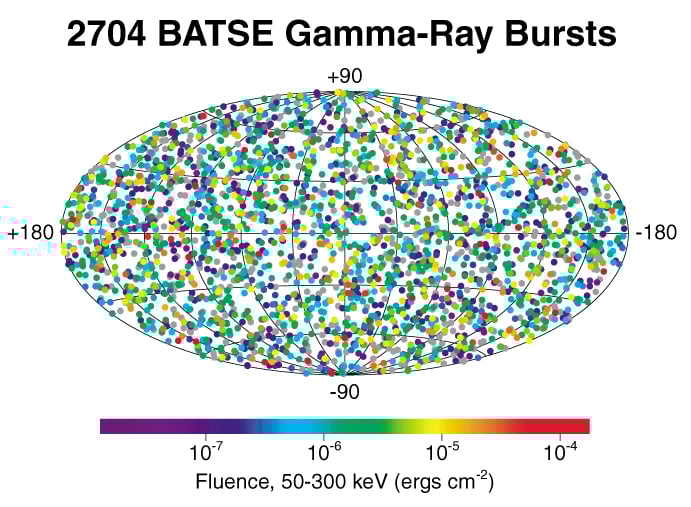
On July 2, 2025, astronomers detected an unprecedented gamma-ray burst known as GRB 250702B, recorded by NASA’s Fermi Gamma-ray Space Telescope. Unlike typical gamma-ray bursts that last mere seconds, this extraordinary event persisted for a staggering seven hours, emitting three distinct bursts throughout the day. The significance of this discovery is underscored by its status as the longest gamma-ray burst ever documented, dwarfing approximately 15,000 bursts cataloged since the phenomenon was first recognized in 1973.
Typically, gamma-ray bursts result from cataclysmic events such as neutron star collisions or massive star collapses. However, GRB 250702B deviated from this norm, prompting astronomers to investigate its origins further. One researcher noted, “This is certainly an outburst unlike any other we’ve seen in the past 50 years,” highlighting the event’s unique characteristics.
A Potential Explanation for the Phenomenon
Recent research published in the Monthly Notices of the Royal Astronomical Society proposes a compelling explanation for GRB 250702B. The study suggests that the gamma-ray burst may have been produced by an intermediate mass black hole, a class of black holes that range from a few hundred to a hundred thousand solar masses. These black holes are theorized to be common, yet they have proven elusive in terms of direct observation.
The researchers hypothesize that an ordinary star, similar in size to our Sun, ventured too close to this intermediate mass black hole and was subsequently torn apart by its tidal forces. As the star’s material spiraled inward, it powered a relativistic jet of particles traveling at nearly the speed of light, producing the exceptional gamma-ray emissions detected by Fermi. This model also accounts for the repeating nature of the bursts, suggesting the star could have been partially stripped across multiple encounters with the black hole, resulting in fresh emissions over time.
Location and Implications of the Discovery
The location of GRB 250702B adds another layer of intrigue to this discovery. Situated approximately 5.7 kiloparsecs from the center of its host galaxy, the event is distinct from the supermassive black hole typically found at the core of galaxies. This distance aligns perfectly with the expected location of a wandering intermediate mass black hole, lending support to the proposed explanation.
If confirmed, GRB 250702B would mark a significant milestone in astronomical history, representing the first observation of a relativistic jet produced by an intermediate mass black hole consuming a star. This event could reshape our understanding of black holes and their behavior, making it one of the most noteworthy astronomical occurrences of the decade.
Despite this promising interpretation, the mystery surrounding GRB 250702B is not fully resolved. Competing models continue to emerge, and the evidence remains a subject of debate among astronomers. In a field where groundbreaking discoveries often present themselves unexpectedly, this seven-hour explosion exemplifies the complex and evolving nature of astronomical research. As scientists continue to investigate, the implications of this event may lead to new insights into the universe’s most enigmatic phenomena.