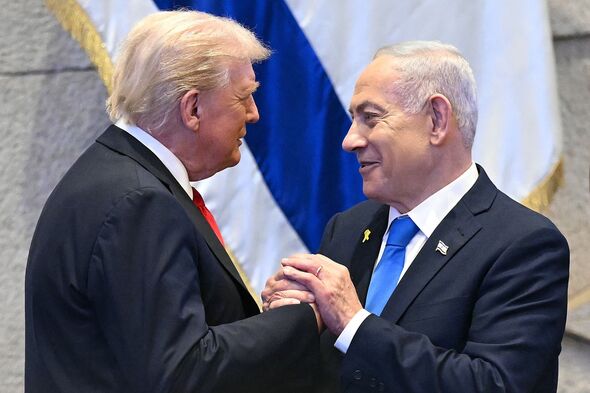
President Donald Trump is scheduled to meet with Israeli Prime Minister Benjamin Netanyahu at his Mar-a-Lago estate on Monday. The meeting aims to revive a ceasefire in Gaza, which the United States helped broker and is currently at risk of collapsing as it approaches a complex second phase.
The ceasefire between Israel and Hamas has mostly held since its initiation in October 2023, shortly after the second anniversary of a Hamas-led assault that resulted in around 1,200 fatalities. While Trump has been a vocal advocate for the ceasefire, recent developments have led to a slowdown in progress, with both sides accusing each other of violations. Disagreements have also emerged among the U.S., Israel, and Arab nations regarding future steps.
During the meeting, Trump may look to leverage his strong relationship with Netanyahu, particularly as the latter faces criticism for not pushing Israel’s agenda more aggressively. The first phase of the ceasefire has seen the release of all but one of the 251 hostages taken during the assault, but the next phase involves more intricate negotiations and arrangements.
Challenges Ahead for Ceasefire Negotiations
Trump’s proposed 20-point plan, endorsed by the U.N. Security Council, seeks to dismantle Hamas’ control over Gaza. The plan outlines a vision for the reconstruction of a demilitarized Gaza Strip under international oversight, led by a body referred to as the Board of Peace. In this arrangement, Palestinians would establish a “technocratic, apolitical” governing body to manage daily operations in Gaza, supervised by the Board of Peace.
As they discuss their strategies, the two leaders may address broader regional issues, such as Iran’s nuclear capabilities, which Trump has claimed were “completely and fully obliterated” following U.S. military strikes on its nuclear sites in June. Both leaders may face a significant challenge in reconciling differing views on the next steps for the ceasefire.
According to Mona Yacoubian, director and senior adviser of the Middle East Program at the Center for Strategic and International Studies, there are critical aspects of the second phase that Netanyahu either does not support or has openly opposed. She stated, “This is going to be a really tall order for President Trump to get Netanyahu to agree.” Yacoubian emphasized that the dynamics of their discussions will be crucial in shaping future negotiations.
Should the first phase succeed, the second phase envisions international oversight of Gaza’s reconstruction, including the establishment of an International Stabilization Force to manage security operations and dismantle Hamas’ military capabilities. This force has yet to be established, with a Western diplomat noting a significant discrepancy between U.S.-Israeli expectations and those of other regional powers and European nations regarding its mandate.
International Dynamics and Reconstruction Plans
The ongoing conflict has led to widespread devastation in Gaza, with neighborhoods reduced to rubble and debris. Discussions among U.S. officials and representatives from Egypt, Qatar, and Turkey have focused on the necessary steps for advancing to subsequent phases of the peace plan. These steps include the deployment of an international security force and extensive rebuilding efforts.
The United Arab Emirates has reportedly committed to financing Gaza’s reconstruction, with plans for new residential developments, although these discussions are ongoing and not yet finalized. A proposed map reviewed by the Associated Press indicates a designated area for “UAE Temporary Emirates housing complex” within an Israeli-controlled section of Gaza. The UAE has not publicly responded to inquiries regarding its commitment to these plans.
As both leaders prepare for their meeting, the outcome remains uncertain. Key issues, including the disarmament of Hamas and the establishment of a functioning Palestinian administration, will require careful negotiation and collaboration among all parties involved. The international community continues to watch closely, with hopes for a sustainable and lasting peace in the region.