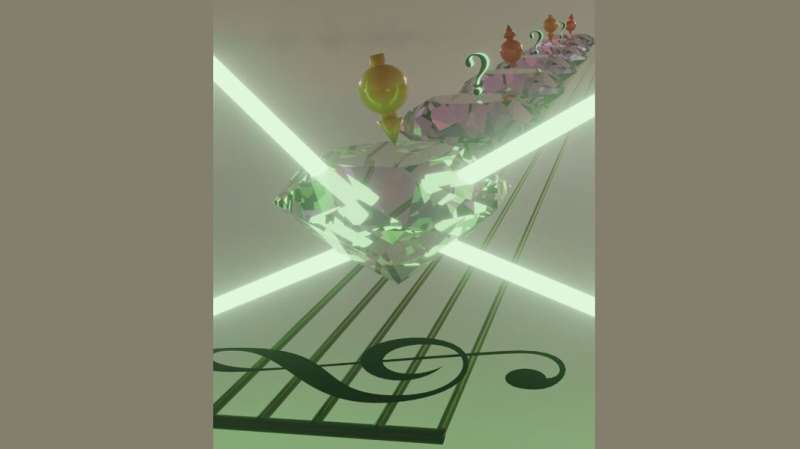
In a groundbreaking study published on November 10, 2025, in Nature Physics, researchers announced the first experimental observation of a time rondeau crystal. This novel phase of matter features a unique characteristic: long-range temporal order coexists with short-time disorder. Drawing parallels with classical music, where a repeating theme alternates with contrasting variations, this discovery reveals a fascinating interplay between predictability and randomness.
The research team, led by Ph.D. student Leo Moon from UC Berkeley, explored how order and variation manifest in both art and nature. Moon explained, “Repetitive periodic patterns naturally arise in early art forms due to their simplicity, while more advanced music and poetry build intricate variations atop a monotonous background.” This analogy extends into the realm of physical substances, such as ice, where oxygen atoms form a crystalline structure while hydrogen nuclei remain disordered.
The study marks a significant advancement in the understanding of time crystals, which have been shown to break time-translation symmetry through long-lived periodic oscillations. Until now, investigations into non-periodic temporal order had primarily focused on deterministic patterns, such as quasicrystals. The time rondeau crystal is distinct in its combination of stroboscopic order and controllable random disorder.
Creating a New Phase of Matter
To achieve this novel phase, researchers employed carbon-13 nuclear spins in diamond as their quantum simulator. This system consisted of randomly positioned nuclear spins at room temperature, interacting via long-range dipole-dipole couplings. The team began by hyperpolarizing the carbon-13 nuclear spins using a technique that leverages nitrogen-vacancy centers—defects in the diamond lattice where a nitrogen atom is adjacent to an empty site. By illuminating these NV centers with lasers, the team achieved a nearly 1,000-fold increase in nuclear spin polarization, creating a strong signal for extended tracking.
Sophisticated microwave pulse sequences were then applied, combining protective “spin-locking” pulses with precisely timed polarization-flipping pulses. This careful orchestration of driving patterns established the time rondeau order. The team’s innovative control system utilized an arbitrary waveform generator capable of executing over 720 different pulses in a single run, which was essential for generating the structured yet non-periodic drives that characterize rondeau order.
Moon noted the advantages of using the diamond lattice, stating, “Diamond itself is incredibly stable—it doesn’t react chemically, it’s insensitive to temperature changes, and it shields the spins well from outside noise.” This stability proved crucial in the researchers’ exploration of exotic temporal phases.
The researchers deployed what they termed random multipolar drives (RMD), which are structured sequences with systematically controlled randomness. At regular intervals during the drive cycle, the nuclear spins flipped their polarization deterministically, displaying the periodic behavior typical of time crystals. In contrast, the polarization fluctuated randomly between these intervals, illustrating the unique coexistence of predictable temporal order and random fluctuations that define rondeau order.
Observations and Implications
The team successfully observed the rondeau order maintain itself for over 170 periods, exceeding four seconds. An analysis using discrete Fourier transforms provided conclusive evidence of this new phase. Unlike traditional discrete time crystals, which exhibit a single sharp peak in their frequency spectrum, the time rondeau crystal showed a smooth, continuous distribution across all frequencies. This “smoking gun” signature confirmed the simultaneous presence of temporal order and disorder.
“Rondeau order shows that order and disorder don’t have to be opposites—they can actually coexist in a stable, driven quantum system,” Moon stated. The researchers gained control over the system’s behavior by varying the drive parameters, allowing them to map out a comprehensive phase diagram detailing the stability of rondeau order.
Furthermore, the team discovered the potential to encode information within the temporal disorder. By engineering specific sequences of drive pulses, they managed to encode the title of their paper, “Experimental observation of a time rondeau crystal. Temporal Disorder in Spatiotemporal Order,” into the micromotion dynamics of the nuclear spins, effectively storing over 190 characters in time rather than space.
Moon remarked on the intriguing possibility of utilizing this tunable disorder for practical applications, saying, “It’s a bit like the analogy between water and ice: ice has ordered oxygen positions but disordered hydrogen bonds, and that local randomness carries structural information.”
The researchers believe that the controllable nature of the disorder may make this platform suitable for designing quantum sensors that are selectively sensitive to specific frequency ranges. The work expands the understanding of non-equilibrium temporal order beyond conventional time crystals. Using the same experimental setup, the team also demonstrated related phenomena with deterministic aperiodic drives, such as the Thue-Morse sequence and the Fibonacci sequence, achieving experimental realizations of time aperiodic crystals and time quasicrystals alongside the rondeau order.
Looking to the future, Moon and his team are exploring alternative material platforms beyond diamond, including pentacene-doped molecular crystals, where hydrogen-1 nuclear spins may offer enhanced sensitivity. “On a more applied front, harnessing the tunable disorder in such systems could pave the way for practical quantum sensors or memory devices that exploit stability in the temporal domain,” he concluded.
This research not only enriches the scientific landscape but has the potential to influence future technologies. As the team continues to investigate novel material platforms, the implications of their findings may extend far beyond theoretical physics into practical applications that harness the intricate dance of order and disorder.