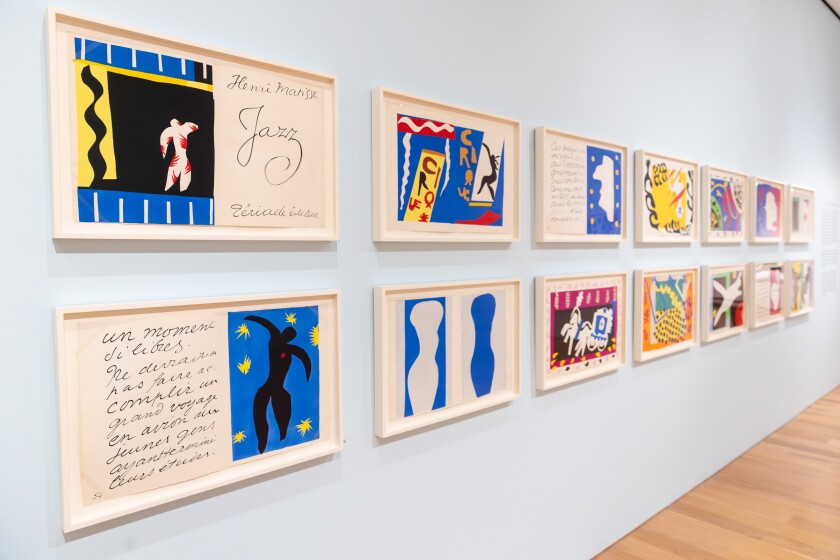
A new exhibition at the Art Institute of Chicago celebrates the late career of renowned artist Henri Matisse, showcasing his innovative cut-out technique that emerged in the 1940s. Titled “Matisse’s Jazz: Rhythms in Color,” the exhibition opened on March 1, 2024, and will run until June 1. This display features all 20 color plates from the iconic artist book “Jazz,” providing an intimate look at Matisse’s work during a pivotal period in his life.
While the exhibition is not a comprehensive retrospective, it offers a concentrated exploration of Matisse’s trajectory leading to his vibrant late works. Organized by Emily Ziemba, a research curator in the museum’s department of prints and drawings, the showcase provides a unique opportunity to view rarely seen pieces from the museum’s extensive Matisse collection. The Art Institute acquired its first work by Matisse in 1922 and has continued to expand its collection over the decades, including the recent addition of “The Seamstress” (1900) in 2022, donated by gallerist Richard Gray and his wife, Mary.
Matisse’s cut-outs represent a significant evolution in his artistic practice. Following serious abdominal surgery in 1941, he began using colorful abstract shapes cut from gouached paper, which he then collaged into dynamic compositions. This inventive technique became his primary mode of expression from the mid-1940s until his passing in 1954. The exhibition prominently features the twenty meticulous reproductions of the “Jazz” plates, produced by the Térianade printing atelier in Paris. These vibrant images depict circus scenes, mythological figures, and memories from Matisse’s time in Tahiti, maintaining a sense of freshness and vitality nearly 80 years after their creation.
The original edition of “Jazz” included 250 copies, with an additional 100 copies of just the color plates. The Art Institute purchased its copy shortly after the book’s release in 1947 for just $375, an incredible investment by today’s standards. Alongside “Jazz,” the exhibition concludes with another major cut-out, “Oceania-The Sea” (1948), which Zika Ascher screenprinted onto a large linen sheet measuring 5.5 by 12.5 feet.
In addition to these central works, visitors can explore Matisse’s recurring themes, particularly his depictions of odalisques, or reclining nudes. Notable pieces include the bronze sculpture “Seated Nude” (1922-29, cast 1951) and the lithograph “Large Odalisque in Striped Pantaloons” (1925). The show also hints at Matisse’s evolving style, as seen in “Daisies” (1939), where sections of the oil on canvas appear to be cut out and collaged, foreshadowing his later cut-out technique.
This exhibition offers a fitting complement to a concurrent display focusing on Matisse’s modernist counterpart, Pablo Picasso. According to Ziemba, “We haven’t done a Matisse project in our [prints and drawings] galleries ever, so I just think it was naturally time.”
Overall, “Matisse’s Jazz: Rhythms in Color” invites art enthusiasts to engage with the exuberance of Matisse’s late works, revealing how the artist embraced innovation and creativity in his later years.