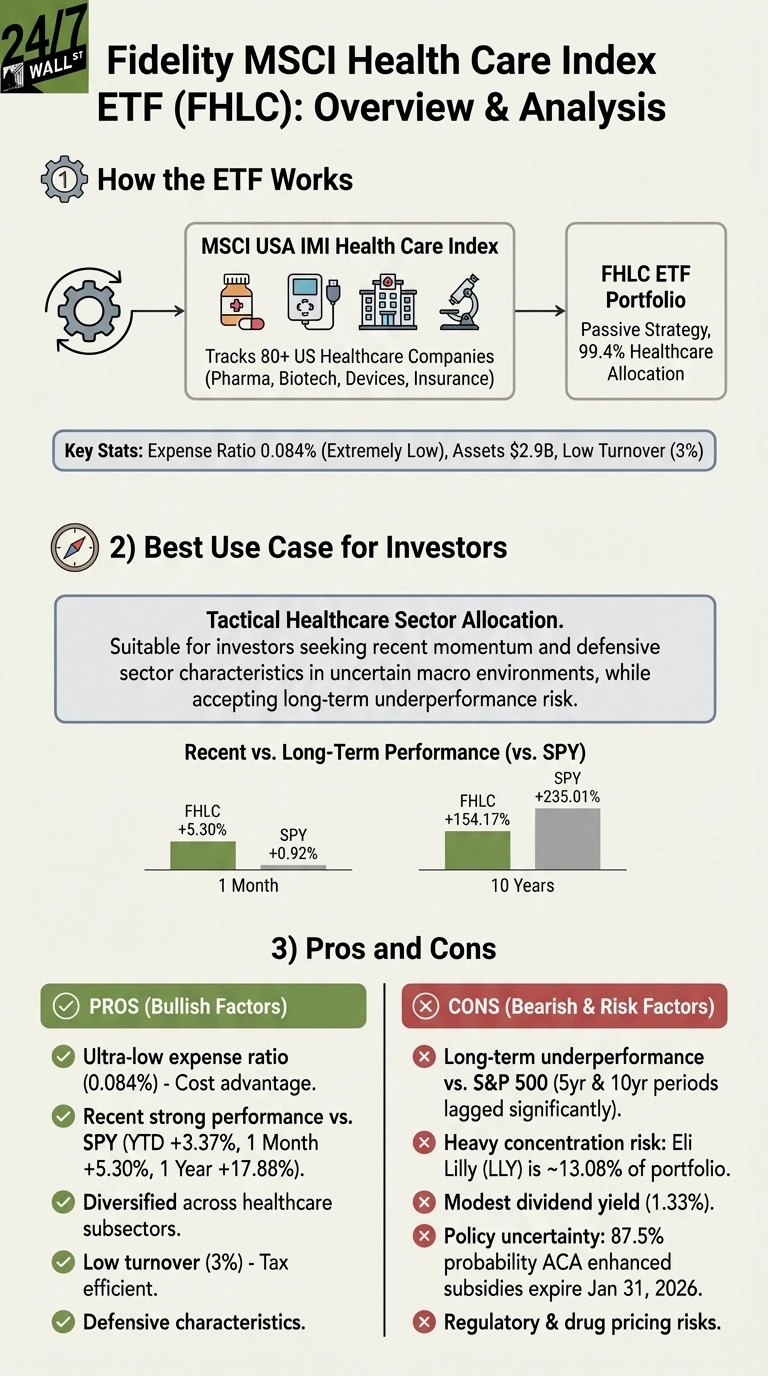
Investors considering the Fidelity MSCI Health Care Index ETF (FHLC) are weighing its recent performance against a backdrop of regulatory uncertainty and market volatility. With an expense ratio of just 0.084%, the fund has gained 17.9% over the past year but lags significantly behind the S&P 500’s 235% return over the last decade. Analysts point to a concentration risk, as 13% of the fund’s holdings are tied to Eli Lilly (NYSE: LLY), which has seen its stock surge 46% in the past year.
Fund Structure and Recent Performance
The FHLC tracks the MSCI USA IMI Health Care Index, granting investors exposure to a broad range of U.S. healthcare companies, including pharmaceuticals, biotechnology, medical devices, and health insurance. With over 80 holdings, the fund aims for capital appreciation alongside modest dividend income from established healthcare firms.
Despite its recent strong performance, FHLC’s long-term track record reveals a stark contrast. Over the past five years, the ETF returned 42.6%, whereas the S&P 500 achieved 84.5%. The decade-long performance gap widens even further, with FHLC returning 154% compared to the S&P 500’s 235%. This disparity reflects ongoing challenges in the healthcare sector, including drug pricing pressures and slower innovation outside specific areas like oncology.
Risks and Alternatives
Healthcare investors face inherent political and regulatory uncertainties. Current predictions suggest an 87.5% likelihood that enhanced Affordable Care Act (ACA) premium tax credits will expire by January 31, 2026. Such changes could adversely affect health insurers like UnitedHealth, which constitutes 4.5% of FHLC’s portfolio and has seen its stock decline 31% over the past year. Furthermore, ongoing drug pricing negotiations under Medicare add another layer of risk for pharmaceutical investments.
For those seeking income, FHLC’s yield of 1.33% may be underwhelming compared to alternatives in other sectors. While dividends have grown at an annual rate of 4.6% over the past five years, this barely keeps pace with inflation and does not measure up to the income potential offered by more stable sectors.
Growth-focused investors might find FHLC unsuitable for their aggressive portfolios. The fund’s historical underperformance against the broader market suggests that those prioritizing capital appreciation should consider other options.
An alternative worth exploring is the Vanguard Health Care ETF (NYSEARCA: VHT). With an expense ratio of 0.09%—slightly higher than FHLC’s—and assets totaling $20.4 billion compared to FHLC’s $2.9 billion, VHT provides better liquidity and tighter bid-ask spreads. VHT also offers a marginally higher dividend yield at 1.38% and has a longer track record since its inception in 2004.
In summary, the Fidelity MSCI Health Care Index ETF may appeal to investors seeking low-cost exposure to the healthcare sector, particularly if they believe in the potential for continued momentum. However, the concentration risk associated with its top holdings and the fund’s historical underperformance necessitate careful consideration and positioning within a diversified portfolio.