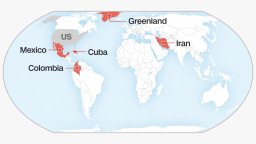
President Donald Trump has made controversial claims regarding Greenland, asserting that the United States should take control of the island for national security reasons. This assertion has been met with rejection from both Greenlandic officials and NATO allies. At the World Economic Forum in Davos on January 17, 2024, Trump emphasized that acquiring Greenland is “a core national security interest of the United States,” reiterating his desire to purchase the self-governing territory from Denmark.
During a meeting with NATO Secretary-General Mark Rutte, Trump indicated a potential framework for a future agreement on Greenland, although he did not provide specifics about this “deal.” His remarks have sparked significant discussion, particularly as he aims to justify his assertions regarding Denmark’s legal claim to the territory.
Disputed Sovereignty Claims
In a message to Norwegian Prime Minister Jonas Gahr Støre on January 19, Trump questioned Denmark’s sovereignty over Greenland, stating, “Denmark cannot protect that land from Russia or China, and why do they have a ‘right of ownership’ anyway?” He claimed there are “no written documents” establishing Denmark’s authority over the island, a statement that is factually incorrect.
There are multiple historical agreements and court rulings that affirm Denmark’s claim to Greenland. A declaration by the U.S. Secretary of State in 1916 explicitly recognized Danish control. Furthermore, an international court ruled in 1933 that Denmark holds valid sovereignty over the entire island. Marc Jacobsen, a professor at the Royal Danish Defence College, stated that Denmark’s sovereignty has been internationally acknowledged, including by the United States.
Claims of Russian and Chinese Naval Presence
Trump has also asserted that Greenland is surrounded by Russian and Chinese ships, claiming at a press event on January 4, “Right now, Greenland is covered with Russian and Chinese ships all over the place.” He reiterated these claims during a press conference on January 9, suggesting that the presence of foreign naval forces posed a threat to U.S. interests.
However, there is no evidence to support Trump’s allegations. Greenland’s Minister of Business, Naaja Nathanielsen, stated that she was “not aware” of any Russian or Chinese naval activity in the vicinity. Analysis of public ship-tracking data reveals that the majority of vessels near Greenland are fishing boats, with no significant presence of Russian or Chinese military ships. Romain Chuffart, managing director of The Arctic Institute, affirmed that Trump’s claims do not hold water.
Misrepresentation of Greenland’s Defense
In a statement made on January 11, Trump remarked that Greenland’s defenses consist of “two dog sleds.” Although this comment was likely intended in jest, it misrepresents the actual military presence in Greenland. While Danish special forces do operate the Sirius Dog Sled Patrol, which uses sled dogs for patrols in remote areas, this is just one facet of Denmark’s military capabilities in the region.
According to the Danish Ministry of Defense, Denmark maintains a military base in Nuuk with approximately 150 personnel, alongside Arctic patrol vessels and surveillance aircraft. Furthermore, Denmark has committed around $6.5 billion to modernize its military capabilities in Greenland over the next decade. The Sirius Dog Sled Patrol’s utilization of sled dogs is due to the harsh landscape, not a lack of military resources.
The United States already operates an air base in Greenland and has the option to expand its presence under a 1951 agreement with Denmark. Danish officials have expressed their willingness to enhance U.S. cooperation on security matters, but they maintain that Greenland is not for sale.
As the debate continues, Trump’s claims about Greenland raise concerns about the accuracy of information being presented on an international stage. The dynamics surrounding Greenland’s sovereignty and the geopolitical interests of major powers in the Arctic region remain complex and multifaceted.