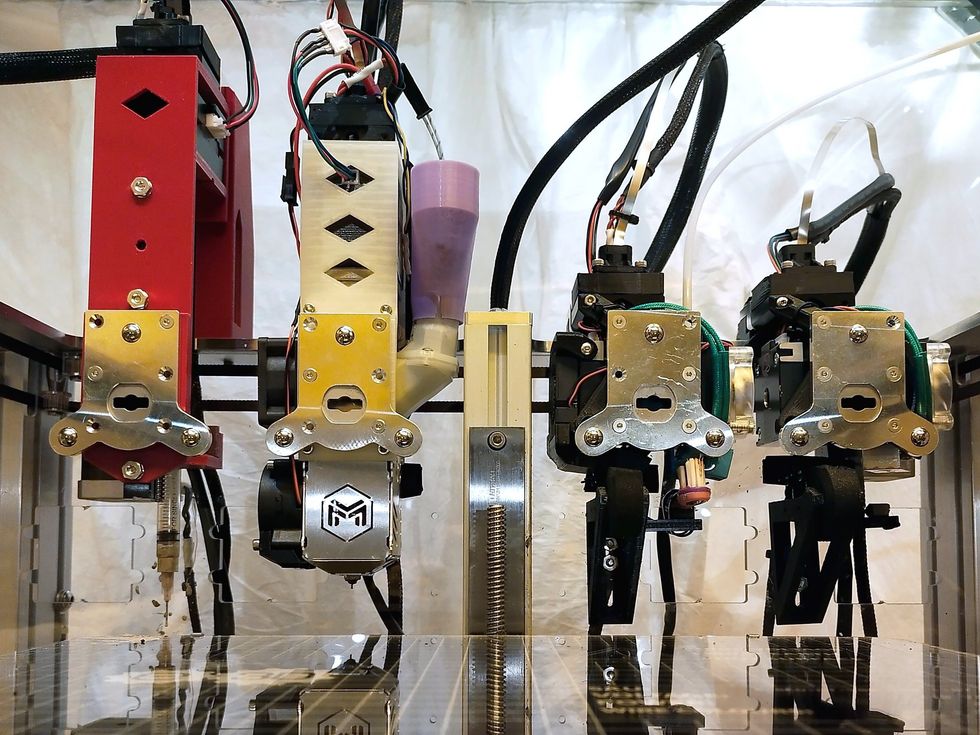
Researchers at the Massachusetts Institute of Technology (MIT) have developed a groundbreaking multimaterial 3D-printing system that can produce a functional electric linear motor in approximately three hours. This innovation, detailed in a paper published last month in the journal Virtual and Physical Prototyping, aims to revolutionize hardware production by offering a more efficient, localized, and cost-effective alternative to traditional manufacturing methods.
Current 3D printers primarily focus on producing plastic components for various applications, including prototypes and decorative items. In contrast, creating a functional electric machine requires the integration of multiple materials with distinct properties. Electric motors, for instance, rely on materials that conduct electricity, insulate it, generate magnetic fields, and provide structural support. The MIT team’s new platform can process five different functional materials simultaneously, including conductors, magnetic structures, and flexible components, allowing for the direct printing of these complex devices.
The cost of raw materials for producing the linear motor is estimated at just $0.50. This is a stark contrast to conventional electric motors, which are typically assembled from separately manufactured parts through multiple fabrication steps. The MIT system streamlines this process by printing the motor’s functional components in a single build, requiring only one additional step to magnetize the motor’s magnetic parts.
Advancements in Multimaterial 3D Printing
The evolution of 3D printing has primarily favored plastic materials, but most printers still operate as single-material, single-nozzle machines. Even those marketed as “multi-material” often utilize similar polymers rather than truly distinct functional materials. According to Luis Fernando Velásquez-García, principal research scientist at MIT Microsystems Technology Laboratories, true functional hardware often necessitates the use of varied materials. “Very few applications can be satisfied with just one material,” he states.
The MIT prototype employs a multimaterial approach that enables the printer to switch between four different tools, each designed to handle feedstocks with unique properties. These include a heater for curing ink, a filament extruder, a custom ink extruder, and a modified pellet extruder. The latter is particularly advantageous as it accommodates higher concentrations of magnetic particles, enhancing the performance of printed components.
Velázquez-García emphasizes that material selection is critical for performance. “You shouldn’t make any compromises in materials and performance,” he asserts. If the foundational properties of the materials fall short, the resulting device will not meet its intended function.
Demonstration of a 3D-Printed Linear Motor
For their demonstration, the MIT team focused on a linear motor, which is widely used in applications ranging from robotics to medical imaging. This prototype system incorporates a mix of off-the-shelf components and custom parts, with a total cost estimated at around $3,000. It utilizes five functional material classes: dielectric, electrically conductive, soft and hard magnetic, and flexible materials.
The researchers reported that the performance of the printed linear motor is comparable to, or even exceeds, that of motors produced through traditional multi-step fabrication methods. Notably, it generates more actuation than typical linear systems that rely on hydraulic amplifiers. Despite these advancements, Velázquez-García cautions against overestimating the current capabilities of the technology. “There’s a long way between what we have and a 3D-printed engine in an electric car,” he explains.
The team’s future goals include integrating magnetization directly into the printing process and expanding the system with additional tools. These steps are vital for developing more complex electronic systems on a single platform. The ultimate vision is to enable engineers to fabricate specialized components remotely, reducing reliance on global supply chains and enhancing local manufacturing capabilities.
As this research progresses, the implications for industries reliant on electric motors could be significant. If successful, the multimaterial 3D-printing platform could transform how hardware is produced, making it faster and more resilient to disruptions in supply chains.