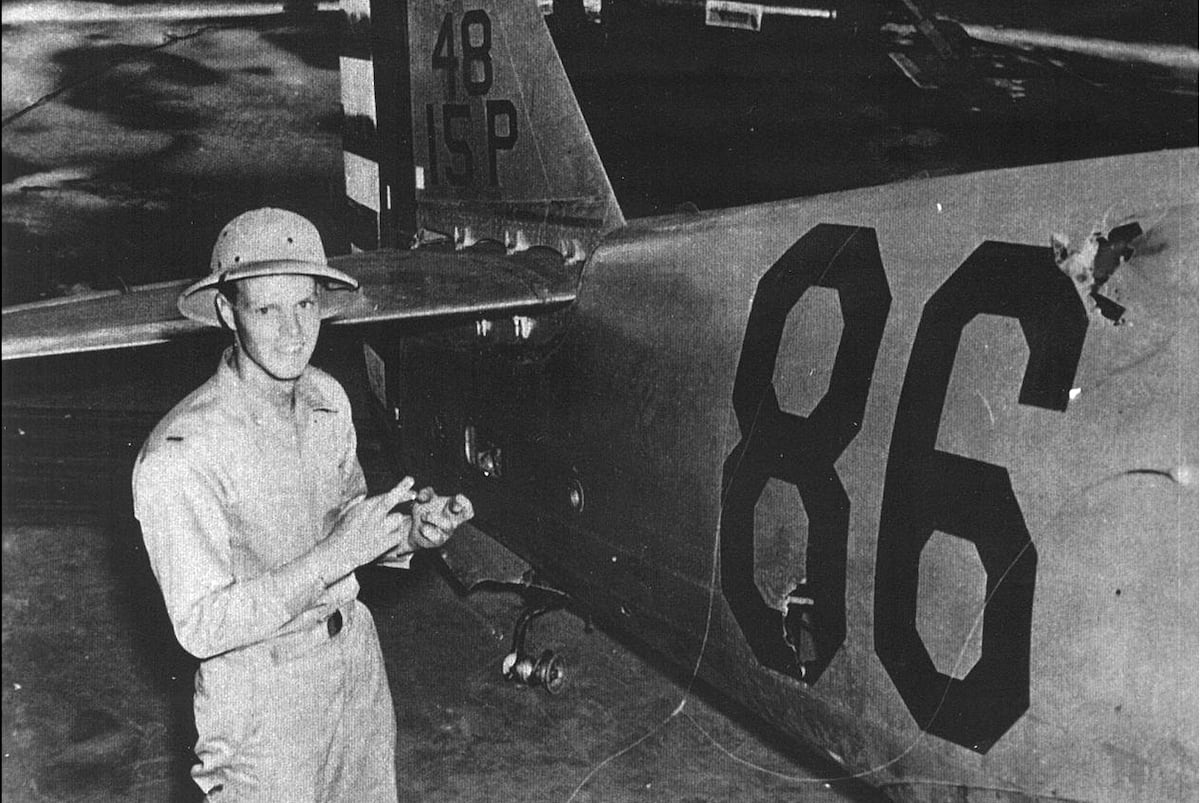
On December 7, 1941, Japanese forces launched a surprise attack on Pearl Harbor, leading to a pivotal moment in U.S. history. Among the few American pilots who took to the skies during the assault was Philip M. Rasmussen, a 23-year-old second lieutenant in the U.S. Army Air Corps. His quick actions during the attack not only showcased his bravery but also earned him recognition, including the Silver Star for his heroism that day.
Rasmussen was stationed at Wheeler Field on the island of Oahu as part of the 46th Pursuit Squadron. His training began in September 1940 and concluded in April 1941, leading to his immediate deployment to a mission focused on defending against potential aerial threats. Despite the growing tensions with Japan, Rasmussen and his fellow pilots believed they were safe, being situated over 3,000 miles from the Japanese mainland.
At approximately 08:00 local time, while preparing for the day, Rasmussen witnessed a Japanese aircraft dive towards the hangar line. He immediately recognized the aircraft’s insignia, which confirmed his fears: “We were being attacked by the Japanese,” he recalled. In a hurry, he donned a webbed belt with a 0.45 caliber pistol, put on shoes, and sprinted towards the flight line as enemy planes strafed nearby.
Rasmussen observed that the aircraft were tightly packed, making them vulnerable to the attack. He quickly located a Curtiss P-36 and, with the help of an armorer who brought ammunition, prepared for flight. As he taxied down the runway, he experienced a brief lull in enemy fire. Once airborne, he and his squadron received orders to head towards Kaneohe Bay, which was also under attack.
The adrenaline surged as Rasmussen and his fellow pilots engaged the enemy. During the encounter, he successfully shot down one Japanese aircraft, but his success was met with danger when another enemy plane attempted to ram him. In the ensuing chaos, Rasmussen’s plane was hit, damaging its controls. He managed to maneuver into the clouds to stabilize his aircraft, all while assessing his injuries, finding only fragments of Plexiglas in his hair.
Despite the intense action, Rasmussen’s focus remained on safely returning to Wheeler Field. As he approached the base, he was relieved to see friendly forces organizing themselves. However, they nearly opened fire on him, mistaking him for a Japanese pilot. Rasmussen successfully landed his damaged plane on a grassy field, where it came to a stop after spinning several times.
After disembarking, he was dazed but unharmed, and quickly changed into a flight suit to rejoin his comrades. The aftermath of the attack revealed the devastation: many aircraft were destroyed, and the toll on personnel was significant. Rasmussen continued to serve throughout World War II, participating in numerous combat missions, including a bombing run over Japan, for which he received the Distinguished Flying Cross.
Rasmussen’s military career spanned various theaters, including the Pacific, Europe, and the Middle East, culminating in his retirement in 1965 as a lieutenant colonel. He passed away in 2005 at the age of 86 and was laid to rest at Arlington National Cemetery. His account, preserved through an oral history interview conducted in 1991, provides a first-hand glimpse into the heroism displayed on that fateful day and the realities faced by those who served in World War II.