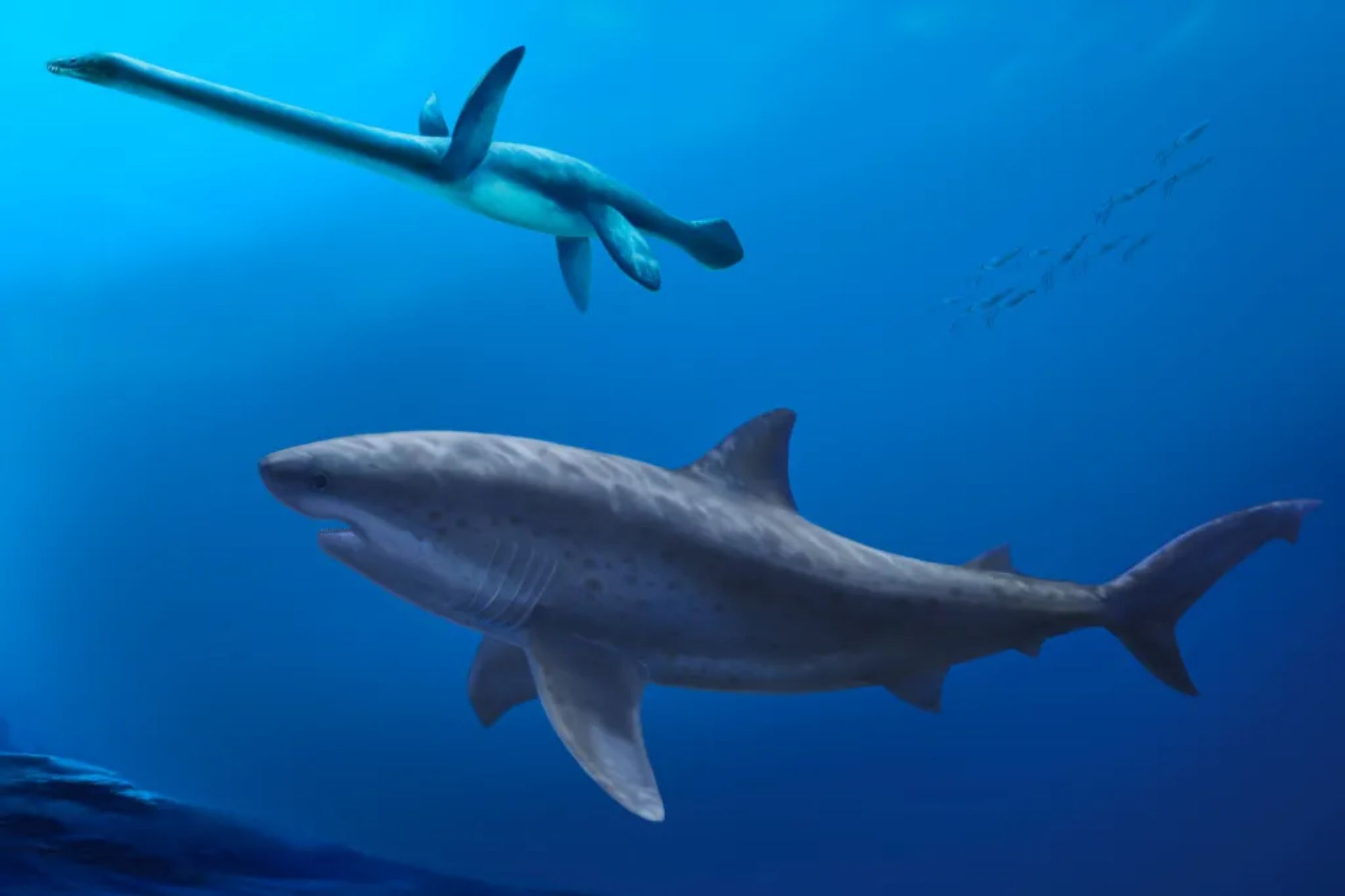
BREAKING: A groundbreaking discovery off the coast of Darwin, Australia, has unveiled a monstrous shark that ruled the ancient seas a staggering 15 million years before the infamous megalodon. Researchers have identified this creature as the earliest known mega-predator in the modern shark lineage, following the analysis of massive vertebrae discovered on a beach.
The study, published in the journal Communications Biology, reveals that this ancient shark was approximately 26 feet long, significantly larger than today’s 20-foot great white sharks. Senior curator in paleobiology at the Swedish Museum of Natural History, Benjamin Kear, emphasized the significance of this find, stating, “This pushes the time envelope back of when we’re going to find absolutely enormous cardabiodontids.”
The vertebrae were found on a coastline that was once part of an ancient ocean, rich in fossil evidence of prehistoric marine life. The fossils, originally unearthed in the late 1980s and 1990s, were largely overlooked until now. Measuring 4.7 inches across, these vertebrae provided the key to estimating the size of this colossal predator.
Shark skeletons are primarily made of cartilage, making vertebrae rare and invaluable for paleontological studies. Kear explained, “The importance of vertebrae is they give us hints about size.” This research utilized advanced methods, including CT scans and mathematical models, to accurately reconstruct the shark’s size and shape.
The results suggest that this ancient predator resembled modern large sharks, highlighting an evolutionary success that has persisted for over 115 million years. Kear noted, “It would’ve looked for all the world like a modern, gigantic shark.”
The discovery has profound implications for understanding the evolutionary history of sharks and their adaptive responses throughout changes in climate and biodiversity. Kear stated, “By looking at what happened during past shifts, we can get a better sense of what might come next.”
As researchers continue to explore similar environments globally, they anticipate uncovering more ancient mega-predators, indicating that these sharks had ancestors long before the megalodon. This study not only reshapes our understanding of ancient marine ecosystems but also provides critical insights into how current species may react to ongoing environmental changes.
Stay tuned for more updates on this exciting discovery that sheds light on the prehistoric oceans and the giants that once roamed them.