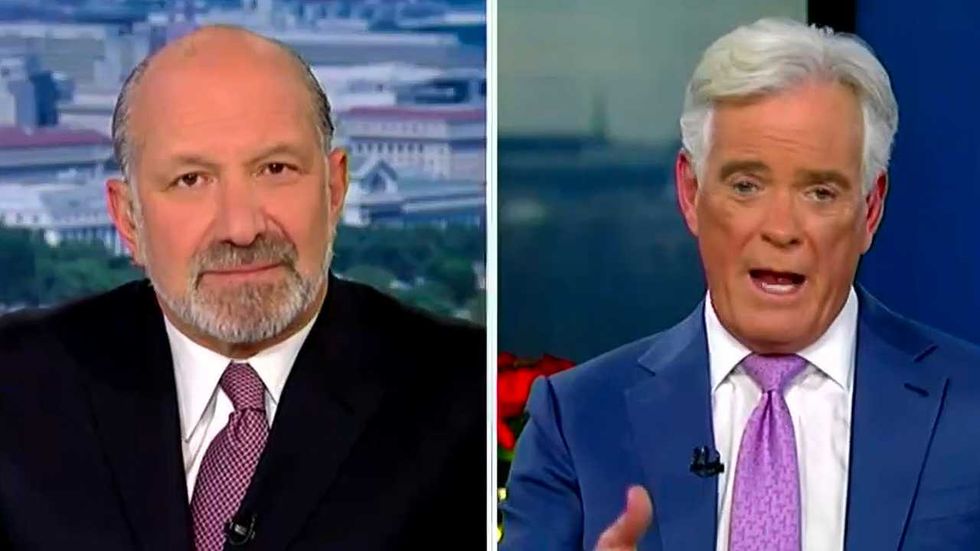
UPDATE: In a tense exchange on Fox News, host John Roberts challenged White House aide Howard Lutnick on President Donald Trump’s astonishing claim of reducing drug prices by an impossible 600%. This urgent discussion occurred just hours after Trump’s speech to the nation, where he touted significant reductions in healthcare costs.
Roberts wasted no time, stating that Trump’s assertion was “mathematically impossible.” He pressed Lutnick, questioning the credibility of the President’s claims. “If you cut something by 100%, the cost goes down to zero,” Roberts explained. “If you cut it by four, five, or 600%, the drug companies are actually paying you to take their products.”
Lutnick attempted to clarify Trump’s point, referencing a hypothetical scenario where a drug priced at $100 could be sold for $13. “If you’re looking at it from $13, it’s down seven times,” Lutnick argued. Roberts quickly rebutted, emphasizing that the narrative was misleading. “It’s not 600%!” he asserted.
The back-and-forth highlighted a growing skepticism around Trump’s healthcare promises. Roberts raised the critical question of how much of the President’s statement was mere hyperbole versus hard fact. Lutnick maintained that the conversation about drug pricing is complex, suggesting that the significant reductions may not be as straightforward as they seem.
The implications of this debate extend beyond mere numbers. Millions of Americans are affected by drug pricing, and the accuracy of these claims could influence public perception and policy. As the conversation around healthcare intensifies, the urgency to clarify such statements has never been more critical.
As this story develops, viewers are left to ponder: How much of Trump’s speech was rooted in reality? As the nation grapples with healthcare costs, statements like these spark vital discussions on transparency and accountability in governance.
Stay tuned for more updates as this story unfolds and further reactions come to light. The implications of these claims could significantly impact public trust and the future of healthcare policy in the United States.