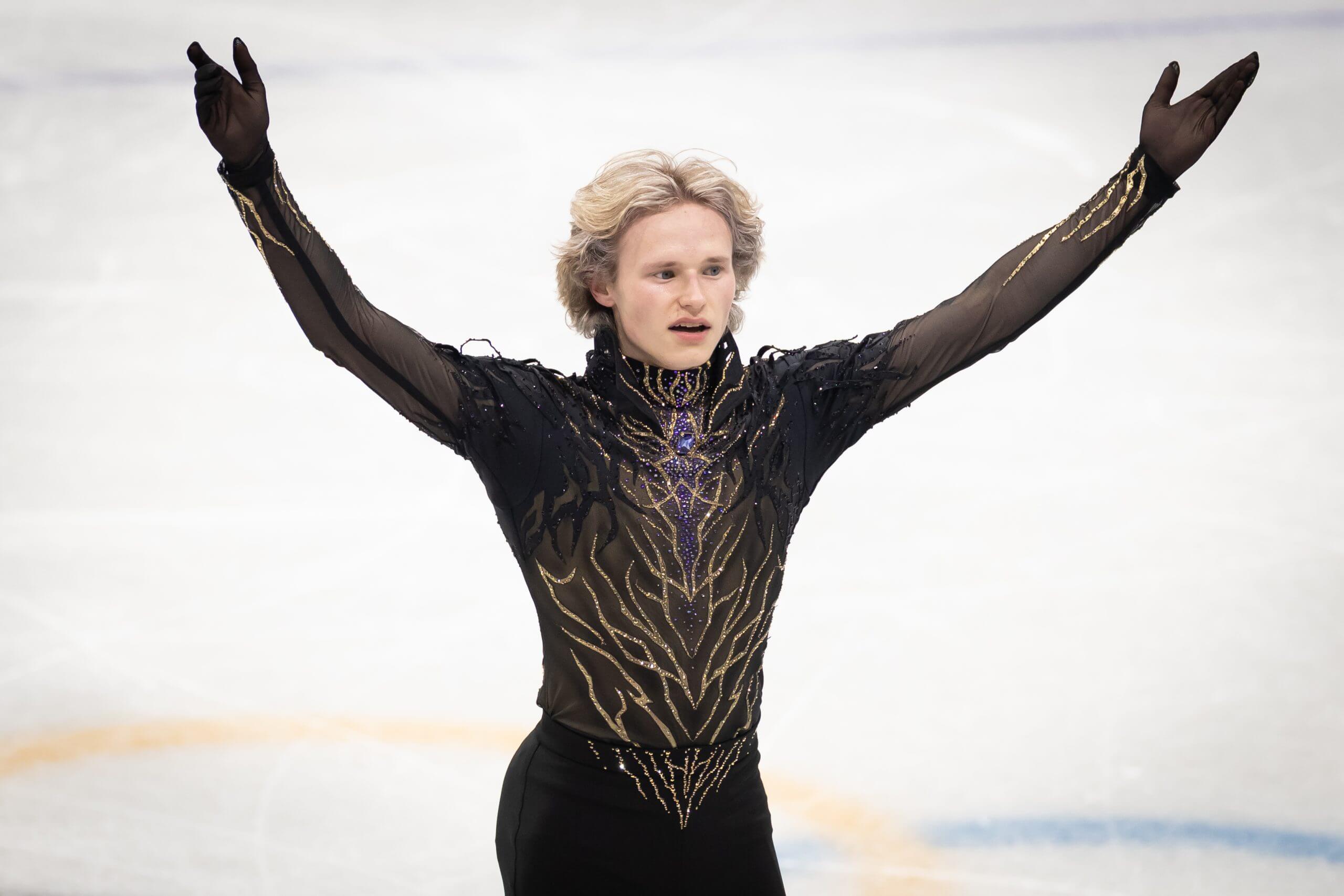
Ilia Malinin enters the Olympic figure skating competition with overwhelming odds in his favor, positioning him as a frontrunner for the gold medal. As he prepares to take the ice on March 5, 2024, FanDuel lists his odds at an astonishing -10000, indicating a 99 percent chance of victory. Such high probabilities are rarely seen in sports, often reserved for significant mismatches, like No. 1 seeds facing No. 16 seeds in basketball tournaments.
Malinin’s dominance in the sport can be attributed to his exceptional technical skills, particularly his ability to execute challenging jumps. In comparison, Japan’s Kaori Sakamoto, the leading contender in the women’s event, has odds of +160 on Caesars Sportsbook, suggesting she has less than a 40 percent chance of winning. Sakamoto has a remarkable record, having won the world championship three consecutive times from 2022 to 2024, but her recent silver medal finish last year has left room for doubt.
Malinin’s Technical Edge
The key to Malinin’s success lies in the degree of difficulty he incorporates into his performances. Each move in figure skating carries a base score, and skaters earn or lose points based on their execution, known as the grade of execution (GOE). By attempting more complex jumps, Malinin increases his scoring potential significantly, even if he stumbles during a routine.
“Ilia packs his programs with quadruple jumps, so it raises his ceiling,” noted Marcus Thompson, a figure skating journalist for The Athletic. “If you do two quads and six triples, and I do seven quads and one triple, I have the higher possibility. If I execute well, I’m outperforming you because my jumps yield more points.”
This strategy became evident during the recent team competition in Milan. Despite making mistakes in both segments, Malinin still managed to secure victory in the free skate, solidifying the gold medal for the United States. He finished second in the short program behind Japan’s Yuma Kagiyama, who delivered a flawless performance.
Malinin’s performance in the free skate included a stumble on a quad Lutz that was part of a combination. Nevertheless, he adjusted his routine to regain points later on. Japan’s Shun Sato also delivered a strong performance, achieving a season-best score of 194.86. Still, Malinin’s overall score crossed the 200-point threshold, a feat neither Kagiyama nor Sato reached throughout the season.
Statistical Supremacy
Malinin’s highest score in the free skate, a remarkable 238.24 at the ISU Grand Prix Final in December, stands as the highest ever recorded by the International Skating Union under the current scoring system established in 2004. In the final standings, he outperformed Kagiyama by nearly 30 points and Sato by over 40 points, showcasing his significant advantage.
The mathematics behind Malinin’s success reveals a stark contrast between his scoring potential and that of his competitors. His “floor” score is almost equivalent to the “ceiling” score of the rest of the field, while his potential for higher scores surpasses any skater in history.
Although the competitive field remains, Malinin’s recent performance has slightly adjusted his odds. FanDuel now lists him at -4000, translating to a 97 percent chance of winning gold, while Caesars gives him odds of -2000, indicating a 95 percent chance. The window for an upset exists, but it remains narrow. Just as in sports tournaments, a “Cinderella story” would require extraordinary performances and a stroke of luck to overcome Malinin’s prowess.
As the Olympic figure skating events unfold, all eyes will be on Malinin, whose unique combination of technical skill and competitive excellence places him in a league of his own.