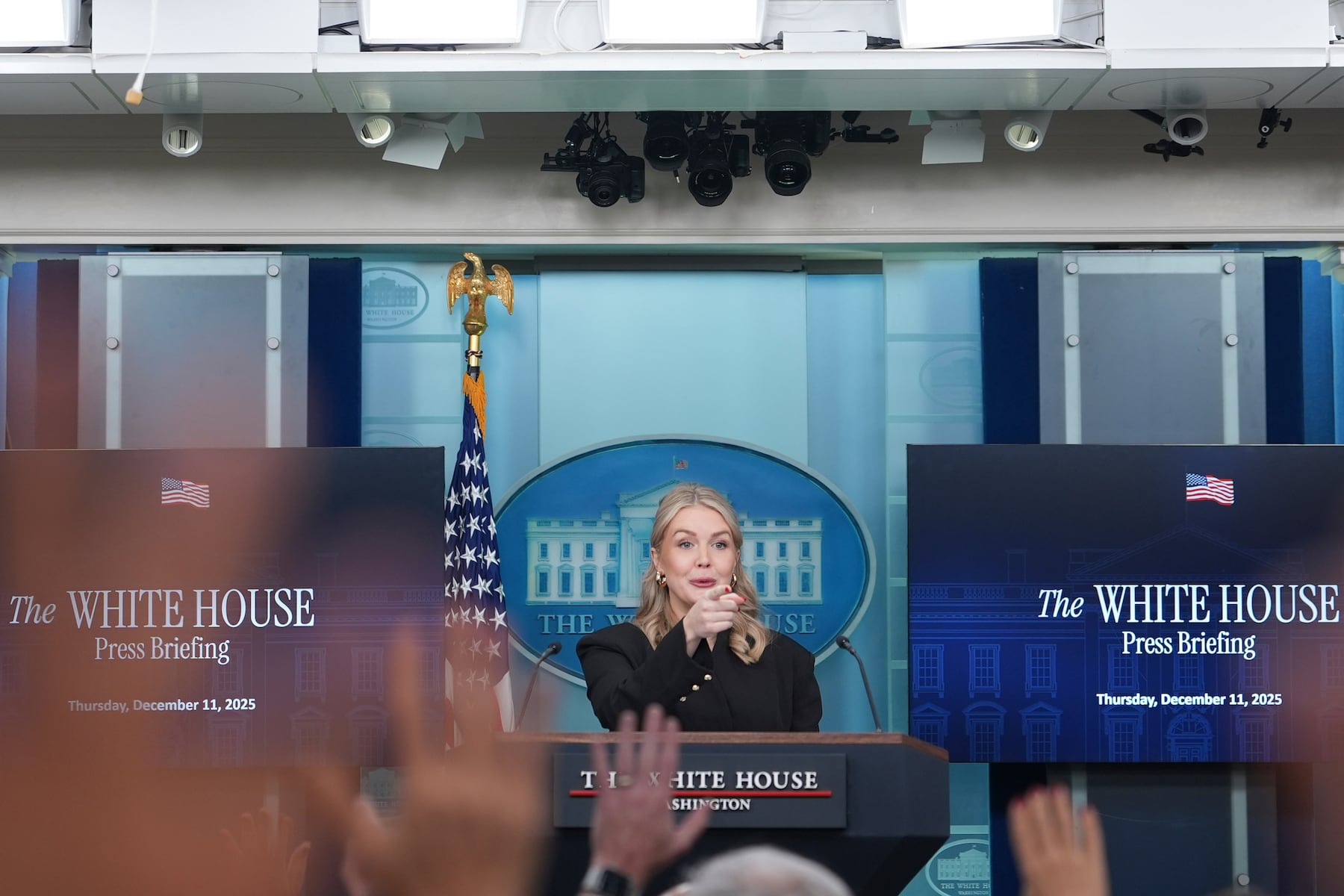
During a press briefing on December 11, 2025, White House Press Secretary Karoline Leavitt announced what she described as positive developments for the U.S. economy. She stated, “Inflation as measured by the overall CPI has slowed to an average 2.5% pace,” referring to the consumer price index. Leavitt also claimed that real wages for the average worker have increased by approximately $1,200 over the past year.
When CNN political correspondent Kaitlan Collins attempted to engage Leavitt with a follow-up question, the press secretary deflected by launching an attack on her predecessor, Jen Psaki. Leavitt asserted that Psaki had delivered “utter lies” from the same podium a year earlier. “Everything I’m telling you is the truth backed by real, factual data,” she insisted, accusing media outlets of pushing false narratives about President Donald Trump.
Despite Leavitt’s assertions, her claims about the economy appear questionable. The actual inflation rate for September was reported at 3%, contradicting her statement. According to CNN business editor David Goldman, U.S. workers have faced the lowest annual paycheck growth since May 2021.
Echoes of Orwell in Political Discourse
As a historian familiar with the themes of truth and deception in political language, I find Leavitt’s comments reminiscent of George Orwell’s dystopian novel, “1984.” Orwell depicted a world where the Ministry of Plenty disseminated inflated statistics, creating a facade of prosperity. The protagonist, Winston Smith, produced these fabricated figures, which were so far removed from reality that they lacked even the characteristics of a direct lie.
In this context, the lack of transparency in current political discourse echoes Orwellian themes, despite Leavitt’s frequent claims that Trump is the “most transparent president in history.” This assertion has become a form of Orwellian “doublespeak,” where the meaning of terms is manipulated to serve political ends.
Leavitt’s use of “transparency” to describe the administration’s handling of sensitive issues, including the dismissal of Bloomberg News journalist Catherine Lucey, further illustrates this point. Her remarks defending Trump’s refusal to release documents related to Jeffrey Epstein were labeled “fabulously audacious” by The Guardian’s Washington bureau chief, David Smith.
Manipulation of Information and Political Language
The past ten months have seen Leavitt make a series of controversial statements that raise concerns about the accuracy of official communication. For instance, she claimed that the now-dismantled U.S. Agency for International Development (USAID) provided a grant of $32,000 for a “transgender comic book” in Peru, a statement that has been debunked. Additionally, her representations of the “One Big Beautiful Bill” as eliminating taxes on tips, overtime, and Social Security contradict the reality that deductions for these are capped.
Leavitt has also misrepresented the origins of the phrase “peace through strength,” attributing it to Trump, despite its use by former President Ronald Reagan long before Trump’s administration. Recently, she attempted to undermine a plea from U.S. Senator Mark Kelly and his colleagues urging service members not to follow illegal orders, arguing that “all lawful orders are presumed to be legal.”
While it is common for governments to manipulate information, Leavitt’s approach exemplifies a mastery of political language designed to enhance her boss’s image, undermine opponents, and distract from administration controversies. As Orwell noted in his essay “Politics and the English Language,” such political language is structured to make lies sound truthful, revealing the complexities and challenges of contemporary political communication.
This article highlights the ongoing discourse around truth and transparency in politics, with Leavitt’s statements serving as a focal point for discussions about the integrity of information disseminated by government officials.