A recent study has established that the rock art of the Pecos River in West Texas dates back nearly 6,000 years. Researchers found that this ancient art not only reflects the beliefs of Indigenous communities but also significantly influenced the cosmologies of various Mesoamerican cultures. The findings were published in the journal Science Advances and stem from collaborative research led by a team including Karen Steelman, Ph.D., Carolyn Boyd, Ph.D., and Phil Dering, Ph.D., all affiliated with Texas State University.
The study, titled “Mapping the chronology of an ancient cosmovision: 4000 years of continuity in Pecos River style mural painting and symbolism,” details how Indigenous communities began creating these intricate murals almost 6,000 years ago. According to Boyd, the research team secured 57 radiocarbon dates from 12 sites, revealing that the murals were painted in a consistent style over a span of more than 4,000 years. “These visual manuscripts were not random collections of images but rather a cohesive narrative,” she explained.
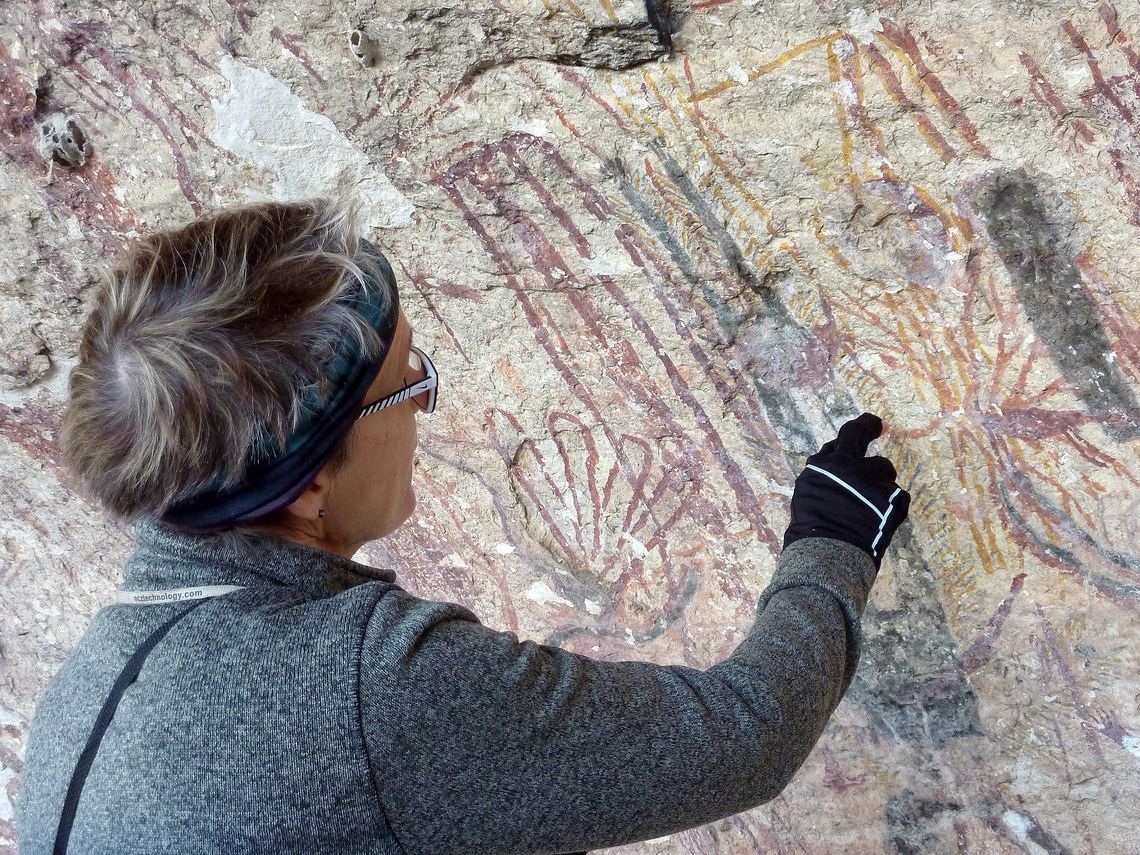
The Pecos River style murals, known as pictographs, were created by forager societies in southwest Texas and northern Mexico. These striking images, found in limestone rock shelters, depict a variety of humanlike, animal-like, and geometric figures. Some murals stretch over 100 feet long and 20 feet tall, with the desert climate of the region contributing to their remarkable preservation.
Prior to this research, many archaeologists believed these murals were developed over centuries. However, the radiocarbon dating revealed a surprising pattern: many dates clustered closely together, suggesting that these artworks were produced in a single event rather than over extended periods. Boyd stated, “This contradicts the commonly held belief that the murals were a random collection of images that accumulated over hundreds or thousands of years.”
The researchers employed advanced techniques, including plasma oxidation and accelerator mass spectrometry, to obtain 57 direct radiocarbon dates and 25 indirect oxalate dates. Bayesian modeling estimates indicate that the Pecos River style began between 5,760 and 5,385 years ago, with activity likely ceasing between 1,370 and 1,035 years ago.
Analysis of the murals revealed consistent thematic elements and a structured approach to composition, indicating a shared iconographic vocabulary among the artists. “Our analysis of the painting sequence shows that the artists followed a rule-bound color application order,” Boyd noted. This adherence to methodical techniques resulted in sophisticated compositions that were passed down through generations.
The implications of this research extend beyond mere artistic expression. The murals are embedded in a cultural landscape that conveys complex metaphysical concepts. Boyd emphasized the relevance of these ancient stories to contemporary Indigenous communities, stating, “Today, Indigenous groups in the U.S. and Mexico can relate the stories communicated through the imagery to their own cosmologies. This demonstrates the persistence of a pan-New World belief system that is at least 6,000 years old.”
As Boyd aptly summarized, the canyons of Southwest Texas serve as a vast and ancient library of painted texts, documenting the sacred stories and Indigenous knowledge of 175 generations. This discovery not only enriches our understanding of the past but also highlights the enduring legacy of these cultures in the present day.