Researchers have detected the presence of tryptophan, an essential amino acid, on the asteroid Bennu. This significant finding comes from samples collected by NASA’s OSIRIS-REx mission, which successfully landed on Bennu in 2020. The spacecraft captured approximately 4.3 ounces (121.6 grams) of rocks and dust, returning them to Earth in 2023. Scientists believe that studying Bennu is crucial as it offers insights into the early solar system and the origins of life.
The discovery of tryptophan, a compound often associated with the belief that turkey induces sleepiness, marks a milestone in astrobiology. Earlier analyses of Bennu had already revealed 14 of the 20 amino acids essential for life on Earth, along with all five biological nucleobases that form the genetic code in DNA and RNA. The latest research builds on this knowledge, suggesting that asteroids may have played a role in delivering vital ingredients for life to our planet.
José Aponte, an astrochemist at NASA’s Goddard Space Flight Center and coauthor of the study published in the journal PNAS, described the identification of tryptophan as a remarkable achievement. “Finding tryptophan in the Bennu asteroid is a big deal, because tryptophan is one of the more complex amino acids, and until now it had never been seen in any meteorite or space sample,” Aponte stated. He emphasized that the formation of these amino acids in space suggests that the building blocks of life might not have originated solely on Earth.
Bennu: A Window into the Early Solar System
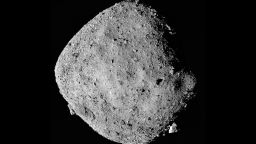
Bennu, named after an ancient Egyptian deity symbolizing creation and rebirth, is approximately one-third of a mile wide. Scientists believe it originated from a larger asteroid that broke apart between 2 billion and 700 million years ago. Its chemical makeup reflects the early solar system, dating back around 4.5 billion years. Bennu has been in orbit near Earth for about 1.75 million years, with a potential impact risk estimated at 1 in 2,700 by the year 2182.
The materials that constitute Bennu stem from supernova explosions that occurred well before the formation of the solar system. These cosmic events generated elements that were altered further by the heat of the impact that created Bennu and the radiation from the sun. This history positions the asteroid as an essential “time capsule” for understanding early solar system conditions.
In addition to tryptophan, Bennu has been found to contain ammonia and various minerals, which are critical for forming molecules like amino acids. “They’re like jigsaw pieces that are not yet assembled,” explained Angel Mojarro, a postdoctoral researcher at NASA’s Goddard Space Flight Center and lead author of the recent study. “Finding tryptophan expands the alphabet of amino acids that are produced in space and could have been delivered to Earth.”
Implications for Understanding Life’s Origins
While a total of 33 amino acids have been identified on Bennu, only 14 are utilized by living organisms on Earth to construct proteins. Tryptophan belongs to the essential category, meaning humans must acquire it through diet. Mojarro noted that further tests are necessary to confirm the presence of tryptophan in the analyzed sample, which weighed just 50 milligrams. Nevertheless, the pristine condition of the Bennu samples suggests that the findings are unlikely to result from terrestrial contamination.
George Cody, a staff scientist at the Carnegie Institution for Science, emphasized the importance of the findings. “I believe these molecules are legitimately derived from the Bennu asteroid,” he stated, highlighting that the samples returned by OSIRIS-REx provide a clearer picture of the early solar system’s composition.
Dante Lauretta, a professor of planetary science and a coauthor of the study, noted that the pristine samples allow researchers to observe fragile compounds that meteorites lose upon entering Earth’s atmosphere. He pointed out that Bennu’s parent body was a dynamic geologic world, rich in organic materials long before life emerged on our planet.
The identification of tryptophan on Bennu bolsters the notion that the building blocks of life exist beyond Earth. This is in line with the ideas of the late Harold Morowitz, who proposed that the core molecules of living organisms might be molecular “fossils” from the solar system’s inception. The discovery enhances our understanding of how life-sustaining compounds could be produced naturally in extraterrestrial environments.
The research also underscores the significance of sample return missions. While many scientists study meteorites, the uncontaminated material returned from space missions like OSIRIS-REx is crucial for achieving a comprehensive understanding of the origins of life. Kate Freeman, an esteemed professor at Penn State University, remarked that asteroids effectively acted as delivery vehicles of essential molecules to the early Earth.
In summary, the detection of tryptophan on Bennu not only adds to the growing body of evidence regarding the potential for life-sustaining compounds in space but also opens new avenues for exploring the intricate relationship between cosmic chemistry and the origins of life on Earth.