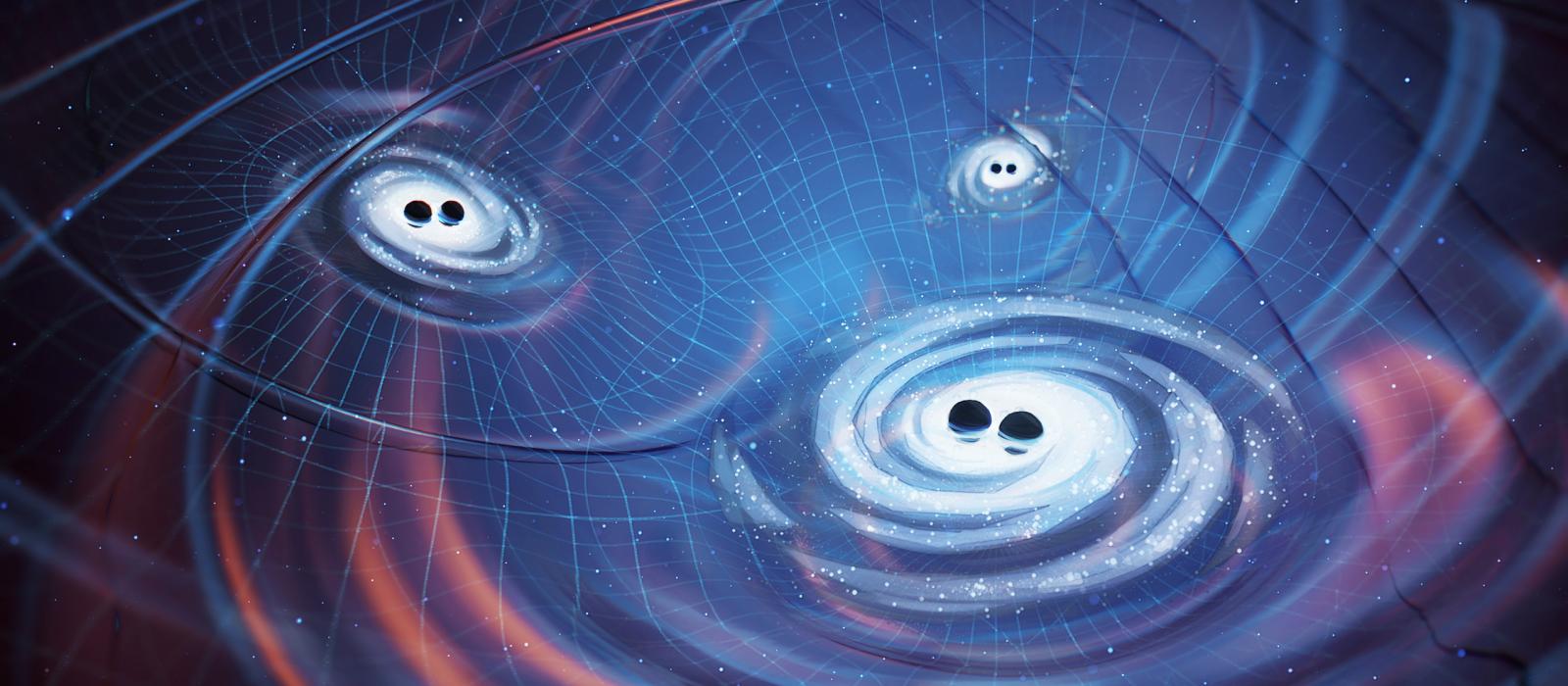
The detection of gravitational waves (GWs) has opened new avenues in astrophysics, and researchers from the University of Amsterdam have now proposed a novel approach to use these cosmic ripples to probe the mysteries of dark matter. Their detailed findings, published in the journal Physical Review Letters, suggest that GWs could play a crucial role in understanding the structure and composition of dark matter, which constitutes approximately 65% of the universe’s mass.
The research team, led by Rodrigo Vicente, Theophanes K. Karydas, and Gianfranco Bertone from the university’s Institute of Physics (IoP) and the Gravitation & Astroparticle Physics Amsterdam (GRAPPA), focuses on the dynamics of extreme mass-ratio inspirals (EMRIs). These phenomena occur when two compact objects, such as black holes or neutron stars, orbit each other and spiral inward, ultimately merging to create larger black holes.
Linking Gravitational Waves and Dark Matter
The study proposes an advanced modeling technique to analyze how dark matter influences the gravitational waves produced by such mergers. For years, previous research typically employed simplified models based on Newtonian gravity, which limited the understanding of the complex environments surrounding black holes. In contrast, this new research utilizes General Relativity, providing a more comprehensive framework to predict the gravitational signals that result from black hole mergers in dense dark matter regions.
The researchers argue that these dense concentrations, or “spikes,” of dark matter could leave distinctive signatures on gravitational wave signals. By utilizing upcoming next-generation instruments, scientists will be better positioned to identify and potentially map the distribution of dark matter across the cosmos.
A Bright Future for Gravitational Wave Research
The European Space Agency (ESA) is set to enhance these research efforts with the launch of the Laser Interferometer Space Antenna (LISA) in approximately 2029. This groundbreaking space-based observatory will employ three spacecraft equipped with six lasers to measure gravitational wave signals with unprecedented precision. LISA is expected to detect over 10,000 gravitational wave events throughout its mission, significantly advancing our understanding of the universe.
This research not only sheds light on the potential capabilities of LISA but also complements existing observatories such as the Laser Interferometer Gravitational Wave Observatory (LIGO), the Virgo Collaboration, and the Kamioka Gravitational-wave Detector (KAGRA). The insights gained from these studies may ultimately contribute to a more cohesive understanding of dark matter and its role in the universe.
By bridging the gap between gravitational wave astronomy and cosmological mysteries, the University of Amsterdam’s research paves the way for future investigations that could redefine our comprehension of both dark matter and the fundamental structure of the universe.