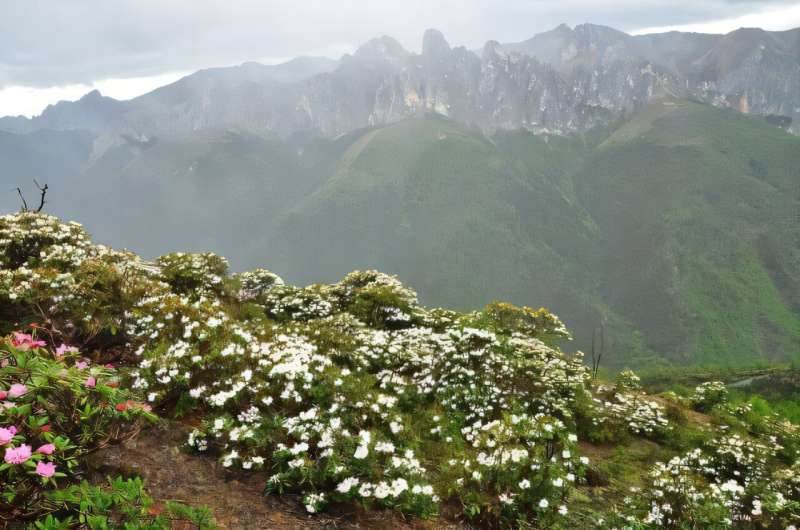
A recent study published in Science Advances has revealed significant insights into how mountain building and climate change have influenced alpine biodiversity over the past 30 million years. Researchers from the Xishuangbanna Tropical Botanical Garden (XTBG) of the Chinese Academy of Sciences, alongside international collaborators, examined five major mountain systems in the Northern Hemisphere. Their findings highlight the dual influence of geological and climatic factors in shaping the rich plant life found in alpine regions.
The study addresses longstanding questions about the mechanisms that foster the diverse plant species in mountainous areas. By integrating phylogenetic analyses with geological context and paleoclimate reconstructions, the researchers were able to trace the evolutionary history of 34 groups of flowering plants, encompassing 8,456 species. This comprehensive approach helped clarify the roles of mountain uplift and climate cooling in the assembly of alpine floras.
Key Findings on Plant Evolution
According to Xing Yaowu, co-corresponding author of the study, “Our work links plant evolution with Earth’s geological and climate history, showing how ancient mountains and climate changes have shaped alpine life in clear, predictable ways.” The research demonstrates that both mountain uplift and cooler global temperatures facilitated the expansion and diversification of alpine plant groups, regardless of their geographical origin.
For instance, the rising mountains provided new habitats conducive to the evolution of new species, while the cooling climate connected previously isolated high-altitude regions, allowing for the dispersal and mixing of plant species across different mountain ranges. The study also identified distinct evolutionary processes among various mountain systems. The Tibeto-Himalayan-Hengduan region served as a “cradle,” yielding over half of its new species from in-situ diversification. In contrast, alpine floras in Europe and the Irano-Turanian regions primarily emerged from local mid- to low-elevation lineages adapting to alpine conditions. Furthermore, the Tianshan Mountains predominantly “imported” species from the THH region.
Implications for Global Biodiversity
The researchers concluded that the active uplift of mountains consistently accelerates the formation of new plant species within specific areas, emphasizing the critical role of geological processes in biodiversity. According to Ding Wenna, first author of the study, “These asynchronous yet predictable assembly dynamics help explain why alpine plant communities differ so much from one region to another today.”
Over the last five million years, global cooling has intensified connections between cold Arctic and alpine habitats, transforming the boreal-arctic region into a “biogeographic crossroads” for floristic exchange between Eurasia and North America.
These findings not only enhance understanding of alpine biodiversity but also provide a coherent explanation for the exceptional richness of plant life in mountain regions. The study underscores the complex interplay between geological forces and climate change, offering insights that may inform conservation strategies for these vital ecosystems in the face of ongoing environmental shifts.
For more detailed information, the full study is available in Science Advances, DOI: 10.1126/sciadv.adz1888.