Researchers at the University of Konstanz have introduced a groundbreaking method for extracting liquids from delicate microstructures without causing damage. This contact-free technique employs vapor condensation to generate surface currents, effectively transporting droplets from microscopic surfaces. The findings, published in the journal Proceedings of the National Academy of Sciences on January 13, 2026, promise significant advancements in industries reliant on micro- and nanotechnology.
Microchips used in smartphones and other modern devices are built using intricate microscopic components that often require exposure to various liquids during manufacturing. Once these processes are complete, it is crucial to remove any residual liquid without harming the sensitive structures. The research team, led by physicist Stefan Karpitschka, has developed a novel approach that leverages surface tension to efficiently transport these liquids away from finished products.
Understanding the Science Behind the Method
Every liquid possesses a natural surface tension that varies between substances. For instance, water’s surface tension allows small insects, like the water strider, to walk on its surface. While this property can be advantageous, it poses challenges for micro- and nanoscale structures, which can be easily damaged even by minimal tension. The manufacturing process for microchips involves numerous complex steps, many of which rely on wet processing techniques.
As Karpitschka explains, “To transform silicon wafers into microchips, several steps require wet processing, such as etching transistors in acid baths.” Simply wiping away residual liquids is not an option due to the fragility of these structures. Additionally, boiling off remaining liquids risks leaving tiny contaminants on the surface rather than removing them entirely.
How the New Technique Works
To overcome these challenges, the research team devised a method that minimizes contact with the surfaces. This innovative approach harnesses the Marangoni force, which arises from differences in surface tension. Karpitschka notes, “When adjacent areas of a surface have different surface tensions, it creates a ‘tug-of-war’ that displaces the weaker side.” This process pulls the liquid along in the desired direction.
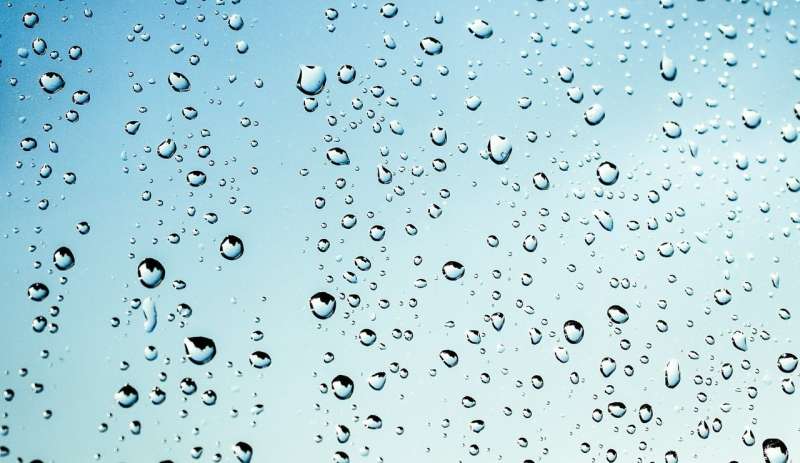
To generate the necessary difference in surface tension, the researchers introduced additional liquid into the equation. By evaporating alcohol—known for its lower surface tension compared to water—they created vapor that condenses on the existing liquid. The result is a controlled current that gathers small amounts of remaining liquid into larger drops, similar to raindrops collecting on a windowpane.
This technique has broad implications for various industries that work with micropatterned surfaces. It enables efficient drying of small structures without causing damage, facilitating the production of micro- and nanomaterials. The potential applications of this research span numerous fields, from electronics to biotechnology.
The research, titled “Vapor-mediated wetting and imbibition control on micropatterned surfaces,” marks a significant step forward in the quest for effective and gentle liquid removal methods in sensitive manufacturing processes. As industries continue to push the boundaries of technology, innovations like these will play a crucial role in enhancing production efficiency and product quality.