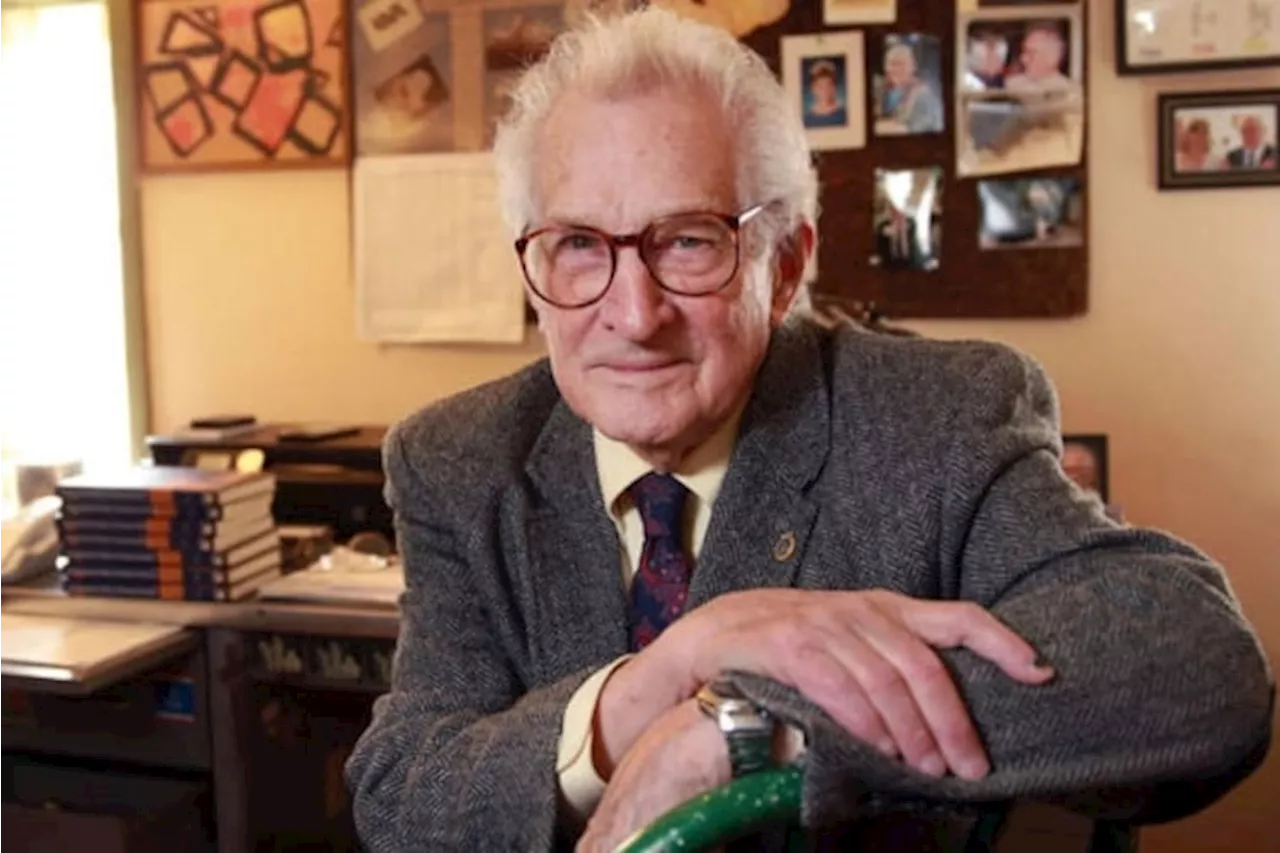
Kenneth W. Ford, a prominent physicist known for his work on hydrogen bombs and contributions to education, passed away on December 5, 2023, at the age of 99. He died of pneumonia at the Foulkeways retirement community in Gwynedd, Pennsylvania, leaving behind a remarkable legacy in the fields of nuclear physics and education.
Dr. Ford was a pivotal figure in the development of the hydrogen bomb during the early 1950s. At just 24 years old, he was recruited while studying physics at Princeton University to assist in the secretive project at the Los Alamos National Laboratory in New Mexico. Reflecting on this experience, he noted in a 2023 interview with The Inquirer, “I was told if we don’t do it, the Soviet Union will, and the world will become a much more dangerous place.”
Throughout his illustrious career, Dr. Ford collaborated with several luminaries in the field, including Albert Einstein and Robert Oppenheimer. His expertise in nuclear structure and particle physics was highly regarded, and he contributed to significant advancements in understanding nuclear fission and fusion. The hydrogen bomb was successfully tested in 1952, marking a milestone in nuclear weaponry.
Academic and Professional Milestones
Dr. Ford’s career was characterized by a commitment to education and scientific advancement. He served as the president of the New Mexico Institute of Mining and Technology from 1975 to 1982, where he oversaw substantial growth in enrollment and faculty. His leadership style was described by Michael Jackson, the current interim president of New Mexico Tech, as that of an “accomplished researcher, scholar, and teacher.”
In 1983, Ford moved to Philadelphia to lead a biotech startup before joining the American Physical Society as an education officer in 1986. He became executive director of the American Institute of Physics in 1987, a position he held until his retirement in 1993. His contributions to physics education were recognized with several awards, including a distinguished service citation from the American Association of Physics Teachers in 1976 and an AAPT medal in 2006.
Despite his pivotal role in nuclear research, Dr. Ford was vocal about his opposition to the Vietnam War. In 1968, he publicly declared his decision to refrain from working on weapons projects, stating it was “a statement of principle.” This decision highlighted his evolving perspective on the ethical implications of scientific research.
A Multifaceted Life
Born on May 1, 1926, in West Palm Beach, Florida, Dr. Ford was a valedictorian at Phillips Exeter Academy in 1944. He earned a summa cum laude bachelor’s degree in physics from Harvard University and completed his doctorate at Princeton in 1953. His academic journey was complemented by two years of service in the Navy.
Throughout his life, Dr. Ford maintained diverse interests. He was an avid pilot and glider enthusiast, enjoyed folk dancing, and was known for his love of ice cream and word games. He embraced the Quaker faith and was an active participant in community activities, even editing the Foulkeways newsletter in his later years.
Dr. Ford is survived by his children, including his son Jason, and eleven grandchildren. His family remembers him as someone who “found connections between things” and had “an active mind that went in all different directions.”
As the scientific community reflects on Dr. Ford’s extensive contributions, his legacy will undoubtedly endure through the many lives he touched—both as a researcher and as an educator. His commitment to scientific inquiry and ethical responsibility serves as an enduring example for future generations. A memorial service is scheduled for January 24, 2024, at Foulkeways at Gwynedd.