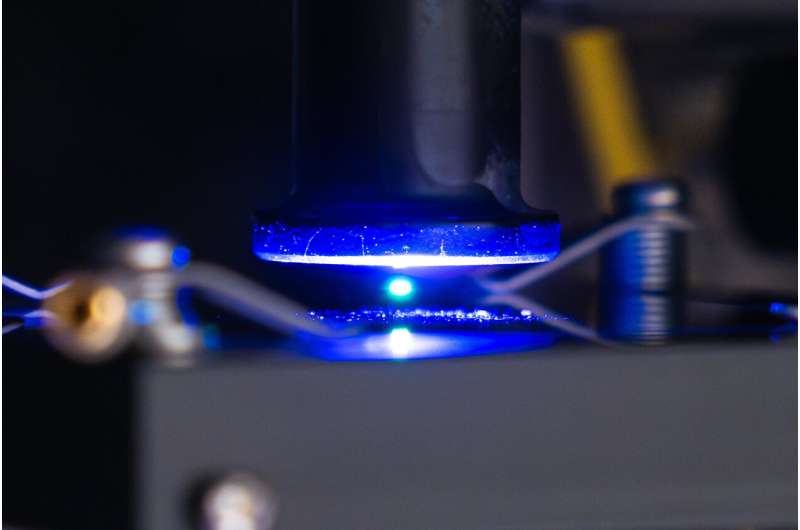
Researchers at the Institute of Science and Technology Austria (ISTA) have made significant strides in the field of acoustic levitation by overcoming a critical limitation known as “acoustic collapse.” This breakthrough, detailed in a study published on December 2, 2025, in the Proceedings of the National Academy of Sciences, allows multiple particles to be levitated simultaneously without clumping together, opening up new possibilities in materials science, robotics, and microengineering.
Acoustic levitation, which uses sound waves to suspend small objects in mid-air, has traditionally been effective for individual particles. However, when multiple particles are introduced, they tend to aggregate due to attractive forces generated by sound scattering. This phenomenon, termed acoustic collapse, has posed a significant challenge for scientists aiming to manipulate matter in three-dimensional space.
Scott Waitukaitis, an assistant professor at ISTA, initiated this research after recognizing the untapped potential of acoustic levitation for fundamental studies in physics. “Originally, we were trying to find a way to separate levitated particles so that they would form crystals—specific repetitive patterns,” said Sue Shi, a Ph.D. student in Waitukaitis’s group and the study’s first author. The breakthrough came when the team integrated electric charge into their experiments, which created electrostatic repulsion to counteract the collapse.
By developing a method to charge the particles, the researchers discovered they could manipulate their configurations—ranging from fully separated systems to those that were fully collapsed, as well as hybrid arrangements. They achieved this by bouncing the particles off a charged bottom reflector plate within the levitation setup.
Discovering New Interactions
The research revealed unexpected behaviors among the levitated particles, particularly non-reciprocal interactions that suggest violations of Newton’s third law of motion. In some instances, particles began to rotate spontaneously or chase one another, phenomena not previously observable due to the limitations of acoustic collapse.
“By introducing electrostatic repulsion, we can now maintain stable, well-separated structures,” explained Waitukaitis. “This finally gives us a controllable platform to investigate these subtle non-reciprocal effects.”
The implications of this work extend beyond mere academic interest; the ability to manipulate particles in mid-air could transform approaches in various fields. Shi noted the frustrations experienced during the research process, where the hybrid configurations initially prevented the formation of clean crystalline structures. Yet, as she presented her findings at conferences, the excitement from the scientific community helped her appreciate the novel dynamics that emerged.
Future Applications
The team’s groundbreaking method not only resolves the challenges of acoustic collapse but also paves the way for future investigations into the behavior of levitated matter. Their work holds promise for advancements in materials science and micro-robotics, where the ability to create controlled dynamic structures from small building blocks is vital.
As researchers continue to explore these new avenues, the potential applications of this technology are vast. The findings underscore the importance of innovation in scientific exploration, demonstrating how unexpected outcomes can lead to valuable discoveries.
In conclusion, the achievement by the ISTA team represents a significant leap forward in the field of acoustic levitation, showcasing the interplay between sound and electrostatics and its potential to revolutionize how scientists manipulate matter in three-dimensional space.