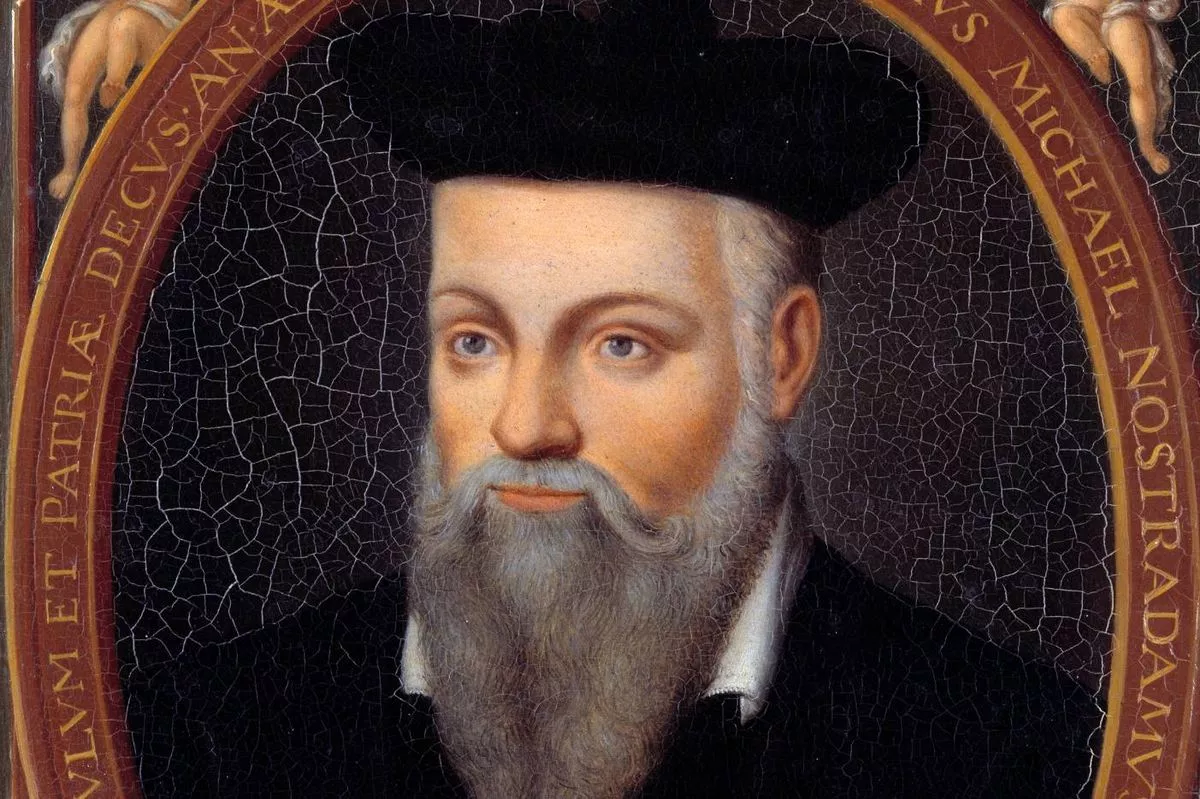
The 16th-century French astrologer Nostradamus has once again captured public attention with his predictions for 2026. Known for his cryptic quatrains, Nostradamus’ insights into future events are often interpreted in various ways. His work, particularly the 1555 publication titled ‘The Prophecies’, comprises 942 quatrains that some believe forecast significant global occurrences.
As the new year approaches, one specific quatrain raises concerns about conflict. It ominously states: “Seven months great war, people dead through evil/ Rouen, Evreux the King will not fail.” This verse has led some to speculate that it could relate to the ongoing conflict between Russia and Ukraine. Nostradamus has a history of predicting warfare; for instance, his line “Within two cities, there will be scourges the like of which was never seen” is often linked to the nuclear bombings of Hiroshima and Nagasaki during World War Two, according to reports from the Mirror.
Whimsical and Grim Predictions
Among Nostradamus’ more whimsical forecasts is a line about a “great swarm of bees” arising by night. Some speculate that this could occur in 2026, with the number 26 associated with the prediction. The exact meaning of the bees remains unclear, and the idea of an actual swarm inflicting harm seems unlikely.
Another striking prediction involves a “great man” who will be struck down by lightning during the day. As stated in the 26th verse of Century I, this figure could represent anyone from a world leader to a celebrity. The imagery of a lightning strike occurring on a red carpet has captured the imagination of many, raising speculation about who might be affected in 2026.
Nostradamus’ predictions also contain more ominous undertones. One quatrain describes a scenario in which “the Ticino will overflow with blood.” This prediction points to Switzerland‘s Italian-speaking region and could suggest a catastrophic event, whether it be a mass casualty incident or a natural disaster. The line has sparked concern over potential violence or calamity in the area.
Interpretations and Skepticism
Many skeptics point out that Nostradamus wrote in Middle French and often employed deliberately ambiguous Latin phrasing. The existence of multiple manuscripts, along with various spelling errors and interpretations over the centuries, makes deciphering his true intentions a challenge. As a result, interpretations of his quatrains can vary widely, leaving room for both fear and fascination.
While Nostradamus’ predictions often spark intrigue, they also reflect humanity’s enduring interest in understanding the future. As 2026 approaches, the ongoing discussions around these forecasts remind us of the delicate balance between prophecy and reality. Whether seen as ominous warnings or mere curiosities, Nostradamus’ quatrains continue to provoke thought and speculation, captivating audiences around the globe.