The interstellar object (ISO) 3I/ATLAS has not yielded any evidence of advanced alien technology, according to a recent study published on December 30, 2025. Utilizing the Green Bank Telescope as part of the Breakthrough Listen program, researchers conducted radio observations on December 18, 2025, the day before the object made its closest approach to Earth. Despite initial speculation surrounding the potential for discovering technosignatures, the findings indicate that 3I/ATLAS appears to be a natural astrophysical object.
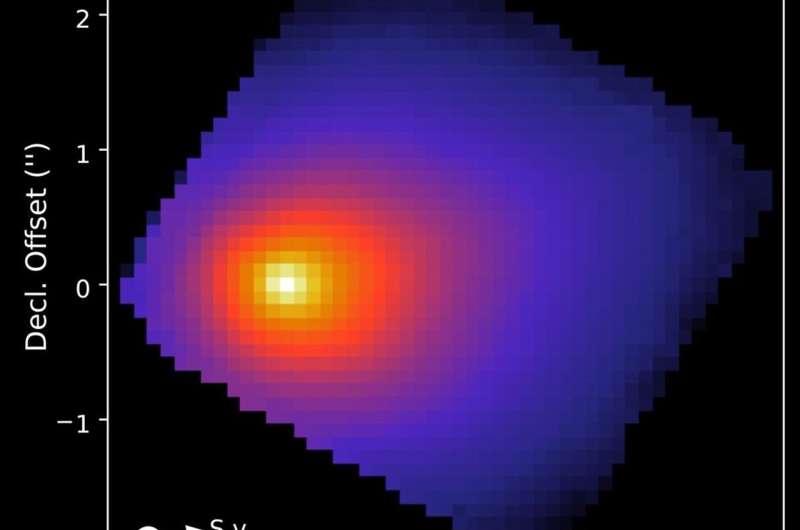
3I/ATLAS was first detected on July 1, 2025, generating significant interest among scientists and the public alike. This curiosity stemmed from its classification as an ISO—only two others, 1I/’Oumuamua and 2I/Borisov, have previously been observed entering our solar system. While the first was initially thought to be an asteroid, and the second a comet, 3I/ATLAS displays typical cometary features such as a coma and a rounded nucleus.
Following its discovery, rumors circulated about unusual attributes suggesting the presence of alien technology. However, researchers have remained cautious. The authors of the new study noted, “There is currently no evidence to suggest that ISOs are anything other than natural astrophysical objects.” They emphasized the importance of rigorous examination, given the limited number of ISOs recorded to date.
Observations and Findings
The recent study involved extensive data collection across various wavelengths, including radio, infrared, X-ray, and optical. According to the Search for Extraterrestrial Intelligence (SETI), no technosignatures were detected across these observations.
Focusing on the potential for communication from interstellar probes, researchers searched for narrowband radio signals—considered efficient for long-distance transmission. They examined four different radio bands from 1–12 GHz during the comet’s closest approach. Initial scans resulted in over 471,000 candidate signals, but further filtering narrowed these down to nine events. These were ultimately attributed to radio frequency interference rather than genuine signals from the object.
The study concluded that there are no isotropic continuous-wave transmitters above 0.1W in the vicinity of 3I/ATLAS, noting that a typical cell phone transmits at approximately 1W. This aligns with the findings of other observational studies.
Future Prospects
Despite the lack of evidence for technosignatures, the search continues. The data collected through the Breakthrough Listen program remains publicly accessible, and further observations will be conducted using various telescopes, including the Hubble Space Telescope. Scientists remain vigilant for future interstellar objects and any potential signs of advanced civilizations.
As researchers continue to explore the mysteries of our universe, the search for evidence of extraterrestrial life remains an ongoing endeavor. The case of 3I/ATLAS serves as a reminder of both the excitement and the challenges of studying objects from beyond our solar system.
This article was authored by Krystal Kasal, edited by Stephanie Baum, and fact-checked by Andrew Zinin. For more detailed findings, refer to the study by Ben Jacobson-Bell et al, published on arXiv.