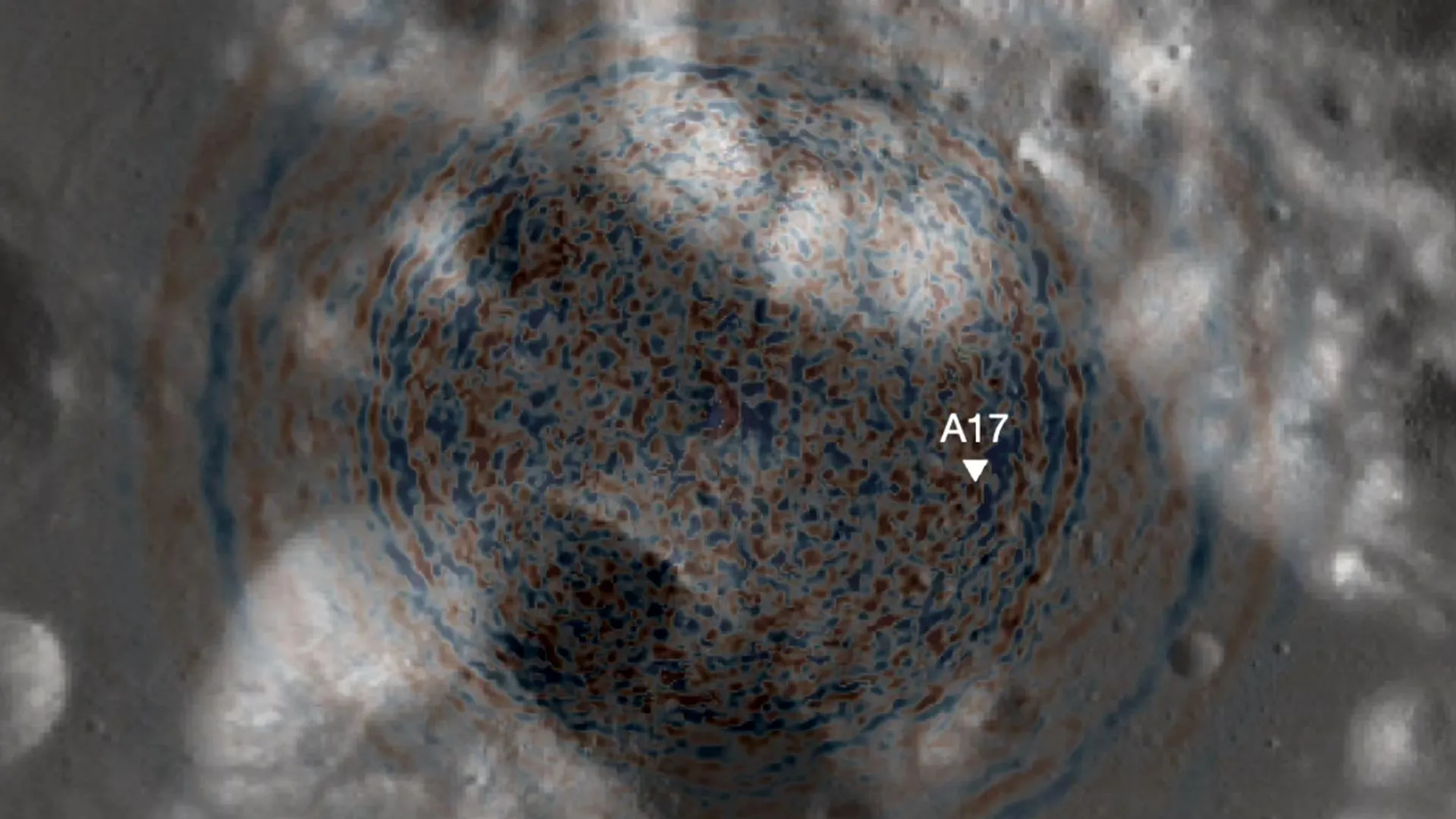
Scientists at the University of Maryland have uncovered significant findings regarding moonquakes, revealing that these seismic events, rather than meteoroid impacts, play a primary role in altering the terrain near the Apollo 17 landing site. The study, published in the journal Science Advances, indicates that a still-active fault has been generating quakes for millions of years, which could have implications for future lunar exploration and the establishment of long-term bases.
Research led by Thomas R. Watters, Senior Scientist Emeritus at the Smithsonian, and Nicholas Schmerr, Associate Professor of Geology at the University of Maryland, examined geological samples and observations collected during the historic Apollo 17 mission in 1972. The team found that the region, known as the Taurus-Littrow valley, has experienced multiple moonquakes that have caused boulder tracks and landslides, reshaping the lunar surface.
Watters and Schmerr’s analysis reveals that moonquakes with magnitudes near 3.0 have occurred in the area over the past 90 million years. These quakes have been linked to the Lee-Lincoln fault, a tectonic feature cutting through the valley floor. The ongoing activity of this fault suggests it may still be active, posing risks for any future infrastructure built nearby.
Assessing Risks for Future Lunar Operations
The study highlights the need for cautious planning regarding lunar missions. While short-duration missions, like Apollo 17, face minimal risk from moonquakes, the potential danger increases significantly for long-term stays. Using statistical modeling, the researchers estimate a one in 20 million chance of a damaging quake occurring on any given day. However, for missions lasting a decade, the risk escalates to approximately one in 5,500 days, a notable increase that cannot be overlooked.
Schmerr remarked on the implications of these findings for future missions, especially as NASA advances its Artemis program, which seeks to establish a continuous human presence on the moon. “If astronauts are there for a day, they’d just have very bad luck if there was a damaging event,” Schmerr explained. “But if you have a habitat or crewed mission up on the moon for a whole decade, the risk becomes significantly more concerning.”
The researchers advocate for modern missions to prioritize safety by avoiding construction near scarps and active faults. They also suggest that new seismic instruments should be deployed to better monitor lunar activity, enhancing the safety of future lunar operations.
Advancing Lunar Research and Technology
This research contributes to the emerging field of lunar paleoseismology, which focuses on ancient seismic activity on the moon. Unlike Earth, where geological evidence can be excavated, lunar studies must rely on data collected from previous missions and satellite imagery. Watters and Schmerr anticipate that advancements in technology and mapping, along with future Artemis missions, will facilitate more comprehensive studies of lunar seismic activity.
The study received support from NASA’s Lunar Reconnaissance Orbiter mission, which has provided valuable data since its launch on June 18, 2009. The findings underscore the importance of careful planning for lunar exploration, ensuring that investments are made to maximize safety and scientific understanding.
In summary, as NASA prepares for a new era of lunar exploration, these findings serve as a reminder of the dynamic nature of the moon’s geology and the need to address the risks posed by moonquakes in the design and planning of future lunar missions.