Innovative research led by a team from Zhejiang Gongshang University has revealed that natural plant extracts can effectively mitigate the risks associated with human bacterial pathogens in manure-amended soils. Published on November 26, 2025, in the journal Biocontaminant, the study highlights a novel approach that disrupts bacterial communication rather than directly killing these organisms.
Manure plays a vital role in enhancing soil fertility and boosting crop yields. However, its use introduces human bacterial pathogens (HBPs) into agricultural settings. These pathogens can harbor antibiotic resistance genes (ARGs) and virulence factor genes (VFGs), which can spread through mobile genetic elements (MGEs) such as plasmids. Once established in the soil, HBPs pose significant risks to both ecosystems and human health as they may transfer to crops and enter the food chain.
Traditional methods for mitigating these risks, including biochar and engineered nanoparticles, often come with high costs or environmental concerns. In light of these challenges, the study conducted by Meizhen Wang and her team explores the effectiveness of plant extracts, which have been previously studied for their potential in soil remediation and plant protection.
The research utilized manure-amended soil microcosms, combined with advanced techniques such as metagenomic profiling and targeted gene quantification. The team identified a total of 323 HBPs from a curated pathogen database and assessed the impact of three specific plant-derived compounds: curcumin (CUR), andrographolide (AG), and thymol (THY).
The findings revealed that treatment with these plant extracts led to a reduction in total HBP abundance by approximately 25–28%. Notably, the extracts selectively suppressed Actinobacteria- and Proteobacteria-associated pathogens. While the overall richness of the microbial community declined, there were no significant changes in alpha diversity.
Further analysis indicated that ARGs decreased by 20–27%, VFGs by 6–11%, and MGEs by 25–34%, with strong correlations observed among these elements. Network analysis showed significant declines in high-risk HBPs that co-hosted ARGs and VFGs.
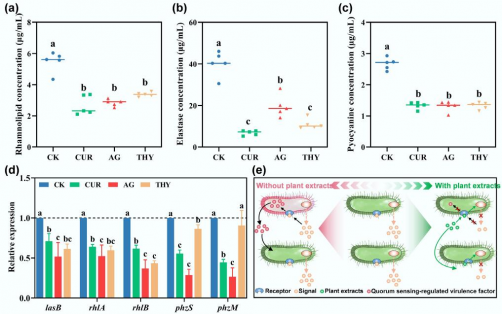
The study also investigated the mechanisms through which plant extracts exert their effects. By disrupting quorum sensing (QS) mechanisms, the extracts lowered the abundance of QS-related genes and reduced signal molecule concentrations. This disruption led to decreased virulence factor secretion, with biofilm formation inhibited by up to 40% and conjugative transfer of ARGs and VFGs suppressed by as much as 90%.
Advanced molecular docking studies confirmed that the plant compounds bound to the QS receptor LasR with greater affinity than native signal molecules, effectively blocking bacterial communication. This innovative approach to utilizing plant extracts demonstrates a method for mitigating soil-borne pathogen risks that does not rely on direct bactericidal effects, thereby reducing the selective pressure for antibiotic resistance.
The implications of this research suggest that using plant extracts as soil amendments presents an environmentally friendly alternative to conventional methods. This strategy not only addresses the risks associated with manure use but also aligns with sustainable agricultural practices aimed at enhancing soil health and reducing microbial threats.
As the agriculture sector increasingly seeks solutions to combat microbial health risks, this study provides a promising avenue for future research and application in sustainable farming practices.