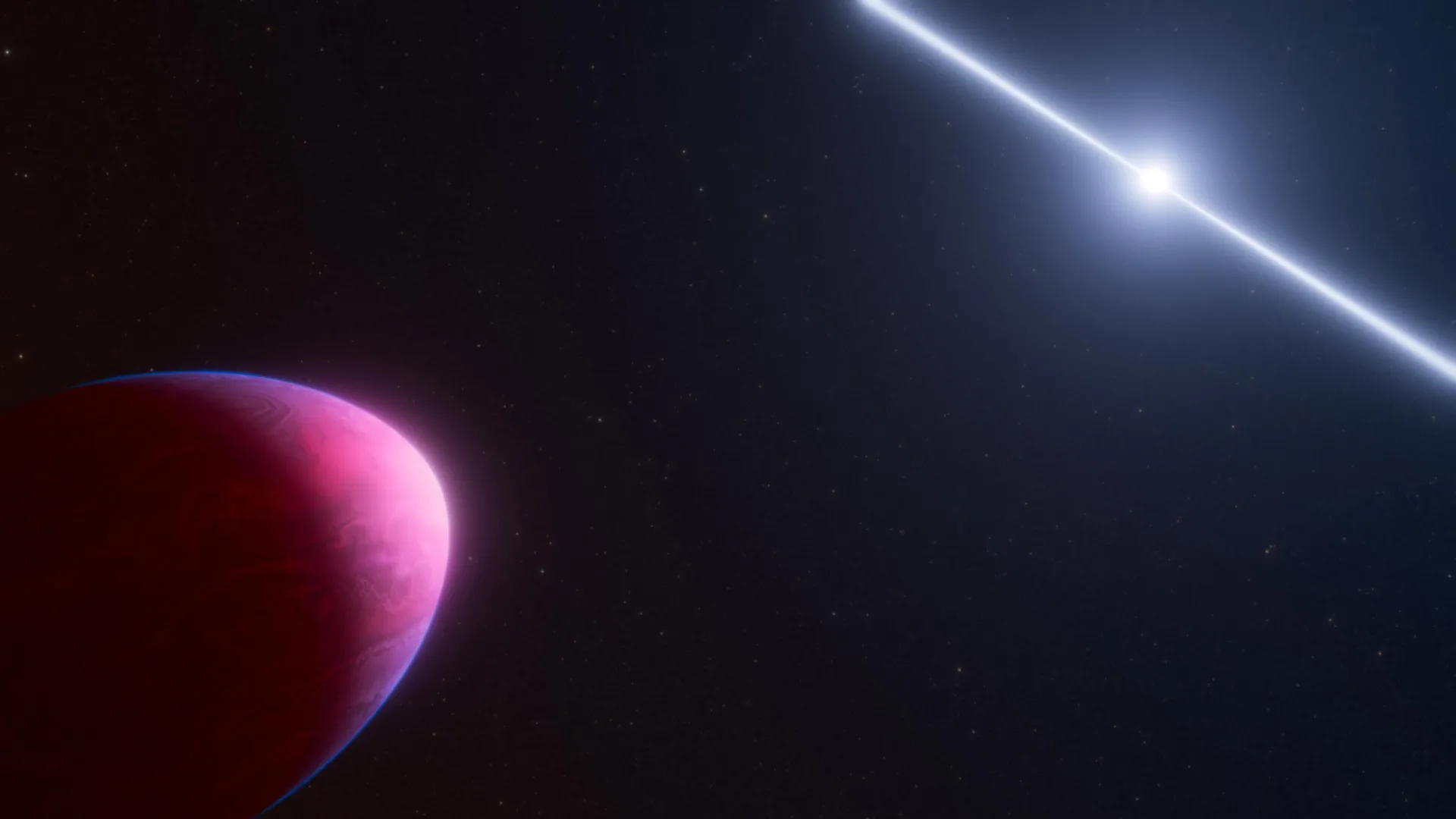
Scientists utilizing NASA’s James Webb Space Telescope have made a groundbreaking discovery, identifying a unique exoplanet that challenges existing understandings of planetary formation. This newly discovered planet, designated PSR J2322-2650b, orbits a neutron star and exhibits extraordinary characteristics, including a carbon-rich atmosphere and a shape resembling a lemon. Researchers are grappling with the implications of this discovery, which defies conventional models of how planets form.
Unusual Characteristics of PSR J2322-2650b
PSR J2322-2650b, with a mass comparable to Jupiter, has an atmosphere primarily composed of helium and carbon, diverging from the typical compositions found on known exoplanets. The planet is enveloped in dark soot-like clouds, and under immense pressure, scientists theorize that carbon within these clouds may crystallize into diamonds at its core. This scenario raises questions about the planet’s formation, as Michael Zhang, the study’s principal investigator from the University of Chicago, noted, “This is a new type of planet atmosphere that nobody has ever seen before.”
The exoplanet’s orbit around a rapidly rotating neutron star, known as a pulsar, contributes to its peculiar shape and composition. The pulsar spins at extraordinary speeds, emitting beams of electromagnetic radiation, primarily in the form of gamma rays. Despite this, the James Webb Space Telescope can observe the planet without interference from the star, allowing researchers to analyze its atmospheric properties in unprecedented detail.
Surprising Atmospheric Discoveries
Analysis of PSR J2322-2650b’s atmospheric signature revealed unexpected findings. Instead of detecting common molecules such as water and methane, scientists identified molecular carbon, specifically C3 and C2. Zhang expressed the perplexity surrounding the planet’s carbon-enriched atmosphere, stating, “It’s very hard to imagine how you get this extremely carbon-enriched composition. It seems to rule out every known formation mechanism.”
The planet orbits at a remarkably close distance of just 1 million miles from its pulsar, completing a full orbit in approximately 7.8 hours. This proximity subjects PSR J2322-2650b to intense gravitational forces, stretching its shape. The system may be part of a rare category known as “black widow” systems, where a fast-spinning pulsar gradually strips material from a smaller companion, which in this case is classified as a planet.
As noted by Roger Romani of Stanford University, potential explanations for the planet’s unusual atmosphere include the crystallization of carbon and oxygen within its interior. Romani remarked, “It’s nice to not know everything. I’m looking forward to learning more about the weirdness of this atmosphere.”
The discovery of PSR J2322-2650b was only made possible through the advanced capabilities of the James Webb Space Telescope. Positioned about 1 million miles from Earth, Webb’s infrared sensitivity allows it to detect faint signals, which would be overwhelmed by Earth’s atmospheric heat if observed from the ground.
The findings from this research have been accepted for publication in The Astrophysical Journal Letters and highlight the need for a reevaluation of existing theories regarding planetary formation and classification. Scientists involved in the study, including contributors from the University of Chicago, are eager to further investigate the implications of this extraordinary discovery.