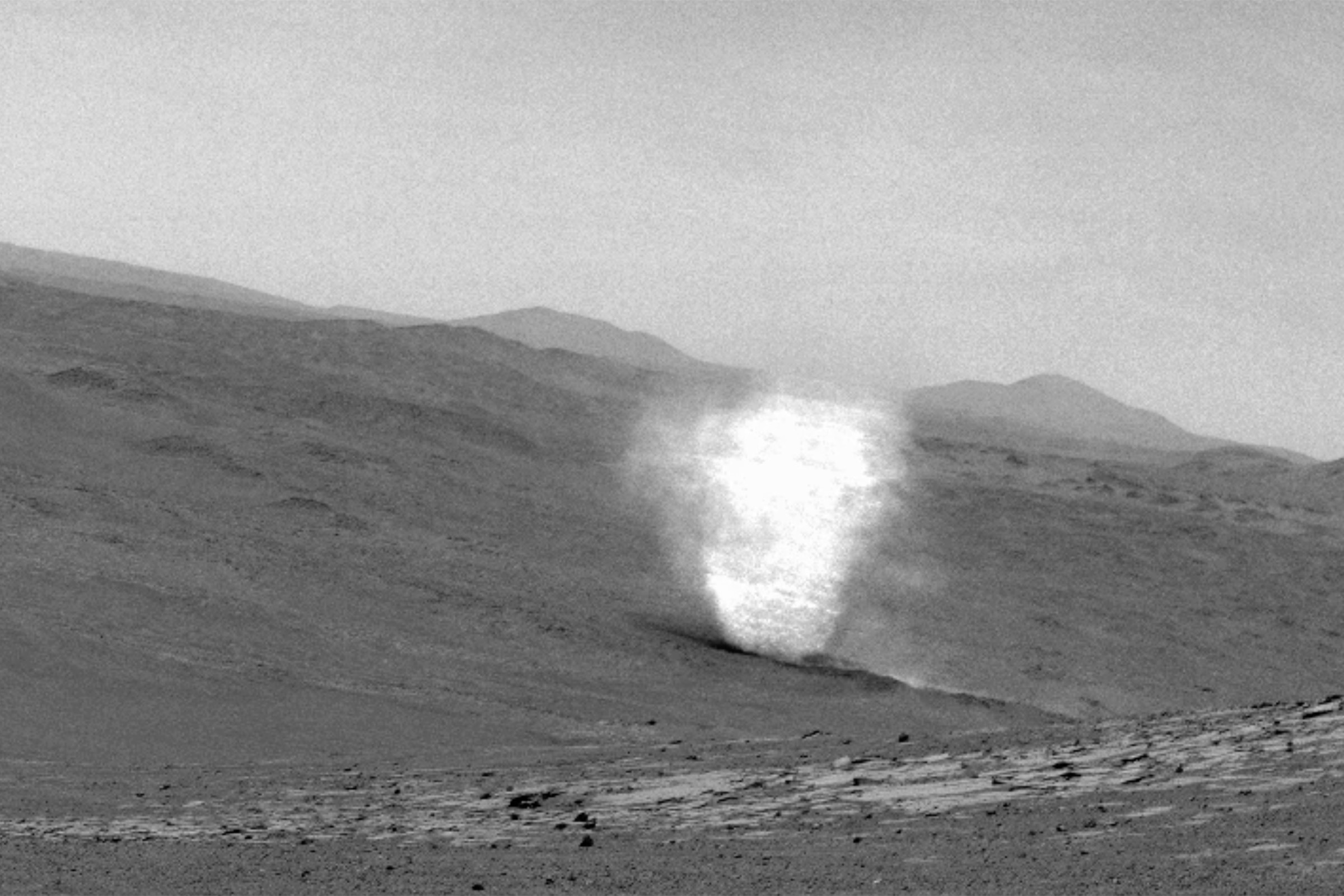
NASA’s Perseverance rover has made a groundbreaking discovery on Mars, capturing evidence of lightning discharges occurring within dust devils, a phenomenon that had long been theorized but never observed. This significant finding, detailed in a study published in the journal Nature, confirms the presence of electrical activity in the Martian atmosphere, marking a notable advancement in our understanding of the Red Planet’s weather systems.
Dust devils, which are common on Mars, are whirlwinds formed by rapidly rising warm air that interacts with the cooler air surrounding it. These whirlwinds can generate static electricity through a process similar to the triboelectric effect, where dust particles collide and create an electrical charge. As Baptiste Chide, a planetary scientist at L’Institut de Recherche en Astrophysique et Planétologie, explained, “Triboelectric charging of sand and snow particles is well documented on Earth, particularly in desert regions, but it rarely results in actual electrical discharges.” On Mars, the thinner atmosphere allows for the generation of sparks with far less charge than is needed on Earth.
The detection of these lightning strikes had eluded scientists for years, despite their occurrence on other celestial bodies, such as Saturn and Jupiter. The breakthrough came fortuitously through the rover’s SuperCam instrument, which is primarily designed to analyze rock acoustics rather than electrical phenomena. Since its launch in 2021, the SuperCam has recorded a total of 55 electrical disturbances, with 16 of these occurring during the passage of a dust devil over the rover.
Interestingly, the frequency of these discharges did not increase during Martian dust storms, leading scientists to conclude that the dust devils are indeed the source of electrical activity. The rover’s unexpected proximity to these dust devils allowed researchers to validate their hypothesis more effectively than anticipated.
This discovery carries profound implications for Martian chemistry. Lightning can instigate unique chemical reactions, potentially influencing the planet’s surface composition and enhancing the likelihood of creating complex compounds, including organic molecules. Such findings could reshape our understanding of the potential for life beyond Earth.
As research continues, the Perseverance rover remains at the forefront of Martian exploration, providing valuable data that may one day help answer the question of whether life ever existed on the Red Planet. This latest revelation is a testament to the rover’s capabilities and the ongoing commitment of NASA to unravel the mysteries of our solar system.