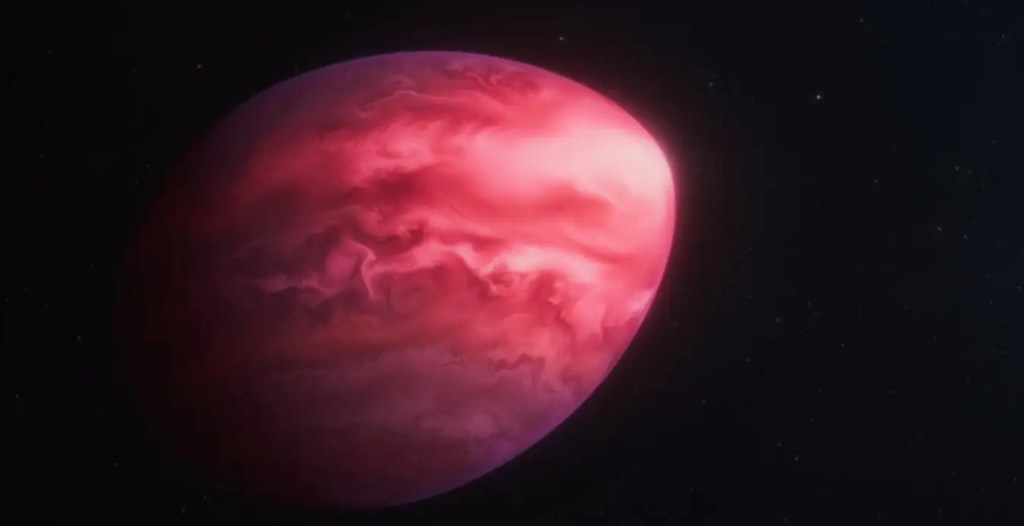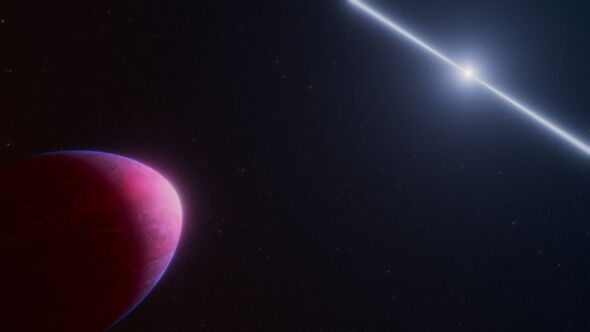
Astronomers have made a remarkable discovery of a new exoplanet, named PSR J2322-2650b, utilizing the James Webb Space Telescope. This planet, which has a distinctive lemon-like shape, presents an atmosphere that defies current scientific understanding, leaving researchers intrigued about its formation and characteristics.
The exoplanet is similar in mass to Jupiter and orbits a pulsar, which is a type of neutron star. Pulsars are known for their rapid rotation and intense gravitational fields. Interestingly, PSR J2322-2650b orbits its pulsar at a mere 1 million miles away, completing a full orbit approximately every 8 hours. This proximity to its host star generates tidal forces that contribute to its unusual ellipsoid shape.
The discovery of this exoplanet adds to the growing list of planets orbiting pulsars, which first gained attention in 1992 with the confirmation of the exoplanets Poltergeist and Phobetor. However, PSR J2322-2650b stands out due to its atmospheric composition, which comprises primarily helium and carbon. Notably, it is believed to possess clouds of carbon soot that could condense and form diamonds, creating a unique weather phenomenon on the planet.
“This was an absolute surprise,” stated Peter Gao, a team member from the Carnegie Earth and Planets Laboratory. He elaborated on the team’s astonishment upon receiving the data, remarking, “What the heck is this? It’s extremely different from what we expected.”
The findings reveal that the atmosphere of PSR J2322-2650b contains molecular carbon in forms such as C3 and C2, which are not typically found in the atmospheres of other exoplanets. Michael Zhang, principal investigator at the University of Chicago, noted the uniqueness of the host star, which has the mass of the Sun but is compressed to the size of a city. This combination results in an atmosphere unlike any previously observed in exoplanet studies.
Unique Observational Opportunities
The research team has benefited from the ability to observe the planet illuminated by its pulsar while not being able to view the pulsar itself. This situation provides a clearer spectral analysis, allowing scientists to study the system in greater detail than is usually possible with exoplanets. Graduate student Maya Beleznay from Stanford University highlighted this advantage, explaining that the pristine spectrum enables a more comprehensive understanding of the planet’s characteristics.
PSR J2322-2650b is categorized as part of a “black widow” system, a rare type where a rapidly spinning pulsar is paired with a small, low-mass companion. In typical black widow systems, the pulsar erodes its companion star through intense radiation and high-energy particles. In this case, however, the companion is recognized as an exoplanet by the International Astronomical Union, rather than a star.
Zhang remarked on the peculiarities of the planet’s formation, stating, “Did this thing form like a normal planet? No, because the composition is entirely different. Did it form by stripping the outside of a star, like ‘normal’ black widow systems are formed? Probably not, because nuclear physics does not make pure carbon.”
The discoveries surrounding PSR J2322-2650b challenge existing theories about planetary formation and atmospheric composition. As scientists continue to analyze data from the James Webb Space Telescope, the findings may lead to significant advancements in our understanding of exoplanets and their diverse characteristics.