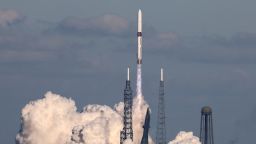
Michaela Benthaus, a 33-year-old aerospace and mechatronics engineer at the European Space Agency, has made history by becoming the first wheelchair user to travel past the Kármán Line, the boundary commonly recognized as the edge of space, located at an altitude of 100 kilometers (62 miles) above sea level. Her groundbreaking journey took place on March 2, 2024, aboard a Blue Origin New Shepard capsule, launching from the company’s facilities near Van Horn, Texas. This mission, designated NS-37, marks the 16th suborbital space tourism flight conducted by Blue Origin, a venture founded by Jeff Bezos in 2000 aimed at expanding access to space.
Benthaus expressed her lifelong dream of space travel, a desire that seemed unattainable due to her spinal cord injury sustained in a mountain biking accident in 2018. “I always wanted to go to space,” Benthaus said in a preflight interview. “But I never really considered it something which I could actually do.” Her reflections highlight the barriers often faced by individuals with disabilities, as she previously thought, “Maybe space is for people who have an amputated leg but still can walk a little bit.”
Her journey not only fulfills a personal aspiration but also serves as a platform for advocacy. Benthaus aims to enhance the experiences of future passengers with disabilities and is raising funds for Wings for Life, a nonprofit dedicated to spinal cord injury research.
Flight Details and Preparations
The flight aboard New Shepard lasted approximately 10 minutes, during which the rocket accelerated to speeds exceeding three times the speed of sound, ultimately surpassing the Kármán Line. Passengers experience a brief period of weightlessness at the peak of the flight, as gravity begins to pull the capsule back toward Earth.
To prepare for her unique experience, Benthaus planned to use a special strap to secure her legs, allowing her to exit her seat and enjoy the sensation of microgravity while taking in the remarkable views of Earth from the capsule’s windows. She previously experienced microgravity during a parabolic training flight, which she felt would help her focus on the panoramic sights rather than performing acrobatics in the cabin.
The mission also included Hans Koenigsmann, a former executive at SpaceX and a friend of Benthaus, who was trained to assist her if needed. “It was not clear going into the flight whether I would be able to return to my seat without assistance,” she noted, underscoring the challenges faced by travelers with disabilities in such unprecedented environments.
Significance and Future Goals
Benthaus’s journey represents not only a personal triumph but also a significant step forward for inclusivity in space travel. Her experience could inspire changes in how future missions accommodate individuals with disabilities. She plans to analyze the effectiveness of her leg strap and gather insights that could benefit others in similar situations.
“I want to see how this leg strap works — and if not, what could maybe be improved in the future,” Benthaus stated. Her determination to contribute to the advancement of accessibility in space exploration emphasizes the potential for broader participation in activities traditionally reserved for a select group.
Michaela Benthaus’s historic flight is a testament to resilience and the spirit of exploration. As she looks back on her journey, she not only celebrates a personal milestone but also opens doors for others who aspire to reach for the stars, irrespective of their physical challenges.