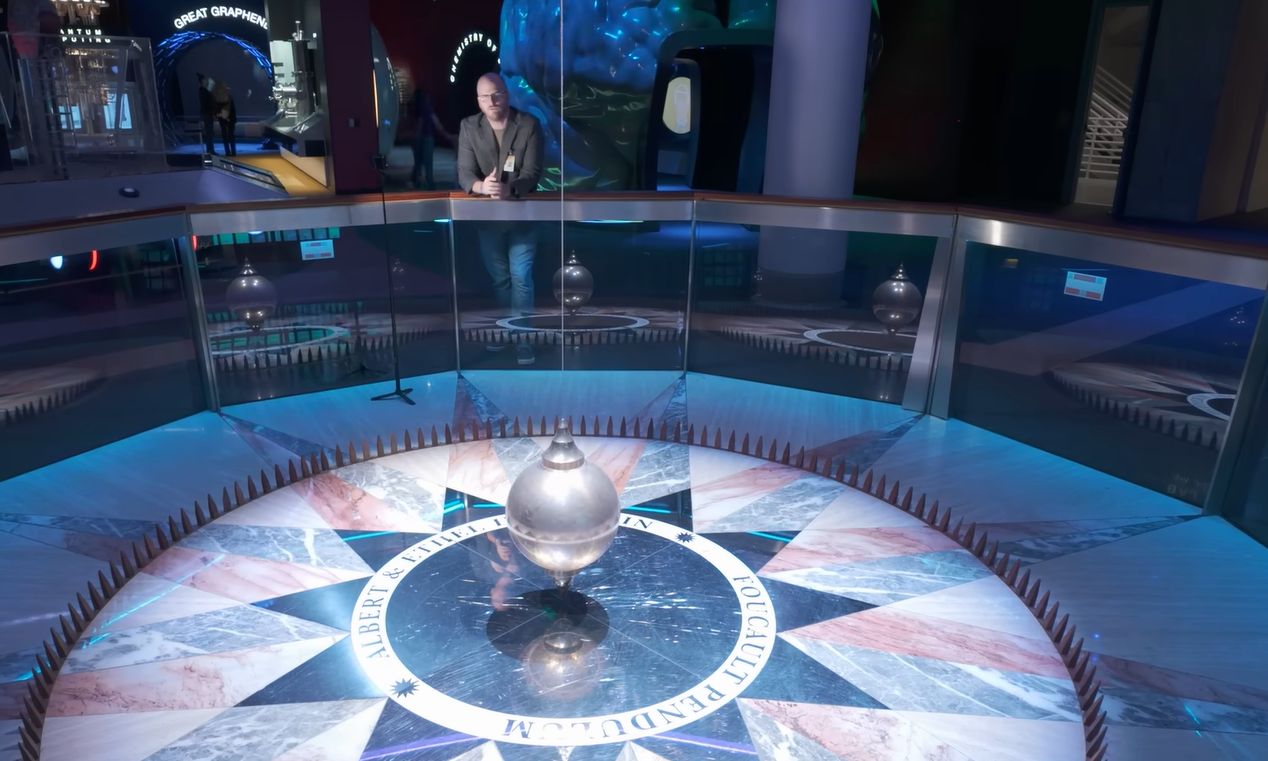
The Houston Museum of Natural Science has reported an unusual incident: their Foucault pendulum has stopped swinging for the first time since its installation in the 1970s. This noteworthy occurrence is attributed to a fault in the electromagnetic system that powers the pendulum, necessitating repairs to restore its function.
The museum has provided an explainer video detailing the mechanics of the Herzstein Foucault pendulum, which serves as an educational tool illustrating the physics behind its operation. Weighing 81.6 kg, the pendulum completes a full rotation every 48 hours. As it swings, pins along its circumference are tipped over sequentially, showcasing the pendulum’s precession.
Understanding the Foucault Pendulum’s Science
Originally invented by Léon Foucault in 1851, the Foucault pendulum serves as an experimental demonstration of the Earth’s rotation. Despite appearing to swing back and forth in a fixed line, the pendulum’s plane of oscillation gradually shifts, creating the illusion that it rotates around its attachment point. This fascinating phenomenon varies depending on the pendulum’s geographic location on the globe.
At the North and South Poles, the pendulum precesses in precisely 24 hours, while at the Equator, it does not exhibit any precession. This characteristic makes the Foucault pendulum not only a captivating exhibit but also a point of contention for those who dispute the spherical nature of the Earth.
Repairing the Houston Museum’s Pendulum
The museum’s team is optimistic about the repair process for the pendulum’s mechanism. There is a strong desire among staff and visitors alike to witness the restoration, including a potential behind-the-scenes look at how the pendulum operates. As the museum works towards resolving the issue, they hope to bring back the captivating display that has entranced audiences for decades.
In the meantime, the Houston Museum of Natural Science continues to emphasize the educational value of the Foucault pendulum, which illustrates fundamental principles of physics and the Earth’s dynamics. Despite its temporary halt, the pendulum remains a significant attraction, embodying the intersection of art and science that has defined the museum since its establishment.