A recent study led by Prof. Zhixue Du from the Guangzhou Institute of Geochemistry at the Chinese Academy of Sciences has revealed that significant amounts of water may have been stored deep within Earth’s mantle during its early, tumultuous years. This discovery, published in the journal Science on December 11, 2025, suggests that as the planet cooled from a molten state, a hidden reservoir of water played a crucial role in shaping Earth’s geological and environmental history.
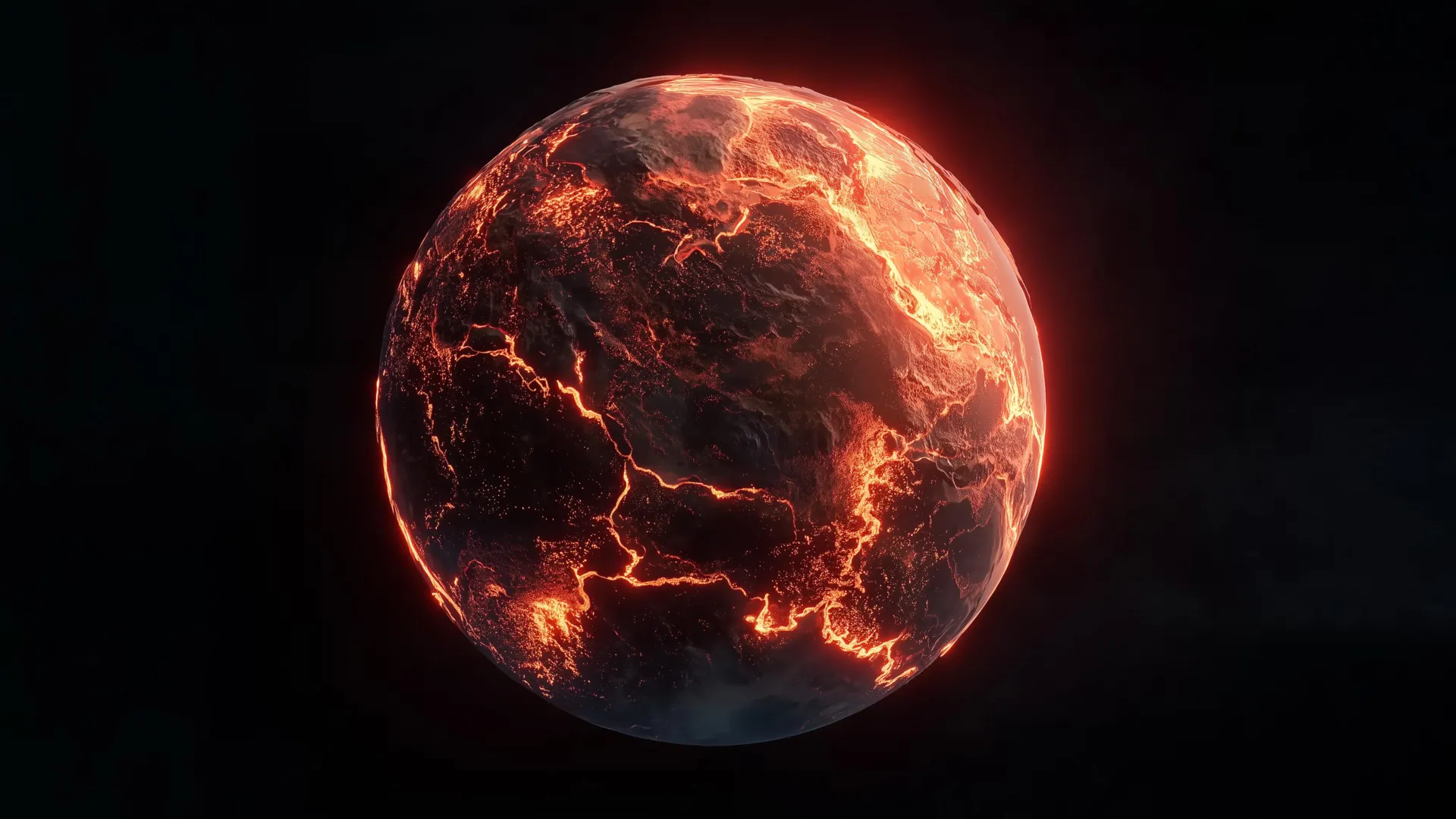
Around 4.6 billion years ago, Earth was a starkly different place, characterized by relentless impacts from space that kept its surface and interior in a molten state. During this period, the planet was largely covered by a global ocean of magma, where temperatures soared so high that liquid water could not exist. Today, oceans blanket approximately 70% of Earth’s surface, but the question of how water persisted through this extreme transition has long intrigued scientists.
The research team conducted experiments to explore the storage capacity of bridgmanite, the most abundant mineral in Earth’s mantle, under conditions mimicking the intense pressures and temperatures found deep within the Earth. Previous studies indicated that bridgmanite could hold only minimal amounts of water, but these findings were based on tests conducted at lower temperatures.
To validate the new hypothesis, the researchers faced two primary challenges: replicating the extreme conditions found over 660 kilometers below the surface and detecting minuscule water traces within mineral samples. To achieve this, they engineered a diamond anvil cell system coupled with laser heating techniques that could reach temperatures as high as 4,100 °C. This innovative setup allowed them to simulate deep mantle conditions accurately and assess how heat influences mineral water absorption.
Advanced analytical techniques, including cryogenic three-dimensional electron diffraction and NanoSIMS, were employed to map water distribution within bridgmanite. Collaborating with Prof. LONG Tao from the Institute of Geology of the Chinese Academy of Geological Sciences, the team utilized atom probe tomography (APT) to achieve high-resolution imaging of their samples, confirming the structural incorporation of water within the mineral.
The results of their experiments revealed that bridgmanite’s water retention ability increases significantly at higher temperatures. This challenges the long-held belief that the lower mantle is nearly devoid of water. The researchers’ models indicate that this previously underestimated reservoir could contain water volumes equivalent to 0.08 to 1 times the volume of today’s oceans, five to one hundred times greater than earlier estimates.
The implications of this hidden water reservoir extend beyond mere storage. The researchers propose that this water acted as a “lubricant” for Earth’s internal geological processes. By lowering the melting point and viscosity of mantle rocks, it facilitated internal circulation and plate motion, providing the planet with long-term geological energy. Over geological timescales, some of this water gradually returned to the surface through volcanic and magmatic activity, contributing to the formation of Earth’s early atmosphere and oceans.
This study suggests that the deep water reservoir may have been instrumental in transforming Earth from a hostile, fiery world into a vibrant planet capable of supporting life. As scientists continue to unravel the mysteries of Earth’s early history, this research highlights the critical role that hidden water reservoirs played in shaping our planet’s evolution.