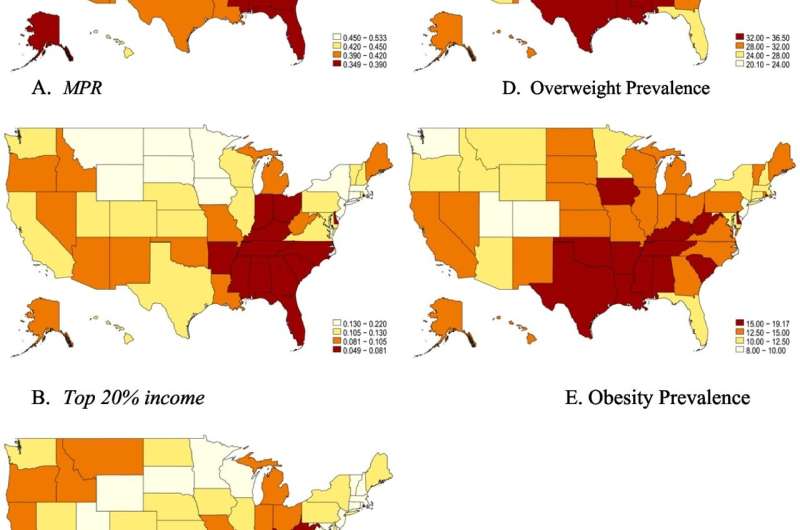
Recent research led by economists from Ball State University reveals a troubling connection between childhood obesity and economic mobility in the United States. The study indicates that childhood obesity may significantly hinder an individual’s ability to achieve upward mobility, potentially limiting their pursuit of the “American Dream.”
The research, titled “Weighing Down the Future: Long-term Effects of Childhood Obesity on Intergenerational Mobility,” has been accepted for publication in the Journal of Population Economics and highlights the long-lasting implications of childhood obesity beyond health concerns.
By utilizing data from the National Longitudinal Study of Adolescent to Adult Health (Add Health), researchers linked participants’ records to the Opportunity Atlas to examine the correlation between adolescent weight and future economic prospects. Findings indicate that adolescents classified as obese are approximately 20 percentile points lower in adult income rank compared to their normal-weight peers.
Moreover, this study highlights a significant reduction in access to high-opportunity neighborhoods for those affected by childhood obesity. Specifically, children with obesity face a 17.6 percentage-point decrease in the likelihood of residing in low-poverty neighborhoods as adults.
Dr. Maoyong Fan, a professor of economics at Ball State’s Miller College of Business and co-author of the study, emphasized that the implications of childhood obesity extend far beyond health issues. He stated, “Childhood obesity isn’t just a health crisis. It is an economic mobility crisis.” The study outlines how the repercussions include lower educational attainment, ongoing health problems, and challenges in the labor market, such as increased job discrimination.
The researchers also found that the economic penalties are disproportionately felt among certain groups. The disparities are evident across several factors:
– **Gender**: Females experience greater mobility penalties than males.
– **Socioeconomic Status**: The consequences are more severe for children from low-income families.
– **Geography**: The effects are particularly pronounced in the South and Midwest, areas identified as “obesity hotspots” and “opportunity deserts.”
Dr. Yanhong Jin, a co-author and professor at Rutgers University, noted, “For millions of American families, excess weight in childhood may be quietly closing doors to opportunity.” This cycle could perpetuate inequality across generations.
As policymakers consider approaches to combat childhood obesity, the study suggests that prevention should be viewed as a crucial investment in economic opportunity, not merely a health priority. Dr. Man Zhang, an assistant professor at Renmin University in China, explained, “Interventions that reduce childhood obesity can deliver benefits well beyond lower medical spending.” The potential advantages include enhanced educational attainment, improved job prospects, and increased economic mobility for future generations.
This research underscores the urgent need for comprehensive strategies to address childhood obesity, recognizing its far-reaching effects on individuals and society as a whole. As the dialogue around this public health crisis evolves, it is essential to understand its implications for economic equality and social mobility.