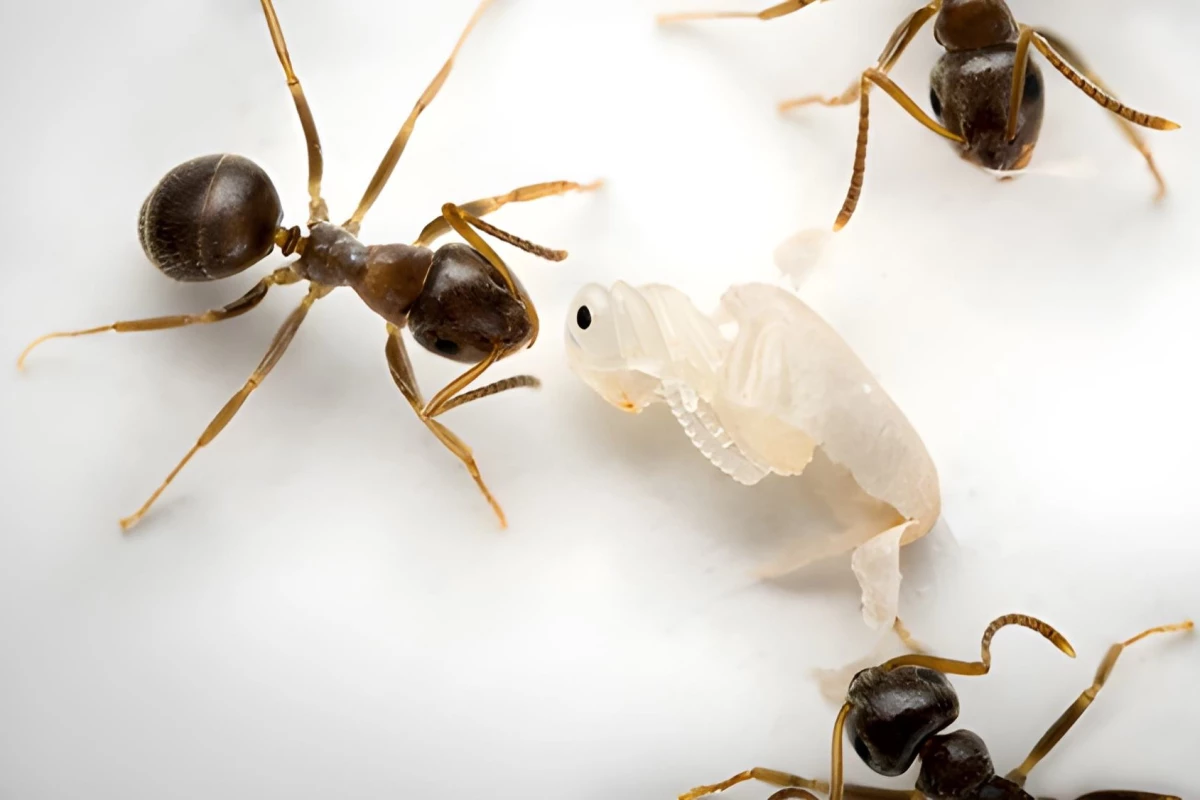
Ant pupae exhibit a remarkable form of self-sacrifice when infected by disease, according to new research conducted in Austria. In a study published in the journal Nature Communications, scientists reveal that these immobile pupae release a specific scent when infected with a terminal illness. This scent prompts worker ants to take drastic measures to protect their colony.
When a pupae is afflicted with an incurable infection, it emits a detectable chemical signal from its cocoon. This signal alerts worker ants, who respond by unpacking the cocoon and creating small openings in the pupae’s body through biting. The workers then apply formic acid, a natural antimicrobial substance produced by ants, to disinfect the infected pupae. While this process effectively eliminates the infection, it also results in the death of the pupae.
Erika Dawson, the first author of the study from the Institute of Science and Technology Austria (ISTA), explains, “What appears to be self-sacrifice at first glance is, in fact, also beneficial to the signaler: it safeguards its nestmates, with whom it shares many genes.” By signaling their illness, these terminally ill ants contribute to the overall health of the colony, enabling it to thrive and reproduce, thus indirectly passing on their genetic legacy.
Ants Functioning as a Superorganism
The findings reinforce the theory that ant colonies operate as a superorganism, where individual ants resemble the cells in a human body. The worker ants engaged in the disinfection process are analogous to immune cells that are attracted to diseased cells through chemical signals. This phenomenon is recognized in immunology as the “find-me-and-eat-me signal.”
In a follow-up experiment, ISTA researchers collaborated with Thomas Schmitt from the University of Würzburg to test their hypothesis. They transferred scent molecules from infected ant pupae to healthy ones. The result confirmed their theory: worker ants targeted and destroyed the pupae that carried the disease scent.
Interestingly, the study found that only worker ant pupae emitted the “find-me-and-eat-me” signal. Queen ant pupae, likely possessing stronger immune systems, did not emit this scent, suggesting they can better withstand infections.
Implications for Ant Behavior
This research complements earlier findings indicating that ants infected with fungal spores begin to socially distance themselves from the colony. In extreme cases, they even construct separate entrances and tunnels within the nest. Additionally, the phenomenon of “terminal altruism” is well-documented, where aging ants remove themselves from the colony to die away from their nestmates.
The newly identified behavior of pupae signaling their illness adds another layer to our understanding of ant social structures and disease management. As researchers delve deeper into the complexities of these behaviors, the findings continue to highlight the sophisticated interactions within ant colonies.
The study underscores the intricate balance between individual sacrifice and the collective health of the colony, showcasing the fascinating dynamics of one of nature’s most successful social organisms.