Images of plants on pottery dating back up to 8,000 years may represent the earliest known evidence of human mathematical thought, according to a recent study. Researchers from the Hebrew University of Jerusalem investigated pottery produced by the Halafian people in northern Mesopotamia, who thrived between 6200 BC and 5500 BC. Their findings, published last month in the Journal of World Prehistory, highlight a geometric sequence in the depiction of floral motifs with petal counts of four, eight, 16, 32, and 64.
The study’s lead authors, Yosef Garfinkel, a professor of archaeology, and Sarah Krulwich, a research assistant and MA student, analyzed pottery fragments from 29 Halafian sites. These excavations spanned over a century, beginning in 1899. They discovered that nearly all of the 375 fragments featuring flowers adhered to a doubling sequence that divides a circle into symmetrical units.
Garfinkel noted, “The strict adherence to these numbers, which are repeated in examples from different sites over hundreds of kilometers, cannot be accidental, and indicates that it was done intentionally.” This mathematical reasoning may have developed as the Halafians managed increasingly complex village communities in the Near East.
The researchers suggest that the ability to divide space evenly, as reflected in these floral patterns, likely had practical applications, such as sharing harvests or allocating communal fields. Garfinkel explained, “The ability to divide space evenly, reflected in these floral motifs, likely had practical roots in daily life.”
Interestingly, the study highlights that substantial written evidence of mathematical systems only emerged in the third millennium BC. The Sumerians, known for their base-60 numerical system, have been suggested to have preceded this with a base-10 system. However, the use of numbers like four, eight, 16, and 32 by Halafians does not align with these systems, indicating a potentially earlier and simpler level of mathematical thinking prevalent in the region during the 6th and 5th millennia BC.
Sarah Krulwich emphasized the significance of the findings, stating, “These patterns show that mathematical thinking began long before writing. People visualized divisions, sequences, and balance through their art.” This research contributes to the field of ethnomathematics, which explores mathematical knowledge embedded in cultural expressions among non-literate communities.
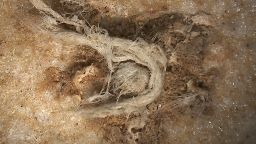
The notion that artifacts can provide insight into early mathematical thinking is not new. Some experts propose that evidence of string-making by Neanderthals over 40,000 years ago indicates a foundational understanding of mathematical concepts such as pairs and sets.
Garfinkel remarked that this discovery represents a vital step in human cognitive development, suggesting that basic division skills were essential for the later emergence of complex mathematics. He noted, “Like everything in human development, aspects of mathematics also developed in an evolutionary way from the simple to the more complex.”
Additionally, Garfinkel and Krulwich highlighted the uniqueness of Halafian pottery as an early instance of applying an understanding of symmetry in art. The floral motifs do not depict edible crops, indicating their purpose was aesthetic rather than agricultural or ritualistic. “These vessels represent the first moment in history when people chose to portray the botanical world as a subject worthy of artistic expression,” they stated.
Despite the compelling nature of the study, not all experts are convinced by the findings. Jens Høyrup, a Senior Associate Professor Emeritus at Roskilde University in Denmark and a specialist in Mesopotamian mathematics, criticized the researchers’ conclusions. He described the symmetry in Halafian floral depictions as “an isolated incident of mathematical technique” rather than evidence of a broader mathematical reasoning system.
Høyrup explained, “If you have to divide a circle nicely, at first you make a diameter — then it’s two. Then you divide the other way, so you have four. It doesn’t amount to any search for a geometric ascending sequence; it’s simply halving.” He acknowledged the presence of symmetry but argued that it does not imply a developed mathematical system, stating, “There’s no higher mathematics; it’s just the simplest way to make divisions.”
This debate highlights the complexities surrounding the understanding of early mathematical thought and its evolution. As research continues, the study of ancient artifacts will likely yield further insights into the mathematical capabilities of our ancestors.