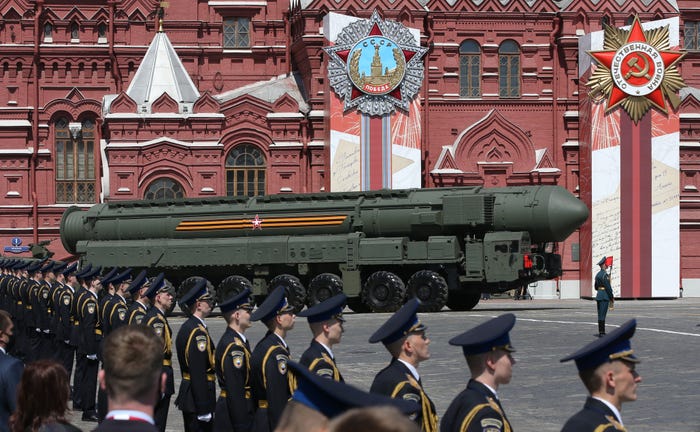
The expiration of the New START treaty this week has left the United States and Russia without a nuclear arms control agreement for the first time in over three decades. The treaty, which originally took effect in 2011, limited both nations to deploying up to 1,550 nuclear warheads and 700 launchers, and included a verification process to ensure compliance. With no replacement or extension in place, experts warn that this development could escalate the risk of nuclear miscalculation and increase tensions between the two powers.
The New START treaty provided a framework for transparency, allowing both the US and Russia to exchange information about their nuclear arsenals. Without these verification processes, defense planners are left in uncertainty, potentially leading to a return to worst-case scenario assumptions regarding each other’s military actions. According to Mackenzie Knight-Boyle, a senior research associate with the Nuclear Information Project at the Federation of American Scientists, this situation raises concerns about increased paranoia and miscommunication.
Implications of a Treaty-Free Environment
The absence of a formal agreement means that both nations may feel compelled to expand their nuclear capabilities. The United States currently possesses around 400 intercontinental ballistic missiles (ICBMs), all of which typically carry a single warhead. However, about half of these missiles could be modified to carry multiple warheads, potentially doubling the US ICBM arsenal from 400 to 800. The Russian Federation, similarly, has the capacity to ramp up its nuclear forces swiftly.
Arms control experts like Eliana Johns emphasize that without the predictability offered by New START, both nations may engage in an arms race reminiscent of the Cold War. The verification mechanisms of the treaty had provided crucial details about the nuclear activities of each country, including operational status and storage locations. These measures not only built confidence but also reduced the chances of miscalculations that could lead to severe consequences.
The potential for rapid military escalation is compounded by the growing nuclear threat posed by China. US officials have expressed concern over China’s expanding arsenal, which is projected to exceed 1,000 warheads by 2030. In light of this, the US government is advocating for future arms control negotiations to include China, a sentiment echoed by Secretary of State Marco Rubio. He stated that achieving meaningful arms control in the current era is impossible without involving China.
Future of Nuclear Arms Control
Despite the expiration of New START, there have been discussions about the possibility of both nations voluntarily adhering to its limitations. As of the treaty’s expiration, Russia indicated it would maintain its nuclear arsenal within the agreed numerical limits for at least another year. However, the lack of verification processes raises questions about compliance and trust.
During a recent press briefing, White House Press Secretary Karoline Leavitt confirmed that there were no known temporary agreements in place following the treaty’s expiration. The absence of an arms control agreement has led to fears that mistrust between the US and Russia could spur an arms buildup on both sides. Knight-Boyle warned that if the US increases its nuclear arsenal in response to perceived threats from Russia, it could trigger similar actions from Moscow.
In summary, the lapse of the New START treaty underscores a significant shift in global nuclear dynamics, with potential ramifications that extend far beyond US-Russia relations. The international community will be watching closely as both nations navigate this precarious landscape, with the specter of an arms race looming large.