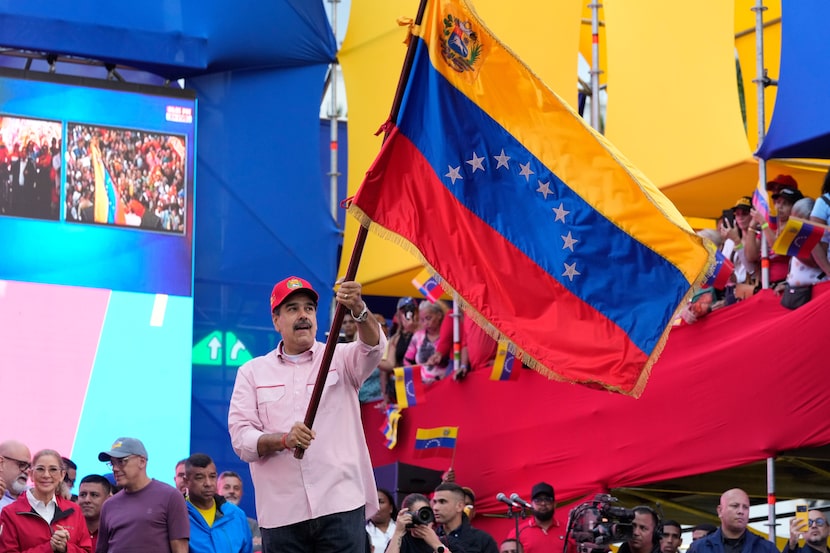
The recent announcement by U.S. President Donald Trump to close the airspace over Venezuela has sparked significant international concern. Citing ongoing efforts against drug cartels operating within the country, Trump’s decision is perceived by many as a provocative action against Venezuelan President Nicolas Maduro. Critics argue this move escalates tensions and raises the prospect of military conflict between the two nations.
Trump’s justification for the airspace closure hinges on combating drug trafficking but has drawn scrutiny due to its potential implications. Observers note the contradiction in his stance, particularly in light of his announcement to pardon Juan Orlando Hernandez, the former president of Honduras, who was convicted of drug trafficking in a New York federal court and sentenced to 45 years in prison. Hernandez’s actions reportedly facilitated drug trade operations in Honduras, raising questions about the consistency of the U.S. approach to narcotics and leadership in the region.
In a letter to the editor, Richard Bach expressed confusion over the rationale behind Trump’s actions. He questioned whether the U.S. is preparing for a larger military engagement with Venezuela while simultaneously offering clemency to a convicted drug trafficker. Bach emphasized the troubling nature of these contradictions, suggesting they reflect poorly on U.S. foreign policy.
Meanwhile, the conversation around immigration policy continues to intensify, particularly concerning the role of U.S. Immigration and Customs Enforcement (ICE). A letter from David West highlighted growing concerns over ICE’s operations, particularly in relation to the vetting of immigrants. West pointed out that while many support lawful immigration processes, the enforcement actions taken by ICE have led to apprehensions about fairness and effectiveness. He argued that undocumented immigrants are often less likely to commit crimes than citizens, complicating the narrative surrounding immigration enforcement.
Addressing the broader implications of current immigration practices, Brian Scott Angerer called for a restoration of trust in the U.S. immigration system. He emphasized the need for humane treatment of individuals and transparent processes, stating that immigration should be viewed as a measure of national character rather than mere policy.
In local news, the city of Dallas is undertaking a survey to determine whether residents prefer street or alley trash pickup. City Manager Kimberly Bizor Tolbert and Sanitation Director Cliff Gillespie have faced vocal opposition from residents regarding changes to trash collection practices. A letter from Mike Loehr suggested that private companies might offer more effective solutions for waste management, proposing that Dallas consider outsourcing its trash collection services.
On a lighter note, Ed Kominski reflected on the upcoming Atlantic Coast Conference football championship, highlighting the unexpected matchup between Virginia and Duke University. He noted the implications of Southern Methodist University’s recent loss, suggesting it may be time to rethink strategies in college football.
Lastly, a new nonpartisan group, Mormon Women for Ethical Government, has emerged, garnering attention for its impactful advocacy. Virginia Dupuy praised the organization for its strong voice and mission, encouraging others to learn about their efforts.
The diverse perspectives shared through these letters underscore the complexity of the political landscape, both domestically and internationally. As events unfold, the implications of these discussions will resonate throughout communities and governments alike.