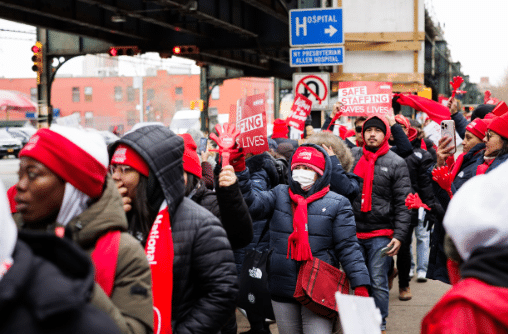
Fifteen thousand nurses across New York City are currently on strike, marking the largest strike of its kind in the city’s history. Organized by the New York State Nurses Association (NYSNA), the nurses are demanding improved working conditions, including safe staffing levels, enforceable nurse-patient ratios, guaranteed healthcare coverage, pensions, and protections against workplace violence. The strike began two weeks ago and has drawn attention to critical issues affecting both healthcare workers and patients.
Key Demands and Challenges
At the heart of the strike are several key demands aimed at improving the quality of care provided to patients. One nurse, identified as J, explained the urgent need for lower nurse-patient ratios, particularly in high-stress environments such as the ICU. He stated, “If she has four patients in the ICU, she can’t possibly attend to all of them properly.” This concern reflects a broader trend where nurses are overwhelmed with the number of patients they are responsible for, leading to burnout and subpar patient care.
The nurses are also advocating for better health insurance and benefits. According to J, Mount Sinai is threatening to remove coverage for nurses, forcing them to bear the costs out of pocket. This situation is exacerbated by a dispute between Mount Sinai and its insurance provider, leaving nurses unable to access care at their own facility. The added financial burden has raised concerns about job satisfaction and retention among nursing staff.
Another significant issue is workplace violence. J highlighted that nurses often face physical assaults, with insufficient measures in place to address these incidents. “The hospital has never responded to these incidents,” he remarked, emphasizing the need for improved security measures to protect healthcare workers.
While salary increases are also part of the conversation, J noted that they are not the primary focus. His colleague expressed differing opinions on the length of shifts, revealing internal divisions on how to best negotiate working conditions. Despite these differences, the nurses agree on the importance of solidarity among all hospital staff, stating, “It’s a team effort.”
Continuing the Fight
As the strike progresses into its third week, the morale among nurses remains strong, although frustrations are beginning to mount. Another nurse, identified as S, emphasized that the strike is fundamentally about protecting not only their own healthcare but also that of their patients and families. She stated, “My insurance is my family’s insurance,” highlighting the personal stakes involved in these negotiations.
The nurses demand enforceable staffing standards, including arbitration and financial penalties when units are understaffed. They pointed out that previous strikes have led to improvements; for instance, Mount Sinai once faced a shortfall of over 1,100 nurses, a number that has since reduced to about 400 after penalties were implemented. This historical context underscores their argument that adequate staffing is essential for patient safety and positive outcomes.
Research supports their claims, indicating that for every additional patient assigned to a nurse, the risk of negative outcomes can increase by up to 7 percent. Despite this evidence, the hospital administration has largely been unresponsive, engaging minimally in negotiations since the strike commenced.
Both S and her colleague A expressed determination to continue the strike until their demands are met. “This has to end somehow,” A stated. “But the longer it goes on, the more motivated — and more entrenched — people become.” Their commitment underscores the collective resolve of nursing staff to advocate for better conditions, not only for themselves but for the patients they serve.
As the strike continues, the outcome remains uncertain. The nurses are prepared to remain on the picket line as long as necessary, hoping that their solidarity and persistence will ultimately lead to meaningful change in the healthcare system.