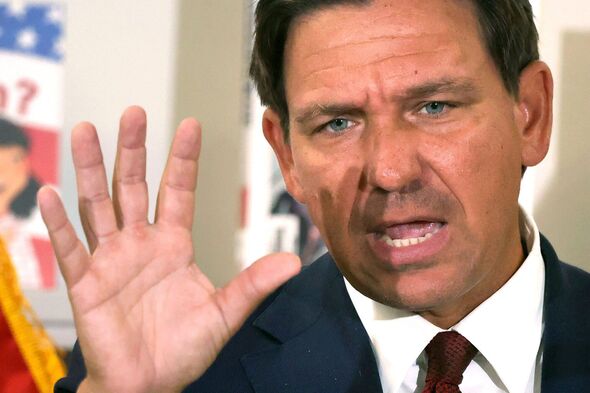
Florida Governor Ron DeSantis has urged state representatives to initiate a redistricting process, aiming to replicate strategies recently implemented in Texas and California. This push comes in light of the potential for Republicans to gain additional congressional seats ahead of the 2026 midterm elections. DeSantis expressed his intentions through a two-word message on social media: “Stay tuned,” in response to comments from state House Speaker Daniel Perez, who indicated that Florida currently lacks a redistricting plan.
During a press conference in Melbourne in August, DeSantis voiced his support for former President Donald Trump‘s unprecedented proposal to conduct a mid-decade census and redraw district maps to benefit Republican candidates. This initiative is seen as a means to expand the party’s congressional representation. Nikki Fried, chair of the Florida Democratic Party, accused DeSantis of attempting to manipulate the electoral landscape. She stated, “After gutting representation for Black Floridians and stacking the court to uphold it, he wants to further gerrymander and suppress the vote of millions of Floridians.”
The call for redistricting has sparked a wave of mid-decade gerrymandering across various states, according to reports from The Associated Press. Democrats are currently aiming to secure just three additional seats to regain control of the House of Representatives. Historically, the party in power tends to lose seats during midterm elections, and Trump’s efforts to influence redistricting are viewed as a strategy to counteract this trend.
On August 29, 2023, Texas became the first state to approve new congressional maps under Trump’s direction, with Governor Greg Abbott signing a law that could potentially yield five additional Republican seats. Presently, Republicans hold 25 out of 38 congressional seats in Texas. However, this new map is facing legal challenges. Following Texas, states such as Missouri, North Carolina, and Ohio are also reviewing redrawn maps that could favor Republican candidates.
California, under Governor Gavin Newsom, has become the first Democratic-led state to respond. On November 4, 2023, voters approved a new map that could help Democrats gain five additional seats, moving away from districts established by an independent citizens commission after the 2020 census. This map, however, is also being contested, with the U.S. Department of Justice joining a Republican lawsuit against it.
In Florida, Speaker Perez has established a special committee focused on congressional redistricting. Currently, Republicans hold 20 out of 28 congressional seats in the state. DeSantis remarked, “We have 28 now, we might have 29, 30, 31, maybe. Who knows?” He emphasized the necessity of redistricting, regardless of whether a new census is conducted, asserting it is appropriate to redraw district lines.
While Florida’s Republican leadership is moving forward, other states are experiencing resistance to Trump’s redistricting pressure. For instance, the Republican leader of the Indiana state Senate announced that the chamber will not convene in December to vote on redistricting, citing insufficient support among members. This decision significantly reduces the chances of redistricting in Indiana, which is the second Republican state to resist Trump’s push.
Senate President Pro Tem Rodric Bray stated, “Over the last several months, Senate Republicans have given very serious and thoughtful consideration to the concept of redrawing our state’s congressional maps.” He further explained that there were not enough votes to proceed, leading to the cancellation of the December session. Despite Indiana Republicans holding a supermajority, many lawmakers have expressed concerns about the ethics and potential political repercussions of gerrymandering.
As the political landscape evolves, the implications of redistricting efforts remain significant. The actions taken in Florida, Texas, and elsewhere will likely shape the outcome of the 2026 midterm elections, making it a pivotal moment for both parties.