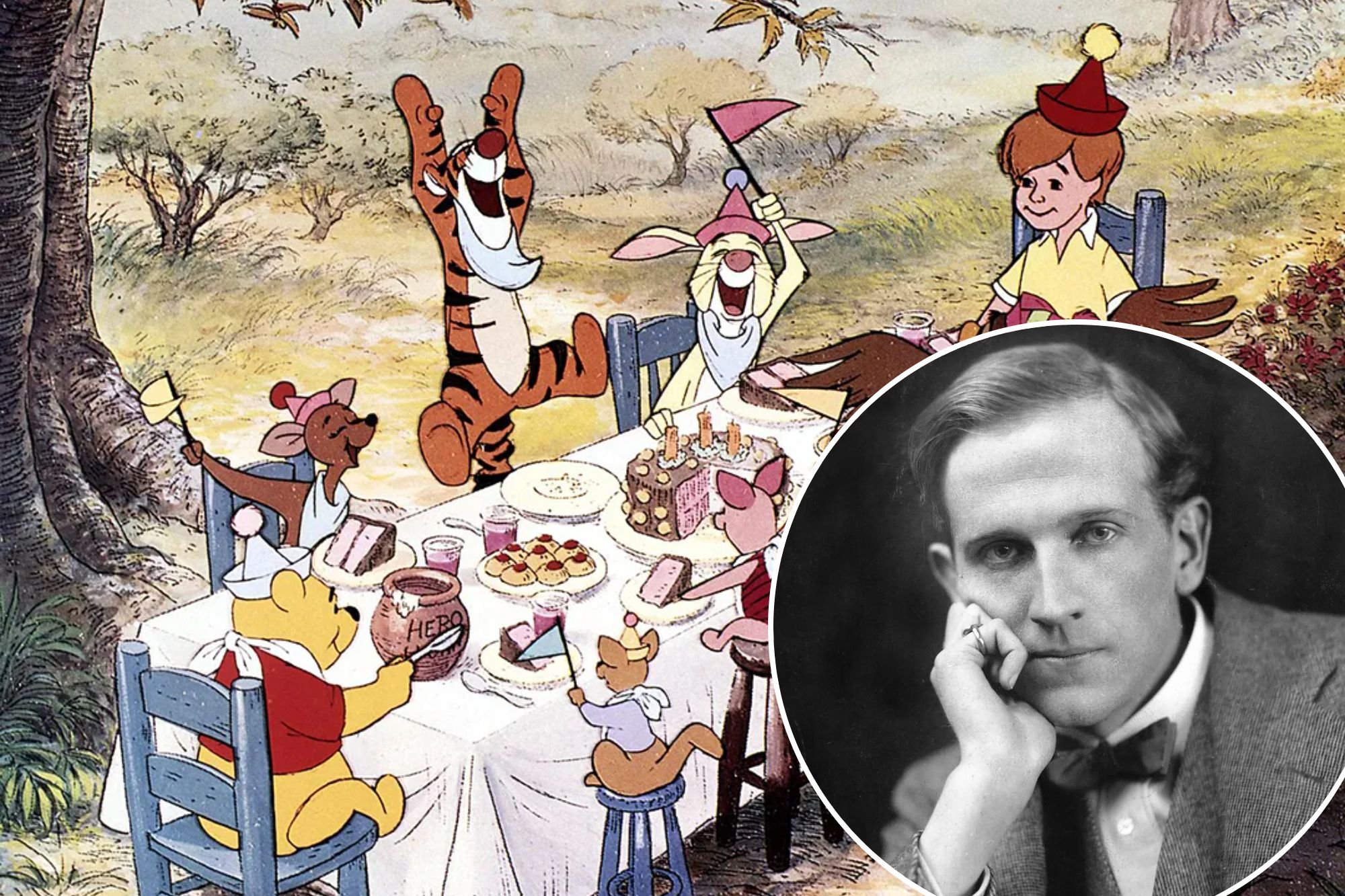
The life of A.A. Milne, author of the beloved children’s classic *Winnie-the-Pooh*, reveals a complex narrative filled with personal struggles and emotional distance. In his new book, *Somewhere, a Boy and a Bear: A. A. Milne and the Creation of ‘Winnie-the-Pooh’*, Gyles Brandreth examines the man behind the iconic stories, highlighting a life marked by disappointment and a desire for deeper connections.
Milne first introduced readers to his honey-loving bear in 1926, and since then, the stories have sold over 50 million copies worldwide. They were inspired by Milne’s only son, Christopher Robin, who received a stuffed bear named Winnie-the-Pooh for his first birthday. The bear was named after Winnipeg, a black bear at London’s Regent’s Park Zoo. While Milne crafted enchanting tales featuring Christopher’s stuffed animals, their relationship was often strained.
Christopher Robin, reflecting on his childhood, expressed mixed feelings about the fame that came with his father’s literary success. “It seemed to me, almost, that my father had got to where he was by climbing upon my infant shoulders,” he shared in his 1974 memoir, *The Enchanted Places*. Although the stories brought joy, they overshadowed Christopher’s identity, leading him to feel robbed of his own name and legacy.
Despite the whimsical world Milne created, he and his son were not particularly close. Christopher stated, “My father’s heart remained buttoned-up all through his life.” The emotional distance left Christopher unsure of their connection, noting, “I’m not sure how well I knew him. I’m not sure how well he knew me.” This sentiment is echoed by others who interacted with Milne. Illustrator Ernest Shepard described him as a “rather cagey man,” while author P.G. Wodehouse remarked on Milne’s “curious jealous streak.”
Milne’s personal life was also fraught with conflict. He had falling-outs with his parents and his oldest brother, Barry, with whom he did not reconcile before Barry’s death. His disapproval of Christopher’s marriage to his first cousin further strained their relationship. As Milne grappled with the success of Pooh, he felt overshadowed, lamenting that his more sophisticated works were often ignored.
The impact of World War I weighed heavily on Milne as well. Initially a pacifist, he enlisted in the British Army, believing in the war’s noble cause. He fought in the Battle of the Somme, witnessing the horrors of the battlefield firsthand. “It makes me almost physically sick to think of that nightmare of mental and moral degradation, the war,” he later reflected.
Milne’s life took a darker turn following the death of his brother and close friend, Ken, in 1929. Both he and his wife engaged in extramarital affairs, yet they remained together until Milne suffered a stroke in 1952. He passed away in 1956 at the age of 74. Christopher attended his father’s funeral but never spoke to his mother again afterward.
By the time Brandreth met Christopher in the 1980s, he had come to terms with his father’s legacy. “I now realize that life is too short for regrets,” Christopher stated. He emphasized the importance of accepting one’s childhood experiences, saying, “We cannot change it. . . . But we can visit and revisit the best of it whenever we want. And be grateful.”
The exploration of A.A. Milne’s life serves as a poignant reminder of the complexities behind the creation of cherished stories. The legacy of *Winnie-the-Pooh* continues to resonate, but the man who created it remains an enigma, revealing that even in the world of children’s literature, the shadows of personal struggles can loom large.