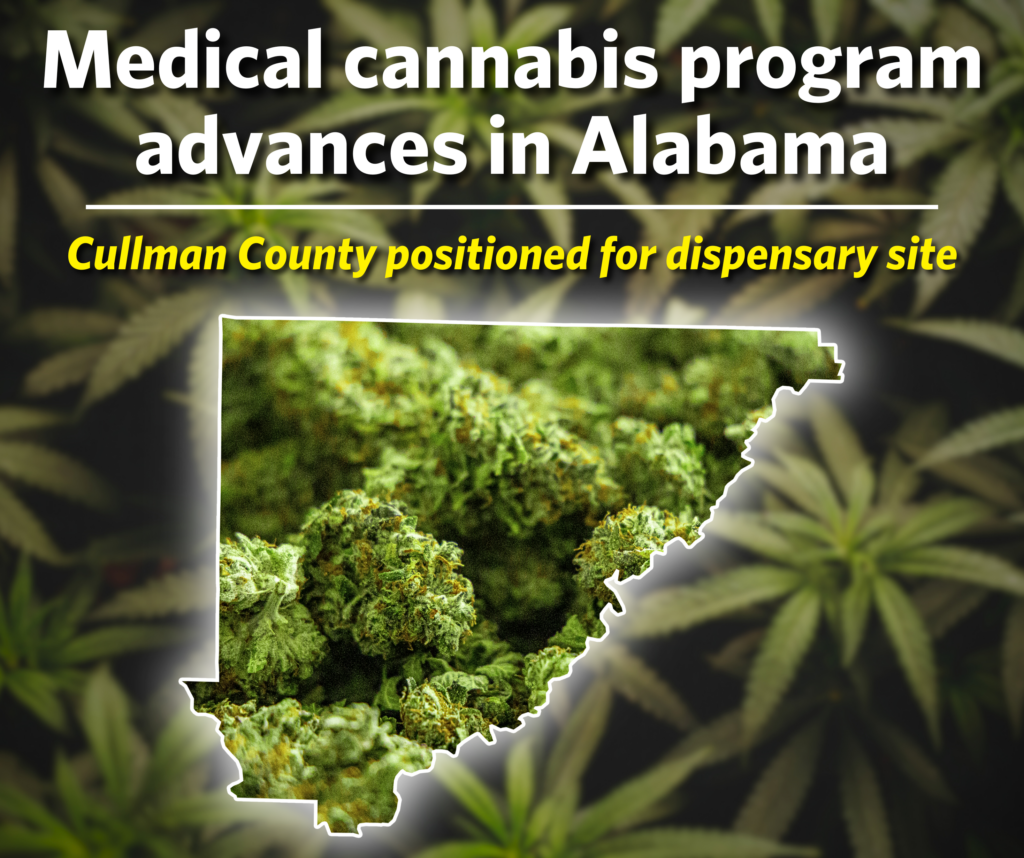
Alabama’s long-awaited medical cannabis program is progressing towards implementation, following recent developments by the Alabama Medical Cannabis Commission. Cullman County is set to become a dispensary site, marking a significant milestone after years of regulatory delays and legal battles.
The program, established under the Darren Wesley “Ato” Hall Compassion Act in 2021, permits the use of marijuana strictly for medical purposes within a tightly controlled framework. Recreational cannabis remains illegal in Alabama. In a decisive vote in December 2025, the Alabama Medical Cannabis Commission granted the state’s first dispensary licenses, a pivotal step after a protracted period marked by pauses and legal challenges that hindered progress for over two years.
The commission’s decision allows for several dispensary locations across Alabama, including one in Cullman County. However, products are not yet available for purchase, and an official opening date remains unannounced. State officials indicate that the program is now in its final administrative phase, moving closer to operational readiness.
Alabama’s medical cannabis regulations are some of the most stringent in the United States. Notably, smoking or vaping marijuana is prohibited, and raw plant materials will not be available for sale. Approved products include capsules, tablets, tinctures, topical creams, oils, transdermal patches, and more. All cannabis sold must be cultivated, processed, and dispensed within Alabama by licensed entities supervised by the Alabama Medical Cannabis Commission.
Wagon Trail Med-Serv, a local company in Cullman County, has played a significant role in the program’s development. The company pursued an integrated facility license to cover cultivation, processing, and dispensing. In June 2023, the commission awarded integrated facility licenses, but shortly after, an emergency meeting led to a temporary hold on those licenses due to inconsistencies in application scoring. This affected Wagon Trail Med-Serv and other applicants.
In August 2023, when the commission reissued the licenses, Wagon Trail Med-Serv faced another setback, being denied the integrated facility license once more. Company leadership appealed the decision while continuing to engage with state regulators. In December 2023, the commission voted again to grant integrated facility licenses, with Wagon Trail Med-Serv among the selected businesses. Pre-issuance inspections followed, indicating progress toward final licensure.
Joey Robertson, CEO of Wagon Trail Med-Serv, expressed optimism despite the delays. “We have had such good support locally; it’s been tremendous and so positive,” he stated. “We just want to get this medicine to people that need it.” However, legal challenges resurfaced in early January 2024, with a temporary restraining order halting the issuance of integrated facility licenses statewide.
Robertson noted that inspections demonstrated the company’s preparedness. “The pre-issuance inspection went well,” he said. “We were able to demonstrate that everything in our application was factual and ahead of our initial projected timelines.” Subsequent court rulings cleared much of the litigation, allowing the commission to resume the licensing process into 2025.
By late 2025, the commission proceeded with issuing dispensary licenses statewide, transitioning the program from planning to execution. At present, no cannabis cultivation or processing facilities are operational in Cullman County. State licensing records indicate that the county is designated as a future dispensary location, contingent upon the completion of final approvals, zoning, and permitting.
Under Alabama law, physicians can now register and become licensed to recommend medical cannabis to eligible patients. Doctors must possess an active Alabama medical license and complete mandatory training before registering with the commission. Upon approval, they can certify that a patient has a qualifying condition, allowing them to apply for a medical cannabis card and purchase products only from licensed dispensaries.
Medical cannabis in Alabama can only be recommended for conditions explicitly outlined in state law, which includes disorders such as autism spectrum disorder, cancer-related symptoms, Crohn’s disease, epilepsy, and post-traumatic stress disorder, among others. Physicians may recommend medical cannabis only for conditions within their training and expertise.
To obtain medical cannabis legally, patients must be Alabama residents with a qualifying condition. They need to be evaluated in person by a licensed physician certified by the commission, as telemedicine evaluations are not permitted. Once approved, the physician registers the recommendation in the state’s medical cannabis registry, enabling patients to acquire a medical cannabis card through the Alabama Medical Cannabis Commission.
Registered caregivers are subject to background checks, and there are limits on how many patients they may serve. Authorities have stressed that marijuana remains illegal outside the parameters of the Compassion Act, with possession without a valid medical card constituting a criminal offense. Driving under the influence laws have not changed.
Physicians participating in the program are regulated by the Alabama Board of Medical Examiners. They cannot hold financial interests in cannabis businesses or receive compensation from licensed operators.
With dispensary licenses now issued and major legal challenges resolved, the focus is shifting to final inspections, permitting, and patient certification. Dispensary operators are securing locations, physicians are preparing to certify patients, and the Alabama Medical Cannabis Commission continues its administrative oversight. For residents of Cullman County with qualifying medical conditions, the coming months could provide the first opportunity for legal access to medical cannabis locally, although officials caution that the rollout will remain carefully regulated.