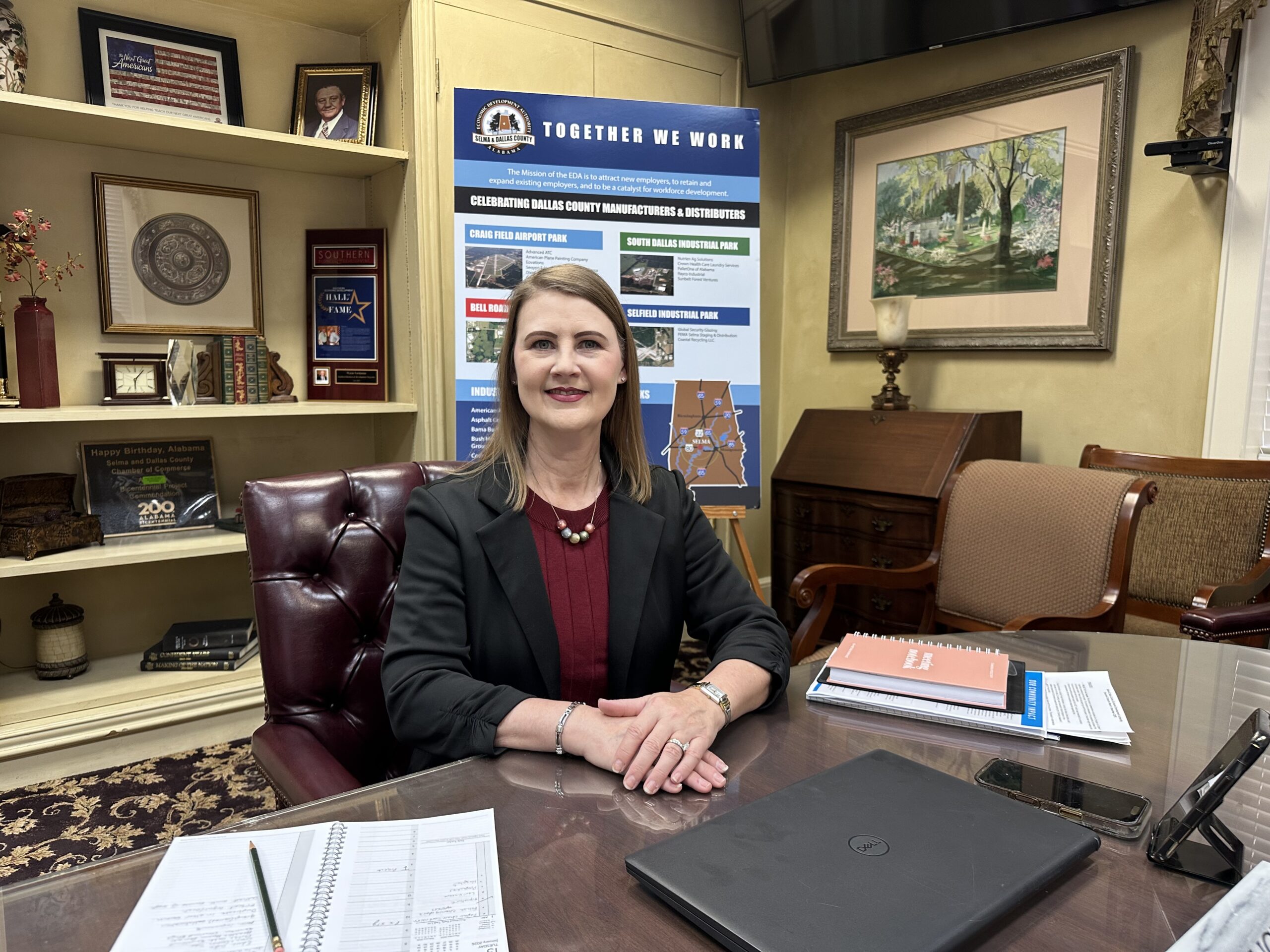
Brenda Tuck officially assumed the position of executive director of the Selma and Dallas County Economic Development Authority in January 2025, marking both a significant career milestone and a return to her roots. With over two decades of experience in economic development across various levels, Tuck succeeds M. Wayne Vardaman, who retired after 24 years of service. Tuck’s appointment was announced in November 2024, and she expressed enthusiasm for leading the authority into the future.
“I am excited about Brenda assuming the role of executive director,” Vardaman stated. “I have worked with her in numerous roles over the past 30 years, and she’s very capable of leading the EDA into the future. Her knowledge and background in economic development are broad and diverse.”
A Homecoming for Tuck
For Tuck, returning to Dallas County signifies a homecoming to the community where her career in economic development began. “I began my journey in economic development here, and I am very proud to be coming back home to work in our communities in Dallas County,” Tuck remarked. She acknowledged Vardaman’s significant contributions, noting, “The accomplishments he has achieved for this county are evident with the numerous announcements for jobs and investment throughout the county.”
A native of Limestone County, Tuck moved to Selma in 1995 with her husband, Shane, where she spent approximately 17 years before relocating. Her early career involved nonprofit management and marketing, which shaped her future in economic development. She began as an office manager for the American Cancer Society in Selma, overseeing operations across an eight-county region. After the consolidation of the Selma office, she worked in marketing at Selma’s American Candy Company, where she experienced firsthand the impact of large-scale layoffs when the company closed.
In January 2000, Tuck transitioned into economic development, joining Pioneer Electric Cooperative as office manager at the Innovation Centre. Under the mentorship of George Alford Jr., she learned about negotiations, contracts, and the challenges faced by entrepreneurs across several counties. “He taught me everything he knew,” Tuck stated, emphasizing the influence of her mentors in shaping her career.
Strategic Vision for Economic Development
In 2005, Tuck and Alford co-founded Alford and Associates LLC, expanding their economic development initiatives. Tuck later served as executive director of the Marengo County Economic Development Authority before joining the Alabama Department of Commerce in 2016. In 2019, she became the state’s first rural development manager, collaborating with 44 rural counties and acting as a regional workforce council liaison.
As she steps into her new role, Tuck has outlined her priorities, beginning with existing industries. “Existing industries will always be first and foremost,” she emphasized. She plans to build upon Vardaman’s legacy by ensuring the availability of “product,” which in economic development terms refers to ready-to-use industrial sites and buildings. Tuck highlighted a significant challenge across Alabama: a shortage of such sites, a situation that also affects Dallas County.
Addressing infrastructure concerns in existing industrial parks is another critical focus. Tuck noted that high costs have stalled necessary improvements. “We’re not in this by ourselves,” she stated, stressing the importance of collaboration with utilities, rail partners, and state resources to enhance the competitiveness of these sites.
Changing perceptions of Dallas County is also a priority for Tuck. “There’s this idea that there’s nothing there,” she explained. “But when people actually look at the number of industries and industrial parks, they’re blown away.” She believes that telling “our best story” is essential, highlighting existing employers, new investments, and the county’s quality-of-life assets. “If we’re not telling our best story, nobody’s telling our best story,” Tuck asserted.
Among Dallas County’s strengths, Tuck first highlights its people. She recalls conversations with former colleagues who emphasize the community’s strong sense of togetherness. The county’s industrial diversity, four industrial parks, and the presence of a local community college are additional assets that can enhance workforce development and long-term growth.
Tuck’s academic background complements her professional experience. She holds an associate’s degree from Wallace Community College Selma and a bachelor’s degree in business administration from Faulkner University. Additionally, she earned a master’s degree in international relations through the Prince Khaled Fellowship at Auburn University Montgomery in partnership with Maxwell Air Force Base.
Beyond her professional achievements, Tuck and her husband have actively volunteered, including serving as Alabama Goodwill Ambassadors and participating in the U.S. State Department’s International Volunteer Leadership Program, where they hosted delegations from around the globe in Selma.
As Tuck transitions from a statewide role back to local leadership, she expresses excitement about returning to direct community engagement. “From the state level, I’m really bringing in resources and guiding,” she explained. “To be able to jump in again and be effective on the ground in the community, just that hands-on aspect, that’s what I’m looking forward to the most.”