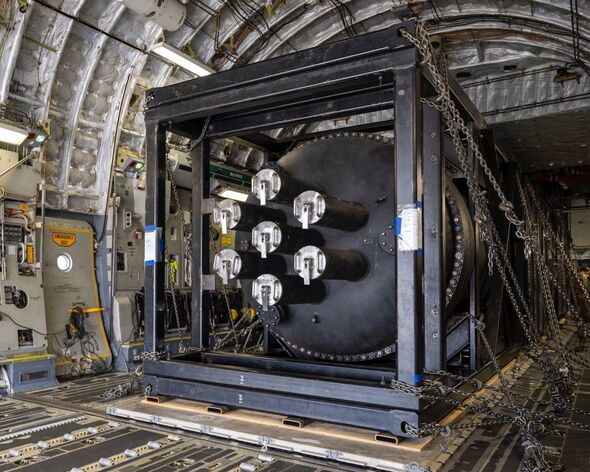
One of the new micro-nuclear reactors developed under the administration of President Donald Trump is ready for transportation, according to the Department of Defense. The reactor, known as the Ward 250, was loaded onto a C-17 Globemaster III aircraft at March Air Reserve Base in California. This step follows a series of executive orders aimed at reshaping and modernising the United States’ nuclear energy landscape.
The Ward 250 is a compact, 5 megawatt nuclear reactor, designed to fit within the confines of a transport aircraft. It has the potential to provide power for approximately 5,000 homes. The aircraft is scheduled to fly to Hill Air Force Base in Utah, after which the reactor will proceed to the Utah San Rafael Energy Lab for testing and evaluation.
Enhancing Military Energy Security
This innovative reactor aims to improve energy security for military operations. By providing a reliable energy source on base, it ensures that military missions do not rely on the civilian power grid. This capability is particularly beneficial for U.S. forces stationed overseas, where traditional fuel supplies can be vulnerable to disruption.
The Department of Defense stated, “A reactor such as the Ward 250 also means greater energy security for the entire United States.” This initiative aligns with President Trump’s executive orders, signed in May 2025, that focus on enhancing the nation’s nuclear energy capabilities. These orders include initiatives such as “Reinvigorating the Nuclear Industrial Base,” “Reforming Nuclear Reactor Testing at the Department of Energy,” and “Deploying Advanced Nuclear Reactor Technologies for National Security.”
Collaboration Between Departments
Michael P. Duffey, the Undersecretary of War for Acquisition and Sustainment, highlighted the importance of collaboration between the Defense and Energy Departments in advancing these initiatives. Duffey remarked, “It’s clear to me that advancing President Trump’s priority on nuclear energy depends on close coordination between the Department of Energy and the Department of War.”
This partnership is crucial for the development and deployment of advanced nuclear technologies, which are expected to strengthen both energy resilience and national security. According to Duffey, the future of military operations will be increasingly energy-intensive, involving technologies such as artificial intelligence data centres, directed-energy weapons, and sophisticated space and cyber infrastructure. The existing civilian power grid, he noted, is not equipped to support these demands, necessitating the establishment of an independent energy infrastructure for the Department of Defense.
As the Ward 250 prepares for its test flight, it represents a significant step toward not only modernising the United States’ nuclear capabilities but also enhancing the operational efficiency and security of its military forces.